


The Tao tribesmen who traveled more than 600km in the largest traditional wooden boat ever built said that fisheries surrounding their native Lanyu (Orchid Island, 蘭嶼) are threatened by fishing boats from Taiwan proper.
Carrying 14 people, the boat departed from the island on June 19, said Si Ankumitan, one of the first group of sailors who rowed from the Lanyu to Taitung.
A traditional Tao boat normally carries three to four people and "10 at the most," he said.
After more than 130 tribesmen took turns rowing the boat, it finally arrived in Taipei last Tuesday, completing the tribe's first 600km boat journey, trip leader Syaman Fumayen said.
`Proud and happy'
"The trip was very hard, but we're proud and happy to finally complete it," Syaman Fumayen said just after he jumped off the boat at Taipei's Dajia Riverside Park.
However, behind the Tao sailors' proud smiles, they still have their worries.
"I would like to ask all to help to preserve our wooden boat culture," Syaman Fumayen said.
The wooden boats are the Tao's tools for catching flying fish, he said.
"Flying fish are the main source of protein for us," Syaman Fumayen said. "However, the large motorized fishing boats from Taiwan [proper] pose a severe threat to our flying fish harvest."
If the marine resource becomes exhausted, the Tao wooden boat culture would gradually disappear, and when the wooden boat culture disappears, the entire Tao culture would eventually die, Syaman Fumayen said.
"It's been at least five years that we haven't had good flying fish harvests," he said, warning that the Tao would "take care of the matter in our own way if the government does nothing."
The government has tried to solve the problem, but without results.
In 2005, when former premier Frank Hsieh (謝長廷) visited the island, he announced that motorized fishing boats that weighed more than 10 tonnes would be banned from venturing within 6 nautical miles (11km) of Lanyu.
Hsieh's announcement was followed by an official Taitung County ordinance that fines violators between NT$30,000 to NT$150,000, Wang Chiang-ho (王江河), chief of Taitung County's fishing section, told the Taipei Times in a telephone interview.
Conflicts
Although the ban has been in effect for two years, conflicts between fishermen from Taiwan proper and those from Lanyu still occur.
"We can't really do anything about fishing boats from Hengchun (恆春) that catch flying fish in the waters surrounding Lanyu because the boats weigh less than 10 tonnes," Wang said.
As the county ordinance does not completely protect Tao waters, the Council of Indigenous People is in search of another solution to the problem.
"We've drafted an Aboriginal Land and Marine Spaces Act (
In the draft bill, the waters that fall within 6 nautical miles of the Island are designated as the Tao's traditional domain, Icyang said.
"We haven't decided on the details -- maybe we'll ban all motorized fishing boats in that area," Icyang said, adding that the draft bill is under Cabinet review at the moment.
"Hopefully we will be able to submit it to legislative review in September," he said.
Opposed
People in the fishing industry in Hengchun, Pingtung County, are opposed to the draft bill.
"It will kill our flying fish industry," said Chu Pin-hsuan (朱品璇), president of the Hengchun Fishermen's Association.
"Since flying fish can only be found within three nautical miles of Orchid Island," the 6-mile nautical-mile ban would be a serious threat for Hengchun fishermen, Chu said.
Flying fish are not only important to Hengchun's fishing industry, but also to its tourism industry.
We've been using flying fish to promote local tourism in recent years," Chu said.
Waters around the Island are especially important to Hengchun fishermen because they were prohibited from fishing near the Philippines more than 10 years ago, Chu said.
"We're all citizens of Taiwan," Chu said. "It's very unfair if the government favors them over us."
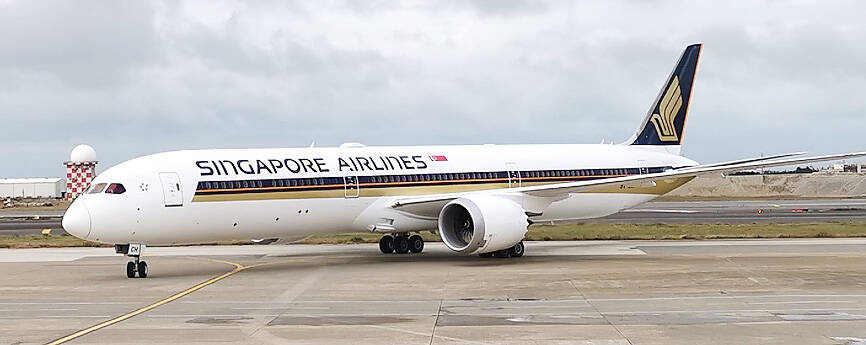
INCREASED CAPACITY: The flights on Mondays, Wednesdays, Fridays and Sundays would leave Singapore in the morning and Taipei in the afternoon Singapore Airlines is adding four supplementary flights to Taipei per week until May to meet increased tourist and business travel demand, the carrier said on Friday. The addition would raise the number of weekly flights it operates to Taipei to 18, Singapore Airlines Taiwan general manager Timothy Ouyang (歐陽漢源) said. The airline has recorded a steady rise in tourist and business travel to and from Taipei, and aims to provide more flexible travel arrangements for passengers, said Ouyang, who assumed the post in July last year. From now until Saturday next week, four additional flights would depart from Singapore on Monday, Wednesday, Friday
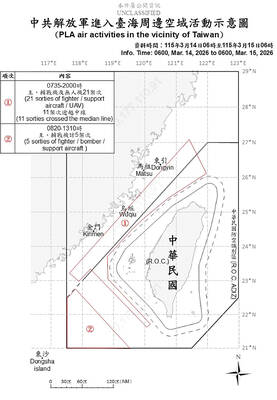
The Ministry of National Defense yesterday reported the return of large-scale Chinese air force activities after their unexplained absence for more than two weeks, which had prompted speculation regarding Beijing’s motives. China usually sends fighter jets, drones and other military aircraft around the nation on a daily basis. Interruptions to such routine are generally caused by bad weather. The Ministry of National Defense said it had detected 26 Chinese military aircraft in the Taiwan Strait over the previous 24 hours. It last reported that many aircraft on Feb. 25, when it spotted 30 aircraft, saying Beijing was carrying out another “joint combat

Taiwan successfully defended its women’s 540 kilogram title and won its first-ever men’s 640 kg title at the 2026 World Indoor Tug of War Championships in Taipei yesterday. In the women’s event, Taiwan’s eight-person squad reached the final following a round-robin preliminary round and semifinals featuring teams from Ukraine, Japan, Thailand, Vietnam, the Basque Country and South Korea. In the finals, they swept the Basque team 2-0, giving the team composed mainly of National Taiwan Normal University students and graduates its second championship in a row, and its fourth in five years. Team captain
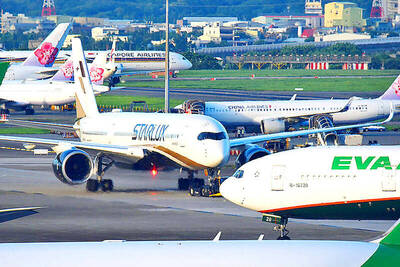
Taiwan’s three major international carriers are increasing booking fees, with EVA Airways having already increased the charge to US$28 per flight segment from US$25, while China Airlines (CAL) and Starlux Airlines are set to follow suit. Booking fees are charged by airlines through a global distribution system (GDS) and passed on to passengers. Carriers that apply the fees include CAL, EVA, Starlux and Tigerair Taiwan. A GDS is a computerized network operated by a company that connects airlines with travel agents and ticketing platforms, allowing reservations to be made and processed in real time. Major players include Amadeus, Sabre and Travelport. EVA Air began


 RSS
RSS