


At the heart of the government's bid to join the UN using the name "Taiwan" is the issue of the nation's sovereignty, a divisive question even among independence activists.
For many who consider Taiwan independent, the bid for UN membership is a clear-cut case of demanding one's basic right to representation. However, some independence activists contend that the nation must seek de jure independence before applying to join the international body, as UN membership requires nationhood.
But some historians and politicians argue that independence is already clear, because Taiwan has been independent from China since 1895, when the latter ceded Taiwan and the Penghu islands in perpetuity to Japan.
In addition, some say the nation's title is technically still the "Republic of Formosa," founded by a Taiwanese government in 1895 -- a government that lasted only 184 days.
Others argue that the question of nationhood is unclear as the 1951 San Francisco Peace Treaty following World War II, which rescinded Japanese colonial control over Taiwan and the Penghu islands, did not specify any new government in place of the Japanese.
This has also led to the claim that the US has disposition rights over Taiwan, as some claim the US was the occupying power of the island during World War II and has never formally ended US Military Government control over Taiwan.
On July 19, President Chen Shui-bian (
The letter was submitted with the sponsorship of two of the nation's diplomatic allies -- Swaziland and the Solomon Islands. The UN Office of Legal Affairs, however, rejected the letter, citing UN Resolution 2758 as its reason.
The 1971 resolution replaced the ROC with the People's Republic of China (PRC) as the sole representative of China in the international body. It did not address the question of who represented Taiwan's population in the body.
The Democratic Progressive Party (DPP) has proposed to hold a referendum on whether to join the UN using the name "Taiwan" in conjunction with next year's legislative election. The referendum would aid the administration in its UN bid, the party has argued.
The proposal was first rejected by the Executive Yuan's Referendum Review Committee, controlled by the pan-blue camp, but it was later upheld by the Appeal Committee, also under the Executive Yuan.
With the Appeal Committee's support, the DPP is poised to proceed with a second-stage petition once the Central Election Commission has verified the authenticity of 90,000 signatures collected in the first stage of its application to hold a referendum.
Chen Lung-chu (
There is no doubt Taiwan is a nation, because it meets all four of the conventional criteria for nationhood: a population, a territory, a government and the supreme authority over affairs within its borders, he said.
Yet Taiwan is not a normalized country, he said, adding that UN membership is pivotal not only to the nation's dignity and security, but also to peace and stability in the Asia-Pacific region.
"Excluding Taiwan from the United Nations is a political apartheid, something worse than racial apartheid," he said.
Robert Chen (陳荔彤), an international law professor at National Ocean University, argued that Taiwan had been independent from China since 1949, when Chiang Kai-shek's (
Because of pressure from China, Taiwan has never declared independence, but there are many ways to do so, he said.
Holding a referendum on the UN bid is one of them and writing a new constitution and changing the nation's name is another, he said.
Robert Chen said that the government must enact a temporary decree stating the consequences of a yes or no vote for nationhood.
He criticized Ban as "illiterate" on matters of international laws, adding that the UN could decide only on Taiwan's representation in the organization, but not on the nation's sovereignty.
He said that the US only "acknowledges" China's assertion that Taiwan is a part of China, which is not the same as agreeing with it.
Hsu Ching-hsiung (
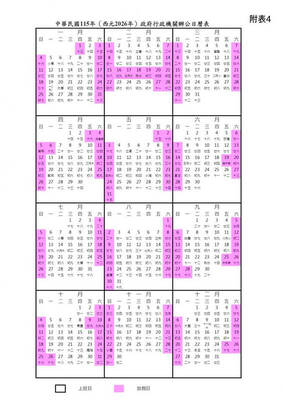
Taiwan is to have nine extended holidays next year, led by a nine-day Lunar New Year break, the Cabinet announced yesterday. The nine-day Lunar New Year holiday next year matches the length of this year’s holiday, which featured six extended holidays. The increase in extended holidays is due to the Act on the Implementation of Commemorative and Festival Holidays (紀念日及節日實施條例), which was passed early last month with support from the opposition Chinese Nationalist Party (KMT) and Taiwan People’s Party. Under the new act, the day before Lunar New Year’s Eve is also a national holiday, and Labor Day would no longer be limited

COMMITMENTS: The company had a relatively low renewable ratio at 56 percent and did not have any goal to achieve 100 percent renewable energy, the report said Pegatron Corp ranked the lowest among five major final assembly suppliers in progressing toward Apple Inc’s commitment to be 100 percent carbon neutral by 2030, a Greenpeace East Asia report said yesterday. While Apple has set the goal of using 100 percent renewable energy across its entire business, supply chain and product lifecycle by 2030, carbon emissions from electronics manufacturing are rising globally due to increased energy consumption, it said. Given that carbon emissions from its supply chain accounted for more than half of its total emissions last year, Greenpeace East Asia evaluated the green transition performance of Apple’s five largest final

Taiwan is to extend its visa-waiver program for Philippine passport holders for another year, starting on Aug. 1, Minister of Foreign Affairs Lin Chia-lung (林佳龍) said on Friday. Lin made the announcement during a reception in Taipei marking the 127th anniversary of Philippine independence and the 50th anniversary of the establishment of the Manila Economic and Cultural Office (MECO) in Taiwan, the Ministry of Foreign Affairs said. The decision reflected Taiwan’s commitment to deepening exchanges with the Philippines, the statement cited Lin as saying, adding that it was a key partner under the New Southbound Policy launched in 2016. Lin also expressed hope
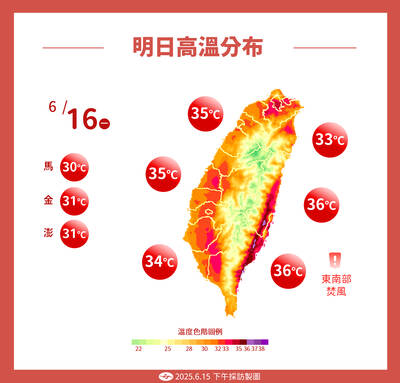
Temperatures in New Taipei City’s Sindian District (新店) climbed past 37°C yesterday, as the Central Weather Administration (CWA) issued heat alerts for 16 municipalities, warning the public of intense heat expected across Taiwan. The hottest location in Taiwan was in Sindian, where the mercury reached 37.5°C at about 2pm, according to CWA data. Taipei’s Shilin District (士林) recorded a temperature of 37.4°C at noon, Taitung County’s Jinfeng Township (金峰) at 12:50 pm logged a temperature of 37.4°C and Miaoli County’s Toufen Township (頭份) reached 36.7°C at 11:40am, the CWA said. The weather agency yesterday issued a yellow level information notice for Taipei, New


 RSS
RSS