


The Maokong Gondola system experienced another equipment malfunction yesterday afternoon, forcing Taipei Rapid Transit Corp (TRTC) to shut down the system for about four hours to inspect it.
The incident happened at Corner Two Station when TRTC workers heard some unusual noise on the headstock of a wheel, and the company immediately sent all passengers to nearby stations at 3:10pm before shutting down the system for inspections in order to prevent visitors from being trapped mid-air, the TRTC said.
The cable car resumed service at 7pm after the problem was fixed.
The incident happened only days after an equipment failure at the Corner One Station last Saturday caused a breakdown and left 323 visitors trapped in the cabins for about two hours.
Taipei City Government said that before Saturday's breakdown, a construction consultant had also heard some unusual noise in the morning, which was believed to be related to the equipment failure.
The service was also temporarily canceled at noon yesterday due to a thundershower, and resumed at 2:20pm before being canceled again for mechanical problems.
Earlier yesterday, Taipei Mayor Hau Lung-bin (郝龍斌) once again shrugged off growing concerns over the safety of the system, insisting that the preliminary inspection found no urgent reason to halt operations.
"We continue to regard passengers' safety as our first priority," he said at Taipei City Hall.
Hau said the city government is demanding its departments, TRTC and POMA of France, the system's builder, to present an inspection and evaluation report on the system as soon as possible.
Taipei City Secretariat Deputy Director Yang Hsi-an (
While director of Taipei City's information department, Yang Hsiao-tung (
"Those passengers were trapped mid-air for more than two hours on such a hot day. It's reasonable to ask for more than NT$10,000," DPP Taipei City Councilor Lee Wen-ying (李文英) said at Taipei City Council.
TRTC gave NT$1,058 and free tickets to each of the 323 visitors after the breakdown on Saturday.
Chen Po-ching (陳柏菁), a Taipei City Consumer Protection Ombudsman, agreed that passengers deserved better compensation, and suggested that they should apply for national compensation.
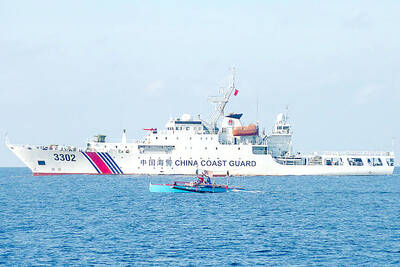
EXPANSIONIST: China deploys an average of 40 to 50 warships and coast guard vessels daily in the South China Sea, despite pledges not to militarize the region, an official said China is attempting to expand its influence across the First Island Chain and increase pressure on Japan by sending coast guard vessels into waters off of Taiwan under the pretext of maritime negotiations with Japan and the Philippines, a national security official said yesterday. China’s recent actions in the waters east of Taiwan and Japan and the Philippines’ exclusive economic zones (EEZ) are attempts to establish dominance in First Island Chain waters, said the official who declined to be named, adding that this is “expansion disguised as law enforcement.” Framing China’s actions solely as a cross-strait issue is a serious misjudgment that
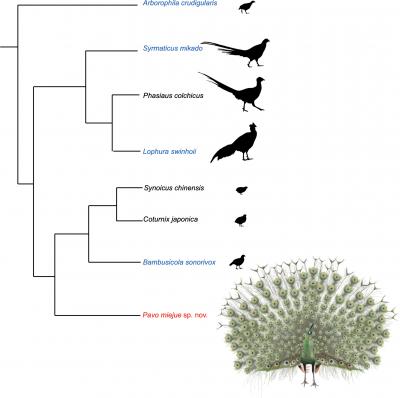
Through analyzing fossil evidence, a research team at National Taiwan University (NTU) discovered the largest endemic bird to have lived in Taiwan, naming it Pavo miejue, or extinct peafowl (滅絕孔雀). The Mikado pheasant, which is printed on the back of the NT$1,000 bank note, was previously believed to be the biggest endemic bird to Taiwan. The research team’s findings suggest that Pavo miejue lived during the Pleistocene epoch tens of thousands of years ago. It is the first endemic extinct bird species discovered and formally named in Taiwan. The study was coauthored by NTU Institute of Ecology and Evolutionary Biology professor Tsai Cheng-hsiu (蔡政修),
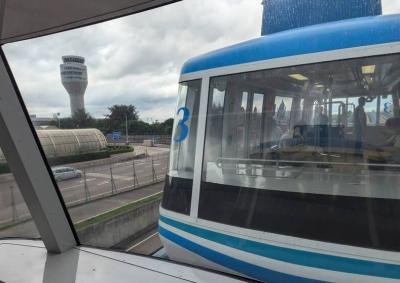
Taiwan Taoyuan International Airport is to suspend its automated Skytrain service connecting Terminal 1 and Terminal 2 starting on July 1 to facilitate connection works for the upcoming Terminal 3, the airport operator said today. Passengers and staff who need to travel between the two terminals after the suspension can instead use the Taoyuan MRT or the airport's 24-hour shuttle bus service, Taoyuan International Airport Corp said. The Taoyuan MRT Airport Line directly links the two terminals, while the shuttle buses are to operate around the clock, the company added. The Skytrain provides free transportation between the airport’s two terminals for travelers and
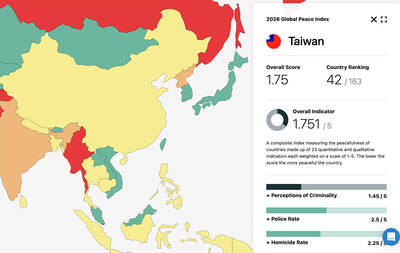
Taiwan ranked 42nd in terms of peacefulness among 163 countries, down five places from last year, according to this year’s Global Peace Index. With an overall score of 1.751, Taiwan dropped from 37th last year, the report published by the global Institute for Economics and Peace showed. The overall score measures a country’s level of peacefulness using 23 quantitative and qualitative indicators across three domains — ongoing domestic and international conflict, societal safety and security, and militarization. While Taiwan ranked 42nd worldwide, it was listed in ninth place among the 19 Asian-Pacific countries in the report, after New Zealand, Singapore, Japan, Malaysia,


 RSS
RSS