


Taipei Mayor Hau Lung-bin (
Hau told a meeting of city government officials that before he will consider charging motorists congestion fees, the city should have a fully operational mass rapid transit (MRT) system.
He said the city government could evaluate the feasibility of whether congestion charges should be introduced in Taipei once the city's MRT system is fully developed, four years from now.
Hau said that he would be willing to discuss the issue with central government officials provided they can help Taipei complete its MRT network sooner than planned with increased financial subsidies.
The mayor made the remarks after newspapers reported that the Ministry of Transportation and Communications was floating a proposal to begin a pilot program in Taipei by charging a NT$20 or NT$50 congestion fee for each car or motorcycle entering the city's eastern district.
The eastern district, where the Taipei city government and the Taipei World Trade Center's three exhibition halls are located, is the busiest and most congested area in Taipei.
In 2003, London began to charge each motorist ?5 (US$10) to enter a 20km2 area in the city center in an attempt to force commuters to switch to public transportation. The congestion fee was raised to ?8 in 2005.
In February this year, the congestion charging zone was extended to West London.
Although the London mayor claims that the congestion charging system has cut traffic jams in central London by 30 percent and reduced greenhouse gas emissions by about 20 percent, most retailers and restaurant owners in the city center have complained about a decrease in customer numbers and falling turnover.
London was not the first city to adopt congestion charging, is the largest city to have done so.
In 1975 Singapore became the first city to implement a cordon-based congestion pricing system. It switched to an automatic electronic road pricing system in 1998.
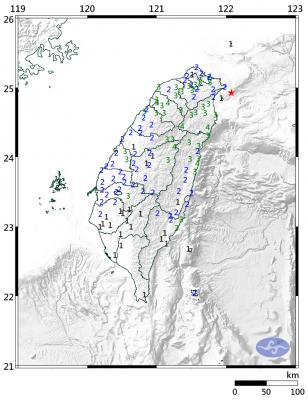
A magnitude 6.1 earthquake struck off the coast of Yilan County at 8:39pm tonight, the Central Weather Administration (CWA) said, with no immediate reports of damage or injuries. The epicenter was 38.7km east-northeast of Yilan County Hall at a focal depth of 98.3km, the CWA’s Seismological Center said. The quake’s maximum intensity, which gauges the actual physical effect of a seismic event, was a level 4 on Taiwan’s 7-tier intensity scale, the center said. That intensity level was recorded in Yilan County’s Nanao Township (南澳), Hsinchu County’s Guansi Township (關西), Nantou County’s Hehuanshan (合歡山) and Hualien County’s Yanliao (鹽寮). An intensity of 3 was
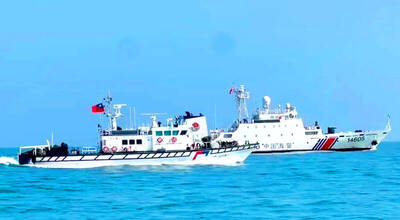
Instead of focusing solely on the threat of a full-scale military invasion, the US and its allies must prepare for a potential Chinese “quarantine” of Taiwan enforced through customs inspections, Stanford University Hoover fellow Eyck Freymann said in a Foreign Affairs article published on Wednesday. China could use various “gray zone” tactics in “reconfiguring the regional and ultimately the global economic order without a war,” said Freymann, who is also a nonresident research fellow at the US Naval War College. China might seize control of Taiwan’s links to the outside world by requiring all flights and ships entering or leaving Taiwan
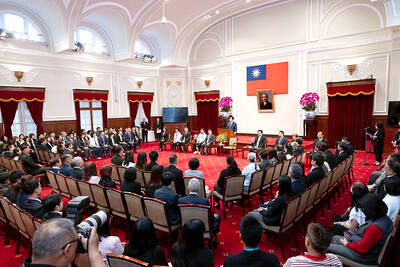
The next minimum wage hike is expected to exceed NT$30,000, President William Lai (賴清德) said yesterday during an award ceremony honoring “model workers,” including migrant workers, at the Presidential Office ahead of Workers’ Day today. Lai said he wished to thank the awardees on behalf of the nation and extend his most sincere respect for their hard work, on which Taiwan’s prosperity has been built. Lai specifically thanked 10 migrant workers selected for the award, saying that although they left their home countries to further their own goals, their efforts have benefited Taiwan as well. The nation’s industrial sector and small businesses lay
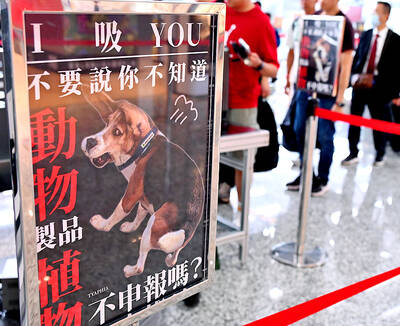
Quarantine awareness posters at Taiwan Taoyuan International Airport have gone viral for their use of wordplay. Issued by the airport branch of the Animal and Plant Health Inspection Agency, the posters feature sniffer dogs making a range of facial expressions, paired with advisory messages built around homophones. “We update the messages for holidays and campaign needs, periodically refreshing materials to attract people’s attention,” quarantine officials said. “The aim is to use the dogs’ appeal to draw focus to quarantine regulations.” A Japanese traveler visiting Taiwan has posted a photo on X of a poster showing a quarantine dog with a


 RSS
RSS