


Although lawmakers yesterday agreed to convene a two-week extra legislative session, they still failed to reach a consensus on the session's agenda.
"The extra session has been scheduled from next Tuesday to July 20, but the negotiation grounded to a halt when it came to the session's agenda," Legislative Speaker Wang Jin-pyng (
deciding vote
Another cross-party meet has been arranged for next Monday, and the agenda will be decided by a vote if the negotiations break down, he said.
Whether the extra session will proceed smoothly remains uncertain because of the Chinese Nationalist Party's (KMT) insistence that the amendment to the Organic Law of the Central Election Commission (CEC) should be the first item on the agenda, Wang said.
not a priority
The Democratic Progressive Party (DPP) agreed to include the CEC bill on the agenda of the extra session, but it was opposed to making it a priority, he said.
The KMT-introduced CEC bill would result in a pan-blue majority in the body by stipulating that its members are chosen according to the parties' relative number of legislative seats, replacing the current system under which they are appointed by the premier.
controversial
The pan-blue camp, composed of the KMT, the People First Party and the Non-Partisan Solidarity Union, put forward 19 bills to be reviewed during the session, with the most controversial being the amendment to the Audit Law (審計法) which aims to clear the embezzlement allegations against KMT presidential candidate Ma Ying-jeou (馬英九).
Another long-standing debate, that of opening direct transportation links between Taiwan and China, will also be on the agenda as the KMT has suggested revising the 28th, 29th and 30th clauses of the Statute Governing the Relations Between the Peoples of the Taiwan Area and the Mainland Area (兩岸人民關係條例) during the session.
Cross-strait
The amendment calls for the government to allow Taiwanese ships and aircraft to sail or fly directly to China. If the amendment passes, the government will have three months to enact the proposals.
On the pan-green side, the DPP and the Taiwan Solidarity Union put forward 18 bills for the session, including two bills designed to force the KMT return its stolen party assets to the nation.

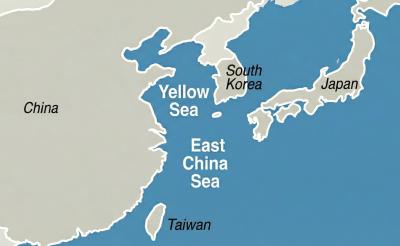
China has reserved offshore airspace in the Yellow Sea and East China Sea from March 27 to May 6, issuing alerts usually used to warn of military exercises, although no such exercises have been announced, the Wall Street Journal (WSJ) reported yesterday. Reserving such a large area for 40 days without explanation is an “unusual step,” as military exercises normally only last a few days, the paper said. These alerts, known as Notice to Air Missions (Notams), “are intended to inform pilots and aviation authorities of temporary airspace hazards or restrictions,” the article said. The airspace reserved in the alert is

NAMING SPAT: The foreign ministry called on Denmark to propose an acceptable solution to the erroneous nationality used for Taiwanese on residence permits Taiwan has revoked some privileges for Danish diplomatic staff over a Danish permit that lists “Taiwan” as “China,” Eric Huang (黃鈞耀), head of the Ministry of Foreign Affairs’ Department of European Affairs, told a news conference in Taipei yesterday. Reporters asked Huang whether the Danish government had responded to the ministry’s request that it correct the nationality on Danish residence permits of Taiwanese, which has been listed as “China” since 2024. Taiwan’s representative office in Denmark continues to communicate with the Danish government, and the ministry has revoked some privileges previously granted to Danish representatives in Taiwan and would continue to review
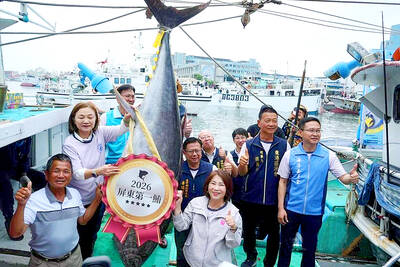
The first bluefin tuna of the season, brought to shore in Pingtung County and weighing 190kg, was yesterday auctioned for NT$10,600 (US$333.5) per kilogram, setting a record high for the local market. The auction was held at the fish market in Donggang Fishing Harbor, where the Siaoliouciou Island-registered fishing vessel Fu Yu Ching No. 2 delivered the “Pingtung First Tuna” it had caught for bidding. Bidding was intense, and the tuna was ultimately jointly purchased by a local restaurant and a local company for NT$10,600 per kilogram — NT$300 ,more than last year — for a total of NT$2.014 million. The 67-year-old skipper

More than half of the bamboo vipers captured in Tainan in the past few years were found in the city’s Sinhua District (新化), while other districts had smaller catches or none at all. Every year, Tainan captures about 6,000 snakes which have made their way into people’s homes. Of the six major venomous snakes in Taiwan, the cobra, the many-banded krait, the brown-spotted pit viper and the bamboo viper are the most frequently captured. The high concentration of bamboo vipers captured in Sinhua District is puzzling. Tainan Agriculture Bureau Forestry and Nature Conservation Division head Chu Chien-ming (朱健明) earlier this week said that the


 RSS
RSS