


Environmental activists yesterday alleged that cellphone tower radiation contributed to high incidences of cancer in residents of Tainan's Annan District (
Research presented by the Taiwan Environmental Protection Union (TEPU) showed that 20 residents living within a 200m radius of a mobile phone tower in Tainan had been stricken with cancer since 2003, when the base station was erected.
"More than 1,000" residents live within a 200m radius of the tower, TEPU figures showed. Five of the 20 were stricken with leukemia, including three children, it added.
The TEPU team measured radio frequency radiation levels of up to 7000 micro watts per square meter at sites inside the homes of the sick or diseased.
In response, government official said the levels of radiation observed by the team was several orders of magnitude lower than the legal limit of 900,000 micro watts per square meter.
"We have followed the recommendations of the International Commission on Non-ionizing Radiation Protection in setting our limit," said Wu Sheng-chung (吳盛忠), deputy director-general of the Environmental Protection Agency's Bureau of Air Quality Protection and Noise Control, at a press conference held jointly by Chinese Nationalist Party (KMT) Legislator Wang Yu-ting (王昱婷) and Democratic Progressive Party (DPP) Legislator Tien Chiu-chin (田秋菫).
The activists replied that the government's limit was too lenient.
"China has a limit that is almost 10 times more strict at 100,000 micro watts per square meter," said former TEPU chairwoman Chen Jiau-hua (
Wang said that the planned Worldwide Interoperability for Microwave Access (WiMax) base stations have the potential to cause even more risk to the health of nearby residents.
"This is a brand new technology and we need to make sure that the Taiwanese people do not become lab rats in an experiment," Wang said.
Tai Cheng-jeng (
"Divide that by the population and you get a background incidence rate of one in 10 thousand or five thousand," he said.
While it appeared that the incidences of leukemia among those living near the base station reported by the TEPU were abnormally high, this did not necessarily mean that there was a causal relationship between the two, Tai said.

Fast food chain McDonald's is to raise prices by up to NT$5 on some products at its restaurants across Taiwan, starting on Wednesday next week, the company announced today. The prices of all extra value meals and sharing boxes are to increase by NT$5, while breakfast combos and creamy corn soup would go up by NT$3, the company said in a statement. The price of the main items of those meals, if ordered individually, would remain the same. Meanwhile, the price of a medium-sized lemon iced tea and hot cappuccino would rise by NT$3, extra dipping sauces for chicken nuggets would go up
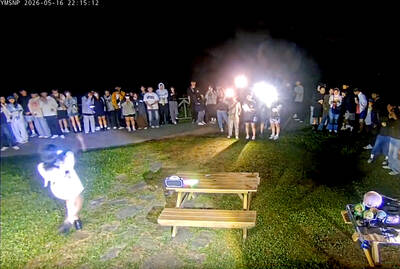
Yangmingshan National Park’s Qingtiangang (擎天崗) nature area has gone viral after a park livestream camera observed a couple in the throes of intimate congress, which was broadcast live on YouTube, drawing large late-night crowds and sparking a backlash over noise, bright lights and disruption to wildlife habitat. The area’s livestream footage appeared to show a couple engaging in sexual activity on a picnic table in the park on Friday last week, with the uncensored footage streamed publicly online. The footage quickly spread across social media, prompting a tide of visitors to travel to the site to “check in” and recreate the

Minister of Digital Affairs Lin Yi-ching (林宜敬) yesterday cited regulatory issues and national security concerns as an expert said that Taiwan is among the few Asian regions without Starlink. Lin made the remarks on Facebook after funP Innovation Group chief executive officer Nathan Chiu (邱繼弘) on Friday said Taiwan and four other countries in Asia — China, North Korea, Afghanistan and Syria — have no access to Starlink. Starlink has become available in 166 countries worldwide, including Ukraine, Malaysia, the Philippines and Vietnam, in the six years since it became commercial, he said. While China and North Korea block Starlink, Syria is not
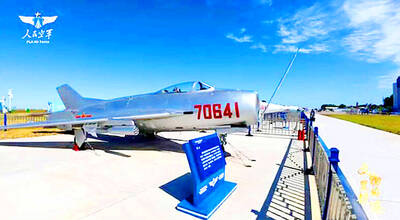
GROUNDED: A KMT lawmaker proposed eliminating drone development programs and freezing funding for counterdrone systems, despite China’s adoption of the technology China has deployed attack drones at air bases near the Taiwan Strait in a strategy aimed at overwhelming Taiwan’s air defense systems through saturation attacks, the Mainland Affairs Council (MAC) said. The council’s latest quarterly report on China said that satellite imagery and open-source intelligence indicate that the Chinese People’s Liberation Army (PLA) had converted retired J-6 fighter jets into J-6W drones, which the PLA has stationed at six air bases near Taiwan, five in China’s Fujian Province and one in Guangdong Province. The report cited J. Michael Dahm, a senior fellow at the US-based Mitchell Institute, as saying that China has


 RSS
RSS