


Taiwan Solidarity Union (TSU) legislators and the Consumers' Foundation asked Council of Agriculture (COA) officials yesterday to reconsider a proposal to relax standards for organic produce.
"Why do consumers pay higher prices for organic? To guarantee that the fruit and vegetables they're eating are free from chemicals," TSU Legislator Tseng Tsahn-deng (曾燦燈), said. "But now the COA wants to allow produce tainted with agrichemicals to be sold as organic."
There are four certifying bodies for organic produce. All have a zero-tolerance standard -- any produce testing positive for agrichemicals has its organic status revoked.
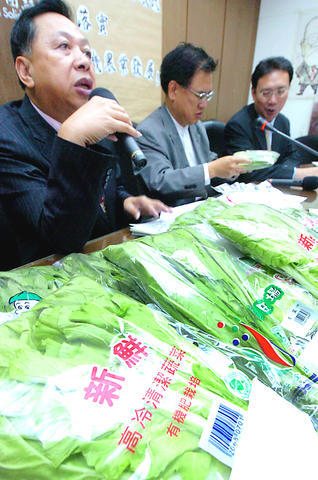
PHOTO: SEAN CHAO, TAIPEI TIMES
The COA is mooting a new legal standard for organic produce certification allowing produce to be certified organic despite having traces of agrichemical present, as long as concentrations are less than five percent of the legal safety limit for conventionally-grown produce.
The COA said the maximum allowable limit protects farmers who do not use pesticides and herbicides but cannot avoid small amounts of contamination from nearby farms.
"Our farmers do not have the luxury of 30m buffer zones between farms," Agriculture and Food Agency Director-General Huang Yu-tsai (
Huang also cited analogous rules for organic certification in the US allowing small amounts of chemical residue. Japan and the EU, however, do not allow any detectable levels of chemical residue on organic produce.
"It's a step backwards," foundation vice chairman Hsieh Tien-jen (
"Let's not punish farmers whose field are contaminated by neighbors. Let's help them to do a better job isolating their crops," he said. "But if crops test positive for agrichemicals, they shouldn't be considered organic."
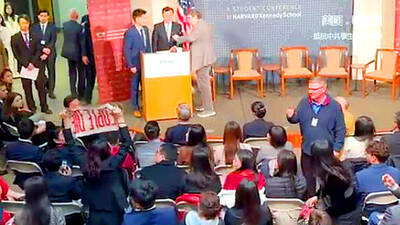
A group of Taiwanese-American and Tibetan-American students at Harvard University on Saturday disrupted Chinese Ambassador to the US Xie Feng’s (謝鋒) speech at the school, accusing him of being responsible for numerous human rights violations. Four students — two Taiwanese Americans and two from Tibet — held up banners inside a conference hall where Xie was delivering a speech at the opening ceremony of the Harvard Kennedy School China Conference 2024. In a video clip provided by the Coalition of Students Resisting the CCP (Chinese Communist Party), Taiwanese-American Cosette Wu (吳亭樺) and Tibetan-American Tsering Yangchen are seen holding banners that together read:

UNAWARE: Many people sit for long hours every day and eat unhealthy foods, putting them at greater risk of developing one of the ‘three highs,’ an expert said More than 30 percent of adults aged 40 or older who underwent a government-funded health exam were unaware they had at least one of the “three highs” — high blood pressure, high blood lipids or high blood sugar, the Health Promotion Administration (HPA) said yesterday. Among adults aged 40 or older who said they did not have any of the “three highs” before taking the health exam, more than 30 percent were found to have at least one of them, Adult Preventive Health Examination Service data from 2022 showed. People with long-term medical conditions such as hypertension or diabetes usually do not
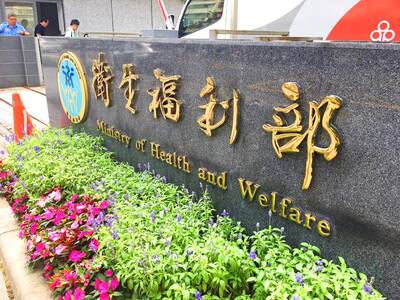
MEDICAL: The bills would also upgrade the status of the Ethical Guidelines Governing the Research of Human Embryos and Embryonic Stem Cell Research to law The Executive Yuan yesterday approved two bills to govern regenerative medicine that aim to boost development of the field. Taiwan would reach an important milestone in regenerative medicine development with passage of the regenerative medicine act and the regenerative medicine preparations ordinance, which would allow studies to proceed and treatments to be developed, Deputy Minister of Health and Welfare Victor Wang (王必勝) told reporters at a news conference after a Cabinet meeting. Regenerative treatments have been used for several conditions, including cancer — by regenerating blood cells — and restoring joint function in soft tissue, Wang said. The draft legislation requires regenerative treatments
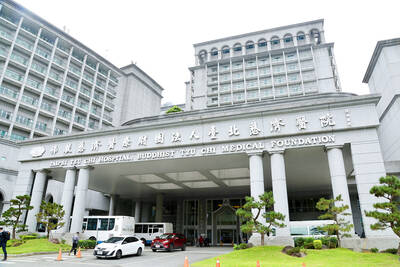
POLICE INVESTIGATING: A man said he quit his job as a nurse at Taipei Tzu Chi Hospital as he had been ‘disgusted’ by the behavior of his colleagues A man yesterday morning wrote online that he had witnessed nurses taking photographs and touching anesthetized patients inappropriately in Taipei Tzu Chi Hospital’s operating theaters. The man surnamed Huang (黃) wrote on the Professional Technology Temple bulletin board that during his six-month stint as a nurse at the hospital, he had seen nurses taking pictures of patients, including of their private parts, after they were anesthetized. Some nurses had also touched patients inappropriately and children were among those photographed, he said. Huang said this “disgusted” him “so much” that “he felt the need to reveal these unethical acts in the operating theater


 RSS
RSS