


She may have a weak body, but she has a strong will -- a girl who grew up in poverty and with a rare disorder that left her partially paralyzed is now a guardian for rare disorder sufferers.
Her name is Yang Yu-xing (楊玉欣) and her life has never been easy.
She grew up in an economically disadvantaged family in which both her parents worked hard to provide for their family of five.

PHOTO: CHIEN JUNG-FENG, TAIPEI TIMES
At the age of 19, she was discovered to have Miyoshi myopathy, a rare genetic disorder in which muscle fibers do not function properly, resulting in muscular weakness.
Since that moment, Yang's physical condition has weakened day by day.
Although she has become partially paralyzed due to the disorder, she never gave up hope or her love for life.
Yang not only became a TV anchor, but has also served in two non-governmental organizations that care for rare disease sufferers and disadvantaged patients.
Her achievement earned her recognition earlier this year as one of 10 rising stars in the country.
Yang shared her story with the Taipei Times in an interview on Thursday.
"I grew up in a lower class family in Hsinchu ? both of my parents worked hard every day; and since they were working most of the time, the three of us children had to take care of ourselves," she said. "My elder brother took care of me, and we took care of our younger brother together."
Instead of complaining about it, Yang said she has learned something from her life.
"I've learned to appreciate everything, whether material or spiritual," she said.
As she learned to appreciate, she also learned to give.
"We [the children] knew that our parents were busy all the time earning money to feed the family, so we automatically would help out with the chores," Yang said. "Being able to give is something precious."
However, misfortune struck the happy family.
"It was discovered that I had Miyoshi myopathy when I was 19, and so were my sister and brother -- they were also found to have Miyoshi myopathy when they turned 19," Yang said.
"I'm still becoming weaker and weaker every day," she said.
"The [physical] pain is a test on my limits ? while enduring the pain, I try to find what the meaning is [in life] and what my responsibilities are," Yang said.
"If you have a purpose in life, then nothing is unbearable," she said, adding that her responsibility is to help those who suffer like her.
"I would suffer for them if my suffering would free them from theirs," she said.
With that in mind, she began to work for the Taiwan Foundation for Rare Disorders and the Taiwan Organization for Disadvantaged Patients.
Asked if she had ever thought about giving up, she replied with a story.
"My sister once told me that she wanted to die," because she just couldn't stand seeing herself becoming weaker and weaker by the day, Yang said.
Yang then asked her sister if she was afraid of death after she had considered all the different ways to commit suicide.
"She told me she wasn't afraid of committing suicide at all ? since death is better than living with the disease," Yang said.
So Yang asked her sister: "If you're not afraid of death, then why would you be afraid of being alive?"
The question convinced her sister to carry on living.
"Of course I've lost many abilities ? but I often feel grateful that I can still think, I can still talk and I can still work," Yang said. "Don't look at what you've lost, but look at what you still have."
After overcoming her difficulties and achieving so much in life, one big surprise still awaited Yang -- her fiance.
"I just never thought there would be someone for me, especially when being with me means a lot of sacrifice," Yang said.
Despite her physical disability, Sun Hsiao-chih (孫效智), her fiance, saw her true beauty.
"Most people would say I'm talented and know a lot, but also have this rare disorder," Yang said. "But my fiance thinks that although I have this disease, I am talented. He could see beyond my illness."
Their wedding is scheduled to be held in July. Sun, a university professor, explained why he could see beyond the ordinary view.
"Life is about love. If you truly believe it, you'll make it part of your life," he said.

A group of Taiwanese-American and Tibetan-American students at Harvard University on Saturday disrupted Chinese Ambassador to the US Xie Feng’s (謝鋒) speech at the school, accusing him of being responsible for numerous human rights violations. Four students — two Taiwanese Americans and two from Tibet — held up banners inside a conference hall where Xie was delivering a speech at the opening ceremony of the Harvard Kennedy School China Conference 2024. In a video clip provided by the Coalition of Students Resisting the CCP (Chinese Communist Party), Taiwanese-American Cosette Wu (吳亭樺) and Tibetan-American Tsering Yangchen are seen holding banners that together read:

UNAWARE: Many people sit for long hours every day and eat unhealthy foods, putting them at greater risk of developing one of the ‘three highs,’ an expert said More than 30 percent of adults aged 40 or older who underwent a government-funded health exam were unaware they had at least one of the “three highs” — high blood pressure, high blood lipids or high blood sugar, the Health Promotion Administration (HPA) said yesterday. Among adults aged 40 or older who said they did not have any of the “three highs” before taking the health exam, more than 30 percent were found to have at least one of them, Adult Preventive Health Examination Service data from 2022 showed. People with long-term medical conditions such as hypertension or diabetes usually do not
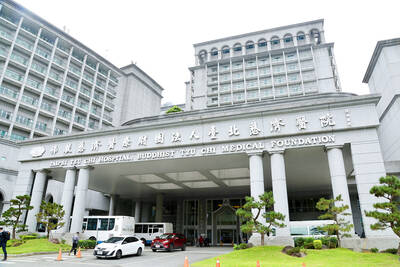
POLICE INVESTIGATING: A man said he quit his job as a nurse at Taipei Tzu Chi Hospital as he had been ‘disgusted’ by the behavior of his colleagues A man yesterday morning wrote online that he had witnessed nurses taking photographs and touching anesthetized patients inappropriately in Taipei Tzu Chi Hospital’s operating theaters. The man surnamed Huang (黃) wrote on the Professional Technology Temple bulletin board that during his six-month stint as a nurse at the hospital, he had seen nurses taking pictures of patients, including of their private parts, after they were anesthetized. Some nurses had also touched patients inappropriately and children were among those photographed, he said. Huang said this “disgusted” him “so much” that “he felt the need to reveal these unethical acts in the operating theater
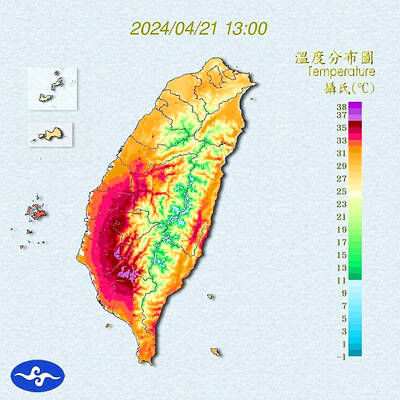
Heat advisories were in effect for nine administrative regions yesterday afternoon as warm southwesterly winds pushed temperatures above 38°C in parts of southern Taiwan, the Central Weather Administration (CWA) said. As of 3:30pm yesterday, Tainan’s Yujing District (玉井) had recorded the day’s highest temperature of 39.7°C, though the measurement will not be included in Taiwan’s official heat records since Yujing is an automatic rather than manually operated weather station, the CWA said. Highs recorded in other areas were 38.7°C in Kaohsiung’s Neimen District (內門), 38.2°C in Chiayi City and 38.1°C in Pingtung’s Sandimen Township (三地門), CWA data showed. The spell of scorching


 RSS
RSS