


Thousands of soldiers yesterday fought to reclaim a military base in northern Taiwan after it was occupied by "Chinese" special forces in a mock drill.
A total of 4,050 soldiers were mobilized to recover a base in Hukou
"Through the drill today, we can see how our army boys cooperate with each other when the base in Hukou was attacked and invaded by the enemy's special forces," said Major General Yao Pei-yung (
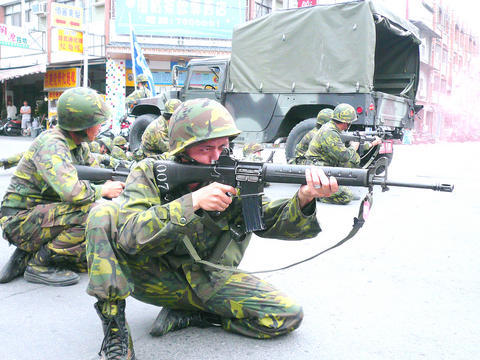
PHOTO: KUO CHING-HUI, TAIPEI TIMES
Yao explained that the drill was designed to simulate a scenario in which a People's Liberation Army (PLA) special forces unit lands in Hukou and tries to take over the base. The enemy successfully occupied the base, home to an army armor unit. The armored forces then regrouped and tried to recover their territory.
The drill was scheduled to begin at 8:30am, but was postponed because of heavy rain. Around 10am, the drill began with the "Red Team" -- simulating the Chinese army -- attempting a helicopter assault.
During the scenario, IDF Ching-kuo and F-16 Falcon fighters were supposed to simulate PLA Air Force (PLAAF) SU-27 Flanker and A-5 Fantan fighters. However, the military announced that the missions were canceled because of poor visibility and rain.
AH-1W Cobra attack helicopters and OH-58D Kiowa attack helicopters simulated PLAAF aircraft, flying in and providing cover for the two CH-47SD Chinook transport helicopters simulating an airborne assault by special forces.
More than 40 Humvees, which were equipped with 50-caliber machine guns and loaded with soldiers, surrounded the landing zone while the Red Team's soldiers were trying to take over the base's command center.
Soldiers began to open fire (with blanks), and the gunbattle lasted more than 10 minutes.
Then, CM-11 Brave Tiger tanks and CM-21 armored personnel carriers began to attack the Red Team. The tanks fired their main cannons several times, using real ammo aimed at targets nearby.
The Taiwanese armor then gradually closed in and encircled the Red Team, eventually retaking the command center. The entire drill lasted approximately one hour.
"As you may see, our tanks were very slow and our soldiers did not run very fast in the field. I asked them not to proceed at top speed, because it is extremely muddy and slippery because of the rain. We do not want any injuries," Yao said.
President Chen Shui-bian (
The Chinese-language United Evening News yesterday said Chen had canceled his trip to observe the drill at the suggestion of the military, which said he would bring bad luck on the drill after having attended a service for Major Wei Tsu-yuan (
The Presidential Office said the allegation was "groundless."
Chen presented awards to the men's families and posthumously promoted Wei to lieutenant colonel and Chan to major. Wei and Chan were killed when their F-5F Tiger fighter jet crashed into a military complex last Friday.
Ministry of National Defense Spokesman Rear Admiral Wu Chi-fang (
"This exercise is carried out island-wide. But, we do not make public every drill because of a concern for security," Wu said.
In Hualien, air force personnel carried out a drill, while in Pingtung, another drill simulated a joint anti-amphibious-landing operation.
At a beach in Taichung County, the Army annihilated Red Team vessels as they tried to land.
Additional reporting by Ko Shu-ling
Also see story:
Editorial: Han Kuang: No guts, all glory

LOUD AND PROUD Taiwan might have taken a drubbing against Australia and Japan, but you might not know it from the enthusiasm and numbers of the fans Taiwan might not be expected to win the World Baseball Classic (WBC) but their fans are making their presence felt in Tokyo, with tens of thousands decked out in the team’s blue, blowing horns and singing songs. Taiwanese fans have packed out the Tokyo Dome for all three of their games so far and even threatened to drown out home team supporters when their team played Japan on Friday. They blew trumpets, chanted for their favorite players and had their own cheerleading squad who dance on a stage during the game. The team struggled to match that exuberance on the field, with
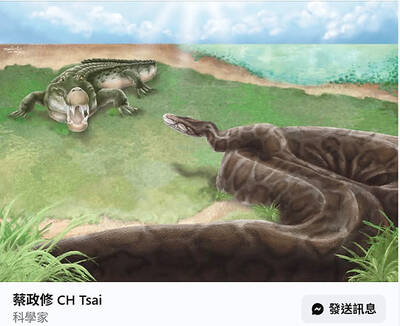
Taiwanese paleontologists have discovered fossil evidence that pythons up to 4m long inhabited Taiwan during the Pleistocene epoch, reporting their findings in the international scientific journal Historical Biology. National Taiwan University (NTU) Institute of Ecology and Evolutionary Biology associate professor Tsai Cheng-hsiu (蔡政修) led the team that discovered the largest snake fossil ever found in Taiwan. The single trunk vertebra was discovered in Tainan at the Chiting Formation, dated to between 400,000 and 800,000 years ago in the Middle Pleistocene, the paper said. The area also produced Taiwan’s first avian fossil, as well as crocodile, mammoth, saber-toothed cat and rhinoceros fossils, it said. Discoveries

Taiwanese paleontologists have discovered fossil evidence that pythons up to 4m long inhabited Taiwan during the Pleistocene epoch, reporting their findings in the international scientific journal Historical Biology. National Taiwan University (NTU) Institute of Ecology and Evolutionary Biology associate professor Tsai Cheng-hsiu (蔡政修) led the team that discovered the largest snake fossil ever found in Taiwan. A single trunk vertebra was discovered in Tainan at the Chiting Formation, dated to between 800,000 to 400,000 years ago in the Middle Pleistocene, the paper said. The area also produced Taiwan’s first avian fossil, as well as crocodile, mammoth, sabre-toothed cat and rhinoceros fossils, it said. Discoveries
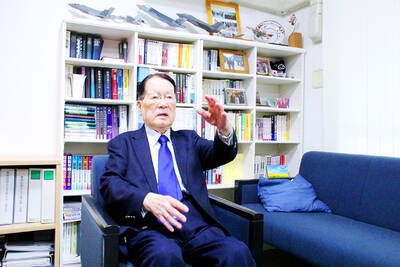
Whether Japan would help defend Taiwan in case of a cross-strait conflict would depend on the US and the extent to which Japan would be allowed to act under the US-Japan Security Treaty, former Japanese minister of defense Satoshi Morimoto said. As China has not given up on the idea of invading Taiwan by force, to what extent Japan could support US military action would hinge on Washington’s intention and its negotiation with Tokyo, Morimoto said in an interview with the Liberty Times (sister paper of the Taipei Times) yesterday. There has to be sufficient mutual recognition of how Japan could provide


 RSS
RSS