


Lawmakers yesterday agreed on a regulation requiring the government reduce greenhouse gas emissions to 2005 levels by 2025 to 2030.
Consensus was reached during a meeting of the legislature's Sanitation and Environment and Social Welfare committees to review a greenhouse gas emissions reduction bill.
While the debate revolved around whether the proposed regulation was too harsh or to weak compared with international standards, lawmakers were able to reach a consensus and agree on the measures the nation should adopt to cut its greenhouse gas emissions.
The bill will be presented to the legislature for consideration.
Democratic Progressive Party (DPP) Legislator Wang Jung-chang (
"The bill will be meaningless without the inclusion of reduction targets. If we were proposing this bill from a business point of view, we wouldn't bother enacting it," KMT Legislator Yang Li-huan (楊麗環) said.
Wang Jung-chang criticized the regulation calling for "a very low standard." For his part, Taiwan Solidarity Union Legislator Lai Shin-yuan (
"We should also aim to bring emissions back to 1990 levels, when the Kyoto Protocol was signed. Such a loose standard [as the one proposed yesterday] would make Taiwan a joke in the world," she said.
Adding to the debate was a clause introduced by Wang Jung-chang stating that "to reduce emissions to 1990 levels would be the country's long-term goal."
KMT Legislator Wu Ing-yi (
Separately, lawmakers reached consensus on an article demanding that a proposal on greenhouse gases produced by electricity and manufacturing departments come into effect within two years -- at the latest -- after the bill is promulgated.
A proposal on emissions reduction for transportation and agricultural departments has to be implemented within four years.
A proposal for commercial, residential and other departments, meanwhile, has to be carried out within six years after the bill comes into force.
The Research Center for Environmental Change at Academia Sinica said that from 1990 to 2005, Taiwan ranked first in the world, among countries with a population of 10 million or more, in the growth rate of carbon dioxide emissions.
"As a committee in charge of the emissions reduction bill, we have to set a reduction target to meet public expectations," DPP Legislator Huang Sue-ying (
Lawmakers, however, failed to agree on a mechanism by which the government would allocate carbon dioxide emission quotas among industrial sectors.
The bill left the committee yesterday and lawmakers will deliberate upon the proposed articles at a future date.

FUKUOKA SITUATION: Japanese media reported that the pathogen is expected to be identified by the summer, while the CDC downplayed the idea that it was hMPV A “mysterious cold-like illness” reported in Japan’s Fukuoka Prefecture does not seem to be a new disease, but Japanese authorities have been asked about the situation, the Centers for Disease Control (CDC) said yesterday. The Fukuoka Prefectural Medical Association on Wednesday told a news conference that a “mystery cold” that has become a hot topic on social media is “highly likely to be caused by some kind of viral infection,” Japan’s KBC News reported. “Many people are experiencing symptoms starting with a sore throat, followed by a runny nose, phlegm and a severe cough,” KBC News reported, citing association officials. Health authorities are

Nvidia Corp CEO Jensen Huang (黃仁勳) arrived in Taiwan yesterday ahead of upcoming AI and technology events, saying he plans to meet with clients and Taiwan Semiconductor Manufacturing Co Chairman C.C. Wei (魏哲家) during his visit. After landing at Taipei Songshan Airport, Huang posed for photos with fans and handed out Yakult drinks to reporters and supporters waiting at the scene, saying he has “a lot to do” during the trip. Asked about reports that Nvidia’s planned headquarters site in Taipei’s Beitou Shilin Technology Park could break ground on May 27, Huang said that if the company holds an event, he would

The Ministry of Finance this afternoon announced the winning numbers for the March-April uniform invoice lottery. The winning number for the NT$10 million (US$318,060) special prize is 19531471, and the winning number for the NT$2 million grand prize is 85941329. Three numbers were drawn for the NT$200,000 first prize: 07225810, 20231230 and 83518781. Those with receipts matching the last seven digits of any of the first-prize numbers will win the NT$40,000 second prize, while those matching the last six digits will win the NT$10,000 third prize. Those whose receipts match the last five digits of the first-prize numbers can claim the NT$4,000 fourth prize,
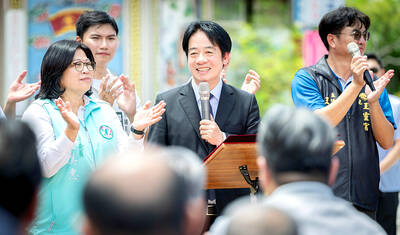
SIX SUBSIDIES: The monthly allowance for older farmers is to increase to NT$10,000, and NT$5,000 is to be given to homemakers under the national pension system, Lai said The government is to implement major welfare policies for disadvantaged groups, including raising the monthly allowance for older farmers to NT$10,000 and providing homemakers with NT$5,000 per month, President William Lai (賴清德) said yesterday. Lai made the remarks during a visit to Wangling Temple in Chiayi County, saying that the planned increases were being introduced amid economic growth and an increase in tax revenue. Touting a policy, in which the government plans to provide a monthly allowance of NT$5,000 for every child under the age of 18 in a bid to address Taiwan’s low birthrate, Lai said that if received for the


 RSS
RSS