


Efforts by the pan-green camp to resolve the impasse over this year's government budget yesterday exacerbated political bickering, and in some cases led to infighting within the camp itself.
Meanwhile, the bill that has left the budget high and dry -- the pan-blue camp's proposal to turn the nation's election oversight body into a partisan organization -- was also stalled.
Politicians took the opportunity to engage in heated fingerpointing, while there appeared to be little indication that the dispute would end any time soon.
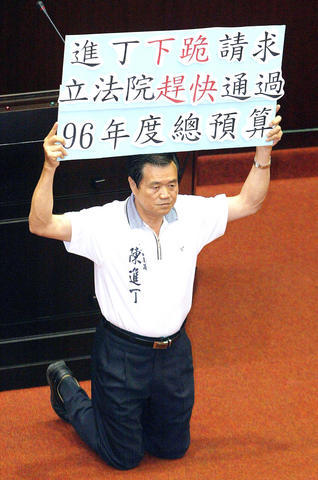
PHOTO: GEORGE TSORNG, TAIPEI TIMES
The Budget Act (
The non-passage of the budget bill marked the first time in the nation's history that the government started a fiscal year without the legislature's approval of its funds.
However, the hype surrounding the stalled budget obscures the fact that, unlike many countries where a stalled budget would mean a government shutdown, the law allows the government to continue operating normally even if its budget isn't passed. Only funding for new construction projects cannot be released.
Therefore, of the NT$1.6 trillion requested by the government, 99.96 percent of the funds -- all but NT$70 billion for new construction -- can be spent, even without legislative approval.
The latest round of inaction followed by denunciation -- which has become the de facto political process at the Legislative Yuan -- began after Premier Su Tseng-chang (
In the advertisement, Su urged the public to voice its anger by e-mail, phone or letter to Chinese Nationalist Party (KMT) lawmakers for holding the budget hostage in its efforts to get an amendment to the Organic Law of the Central Election Commission (
That amendment would strip the Executive Yuan of its control over the CEC and place it in the hands of the Legislative Yuan.
The KMT legislative caucus called a press conference to attack the premier over the advertisement, saying that Su was responsible for the stalled budget bill.
"Su is the first premier to fail to get his budget request cleared in the legislature, which just shows how incapable he is," KMT Legislator Alex Fai (
Democratic Progressive Party (DPP) Legislator Lin Kuo-ching (
"I suspect Su's motives in running the advertisement. He might have hinted that politically appointed officials should choose sides in the DPP primary when asking them to sponsor the advertisement," Lin said.
DPP legislative caucus whip Ker Chien-ming (
The Taiwan Solidarity Union (TSU) called on people to delay filing taxes until the budget bill is passed, while a group of party supporters held protests in front of the legislature.
"It stands to reason that people should boycott filing taxation as a government without a budget is unable to take care of the people," TSU Legislator Lo Chih-ming (
But Deputy Minister of Finance Lin Tseng-chi (
Meanwhile, Non-Partisan Solidarity Union Legislator Chen Chin-ting (
The Cabinet yesterday said its advertisement had nothing to do with the DPP's primary.
"It was merely an SOS message to the public that the government is running out of money," said Cabinet spokeswoman Chen Mei-ling (
"It has nothing to do with the election," she added. "The main purpose is to show the public how serious the problem is and the difficult situation the central government is experiencing."
The spokeswoman said that the total cost of the advertisement in three newspapers was approximately NT$800,000.
The advertisement said it would be paid for by donations from Cabinet members.
However, as of press time yesterday, no donation had been made by Cabinet members.
Asked how the Cabinet was going to pay off the cost of the advertisement if donations proved insufficient, she said the premier would take care of it.
Additional reporting by Mo Yan-chih

UPGRADE: The Kang Ding-class frigate is replacing its Chaparall missiles with Tien Chien II and Hua Yang VLS, which would provide it with long-range, 360° air defense Taiwan plans to produce 1,200 to 1,376 Hai Chien II missiles (海劍二, Sea Sword II) — also known as TC-2N — to serve as the standard air defense system of the navy’s surface combatant fleet, a source said yesterday. Last week, the Hai Chien II, the naval version of the Tien Kung II missile (天劍二, Sky Sword II), completed a live-fire test in waters off the National Chungshan Institute of Science and Technology’s Jiupeng facility (九鵬) in Pingtung County’s Manjhou Township (滿州). The MIM72 Chaparral and other dated air defense missiles that currently arm Taiwanese ships have inadequate range to combat Chinese

REASONS FOR TRAVEL: An assistant professor said that proposed amendments to penalize drivers if they used drugs overseas would not deter people from traveling People who operate a motor vehicle under the influence of marijuana would have their driver’s license revoked, even if they used the substance while overseas, the Ministry of Transportation and Communications said yesterday, citing proposed amendments to the Road Traffic Management and Penalty Act (道路交通管理處罰條例). The amendments would also authorize the government to revoke the licenses of people determined to have used Category 1 or Category 2 narcotics, even if they were not operating a vehicle while under the influence of drugs, as well as ban them from taking the license test for three years, the ministry said. People aged 18 or

HEAVY WEATHER: Typhoon Jangmi is due to crash straight into the Ryukyus as airlines look to shift flights to larger aircraft or cancel flights to Okinawa entirely Taiwan’s international air carriers announced flight adjustments over the weekend as Typhoon Jangmi is forecast to hit the Ryukyu Islands today and tomorrow. The Central Weather Administration (CWA) upgraded Jangmi from a tropical storm to a typhoon at 8am yesterday, with the eye located 580km south of Naha city. It was moving north at 19kph. Today, China Airlines’ CI-120, CI-121, CI-122 and CI-123 flights between Taoyuan and Naha, Okinawa, have been canceled as well as CI-132 and CI-133 between Kaohsiung and Naha. EVA Air’s BR-112, BR-113, BR-186 and BR-185 flights between Taoyuan and Naha are also canceled. Low-cost carrier Tigerair Taiwan canceled IT-230,
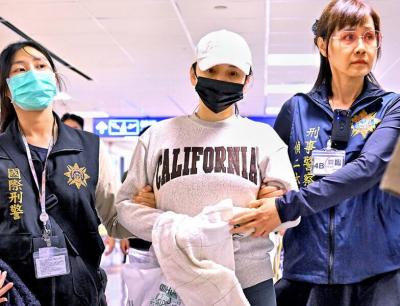
Johanne Liou (劉喬安), a Taiwanese woman who shot to unwanted fame during the Sunflower movement protests in 2014, returned to Taiwan last night after being deported from the US. She is to stand trial in Taiwan for charges involving embezzlement, fraud and drug crimes. The Criminal Investigation Bureau (CIB) said it took her into custody at Taiwan Taoyuan International Airport and would first question her before transferring her to the New Taipei District Prosecutors’ Office. She was arrested upon disembarking a flight from San Francisco that landed shortly before 7pm. Liou absconded to the US in 2019 after jumping bail


 RSS
RSS