


Cyclist rights advocates yesterday appealed to the Ministry of Transportion and Communications to redefine the legal status of bicycles.
"The Highway Law (公路法) refers to any motored vehicle -- including cars, electric vehicles, or any other slow-moving vehicle -- that can operate on highways and in downtown areas," said Chou Sheng-shin (周聖心) event coordinator for the Thousand Mile Trail Project. "The word `motored' essentially rules out bicycles. In other words, the law does not recognize bicycles as vehicles."
Chou said it was time for transportation officials to amend the regulations, given that cycling is gathering popularity as an eco-friendly form of transportation.
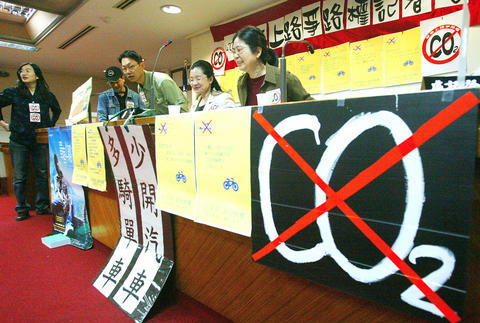
PHOTO: CNA
She suggested the government eliminate the word `motored' in the legal definition of vehicles. In the meantime, the government should strive to establish a bike route system where cyclists can ride their bicycles safely and comfortably.
She emphasized, however, that her group was not asking the government to build additional routes to accommodate the growing demand from bikers.
Instead, they simply want them to re-arrange the lane usage on built highways or reduce the width of each lane so there will be sufficient space for bikers.
Chou added that the campaign for bikers' rights was not just about encouraging more people to drop their motor vehicles. The event also promotes a new, healthier lifestyle.
"It's a way for people to slow down and appreciate the environment they live in," she added.
To increase the appeal of bicycles, Chou's organization and other environmental groups will hold an event tomorrow, International Earth Day, where bikers will ride a 12km route -- from the old tobacco plant in Songshan to the film park on Kangting Road in Taipei.
In related news, the Ministry of Transportation and Communications announced yesterday that small-size electric scooters will be able to operate legally on the roads from June.
The scooters are usually used by senior citizens or physically challenged persons for traveling short-distances.
The government has promoted the use of small-size electric scooters for 10 years, but the ministry did not consider granting legal status to the vehicles until last year.
The new regulations, however, will not be promulgated until May.
They divide electric scooters into two categories; regular size and small size. The latter must be operated by batteries with a capacity of 1.34kw or less. The operating speed must not exceed 45kph, and the entire weight of the vehicle must be no greater than 70kg.
Licence plates must also be mounted on the electric scooters, and those driving without licence plates may face a penalty of between NT$3,600 and NT$9,000.
Operators must be 18 years of age and hold a valid licence issued by their local vehicle registration department. They must wear a helmet, purchase liability insurance and are not allowed to carry additional passengers in the vehicle.
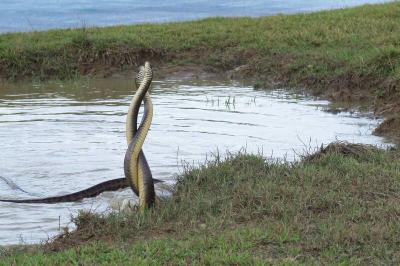
Kenting National Park service technician Yang Jien-fon (楊政峰) won a silver award in World Grand Prix Photography Awards Spring Season for his photograph of two male rat snakes intertwined in combat. Yang’s colleagues at Kenting National Park said he is a master of nature photography who has been held back by his job in civil service. The awards accept entries in all four seasons across six categories: architectural and urban photography, black-and-white and fine art photography, commercial and fashion photography, documentary and people photography, nature and experimental photography, and mobile photography. Awards are ranked according to scores and divided into platinum, gold and

More than half of the bamboo vipers captured in Tainan in the past few years were found in the city’s Sinhua District (新化), while other districts had smaller catches or none at all. Every year, Tainan captures about 6,000 snakes which have made their way into people’s homes. Of the six major venomous snakes in Taiwan, the cobra, the many-banded krait, the brown-spotted pit viper and the bamboo viper are the most frequently captured. The high concentration of bamboo vipers captured in Sinhua District is puzzling. Tainan Agriculture Bureau Forestry and Nature Conservation Division head Chu Chien-ming (朱健明) earlier this week said that the

The Chinese Nationalist Party (KMT) caucus yesterday said it opposes the introduction of migrant workers from India until a mechanism is in place to prevent workers from absconding. Minister of Labor Hung Sun-han (洪申翰) on Thursday told the Legislative Yuan that the first group of migrant workers from India could be introduced as early as this year, as part of a government program. The caucus’ opposition to the policy is based on the assessment that “the risk is too high,” KMT caucus secretary-general Lin Pei-hsiang (林沛祥) said. Taiwan has a serious and long-standing problem of migrant workers absconding from their contracts, indicating that

SPACE VETERAN: Kjell N. Lindgren, who helps lead NASA’s human spaceflight missions, has been on two expeditions on the ISS and has spent 311 days in space Taiwan-born US astronaut Kjell N. Lindgren is to visit Taiwan to promote technological partnerships through one of the programs organized by the US for its 250th national anniversary. Lindgren would be in Taiwan from Tuesday to Saturday next week as part of the US Bureau of Educational and Cultural Affairs’ US Speaker Program, organized to celebrate the 250th anniversary of the signing of the Declaration of Independence, the American Institute in Taiwan (AIT) said in a statement yesterday. Lindgren plans to engage with key leaders across the nation “to advance cutting-edge technological partnerships and inspire the next generation of scientists and engineers,”


 RSS
RSS