


The Ministry of Education said yesterday it will publicly congratulate Chou Chun-hsun (周俊勳), winner of the world go championship held recently in South Korea, in recognition of his career achievements and persevering spirit.
Minister of Education Tu Cheng-sheng (杜正勝) announced the commendation plan after Chou, 27, emerged victorious from the final match of the 11th LG Cup Go Championship in Seoul on Thursday.
Chou was the first-ever go player representing Taiwan to win the world championship.
The victory was just one of a series of firsts for Chou, who was also the first Taiwan-nurtured go player to rise to the professional game's top tier -- ninth dan, or level nine.
Tu said Chou deserved a public commendation not only for his professional brilliance and recent successes but also for the patience and mental strength he has shown in his quest.
During his elementary school years, Chou had to endure his classmates' mockery because of a large scarlet birthmark that covers half of his face.
Chou found comfort in playing go and learned to ignore other people's comments about his "facial defect" while cultivating a habitual concentration and precocious calm -- valuable personal assets in the highly competitive game of go.
Chou's life story was recently put into an elementary-school textbook.
Tu said he looks forward to seeing more similar stories based on contemporary Taiwanese striving to reach the pinnacle in their chosen fields compiled into primary and junior high-school textbooks.
Chou suffered many setbacks and encountered numerous difficulties during his school years as a direct result of his pursuit of a career as a go player, Tu said.
In light of this, Tu said that the education ministry needed to overhaul and expand the existing special education system to benefit more young people with special gifts or talents.
Tu said that special education can be divided into two categories -- courses for gifted elementary school or junior-high-school students and programs intended for the mentally or physically challenged.
On the education programs for gifted children, Tu said the government has done more in helping those with musical and athletic talent go abroad for advanced training.
By contrast, he conceded that the ministry has not done enough to help individuals with special gifts in other areas, such as painting and playing go, better known as "wei-chi" in Taiwan.
Tu said he has told the ministry's special education planning task force to design special elementary and junior-high-school curriculums catering to the needs of those with special talents in various fields.
Meanwhile, Chou was scheduled to return home from Seoul yesterday evening after receiving the go world championship trophy and 250 million Korean won (US$266,400; NT$8.83 million) in prize money in an award-presentation ceremony held in Seoul on Friday.
Chou said during the presentation ceremony that he planned to use part of his prize money to organize an amateur go tournament in Taipei to help increase the country's ability in this intellectually challenging board game.
Chou defeated his Chinese opponent Hu Yaoyu (
Unlike other talented Taiwanese go players who have moved abroad and participated in more competitive venues like Japan, Chou has stayed in Taiwan and represented his country in major international competitions.
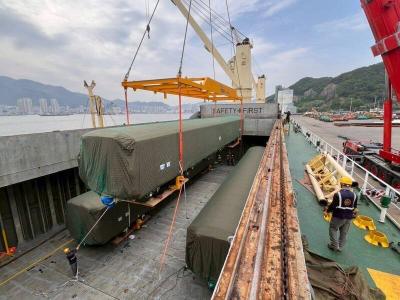
The first of 10 new high-capacity trains purchased from South Korea’s Hyundai Rotem arrived at the Port of Taipei yesterday to meet the demands of an expanding metro network, Taipei Rapid Transit Corp (TRTC) said yesterday. The train completed a three-day, 1,200km voyage from the Port of Masan in South Korea, the company said. Costing NT$590 million (US$18.79 million) each, the new six-carriage trains feature a redesigned interior based on "human-centric" transportation concepts, TRTC said. The design utilizes continuous longitudinal seating to widen the aisles and optimize passenger flow, while also upgrading passenger information displays and driving control systems for a more comfortable
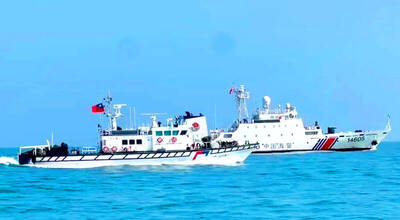
Instead of focusing solely on the threat of a full-scale military invasion, the US and its allies must prepare for a potential Chinese “quarantine” of Taiwan enforced through customs inspections, Stanford University Hoover fellow Eyck Freymann said in a Foreign Affairs article published on Wednesday. China could use various “gray zone” tactics in “reconfiguring the regional and ultimately the global economic order without a war,” said Freymann, who is also a nonresident research fellow at the US Naval War College. China might seize control of Taiwan’s links to the outside world by requiring all flights and ships entering or leaving Taiwan
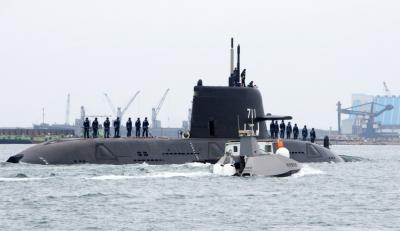
Taiwan's first indigenous defense submarine, the SS-711 Hai Kun (海鯤, or Narwhal), departed for its 13th sea trial at 7am today, marking its seventh submerged test, with delivery to the navy scheduled for July. The outing also marked its first sea deployment since President William Lai (賴清德) boarded the submarine for an inspection on March 19, drawing a crowd of military enthusiasts who gathered to show support. The submarine this morning departed port accompanied by CSBC Corp’s Endeavor Manta (奮進魔鬼魚號) uncrewed surface vessel and a navy M109 assault boat. Amid public interest in key milestones such as torpedo-launching operations and overnight submerged trials,
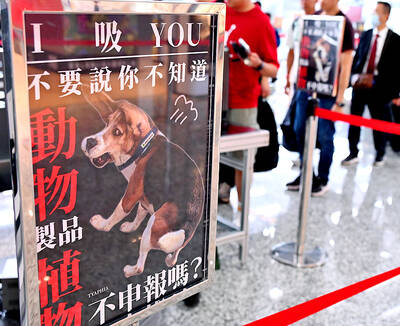
Quarantine awareness posters at Taiwan Taoyuan International Airport have gone viral for their use of wordplay. Issued by the airport branch of the Animal and Plant Health Inspection Agency, the posters feature sniffer dogs making a range of facial expressions, paired with advisory messages built around homophones. “We update the messages for holidays and campaign needs, periodically refreshing materials to attract people’s attention,” quarantine officials said. “The aim is to use the dogs’ appeal to draw focus to quarantine regulations.” A Japanese traveler visiting Taiwan has posted a photo on X of a poster showing a quarantine dog with a


 RSS
RSS