


For three days, the nation's eyes were riveted on an unremarkable black street dog. As the TV cameras looked on, the dog nimbly evaded capture while traffic whizzed by her at more than 100kph.
The dog, dubbed Er-ling-jiu, or "209," because of the kilometer marker she lived near, is said to have lived on the freeway divider on a stretch of the Sun Yat-sen Freeway near Changhua for around two years, when the cable network TVBS made her household news. She quickly became the most famous stray in the country as other media followed suit.
However, 209's existence was no secret to the highway department and local commuters. According to TVBS, the freeway bureau had received more than 50 calls about the dog, although the wily canine managed to evade numerous attempts at capture, including baited cages, chases along the shoulder of the road, and bizarrely, an attempt to lure 209 with a bitch in heat
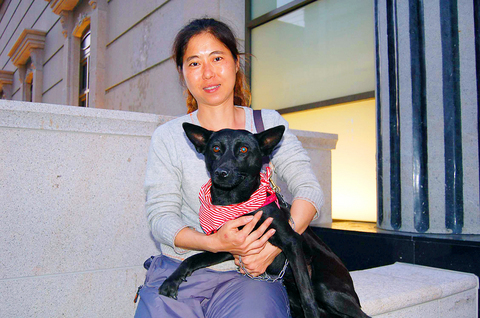
PHOTO: LIN YA-LI, TAIPEI TIMES
But 209's life on the road finally ended when the Kaohsiung Concern Stray Animal Association (KCSAA) formed a team of volunteer dog catchers, who after an exhausting six-hour test of wills, brought her down with an anesthetic blow dart.
"When I heard about 209's story, I knew we had to help her," said Wang Chun-ching (王春經), the director of KCSAA. "It was no life for a dog, and she was a constant danger to herself and others."
According to Wang, the team thought long and hard before putting the plan into action, including a decision not to inform the highway bureau of their intentions.
"We knew that the rescue would take a long time," Wang said. "We decided to act alone."
Although 209 was safely nabbed, Chen Han-yang (
Chen had only became aware of 209's plight shortly before the media storm broke and had been attempting to capture her with baited cages, to no avail.
"We considered blow darts too, but decided that it would be too risky to dart an animal on a highway," Chen said. "Blow darts can take minutes to work. In that time the startled animal could have run onto the highway and caused an accident."
"We took that into account," Wang said.
"We knew that 209 was a very clever dog who could never be caught with baited traps. She had lived on the highway for so long, she was too smart to run into traffic," she said.
Nevertheless, KCSAA's rescue effort could cost the group a fine of between NT$3,000 to NT$6,000.
"We're okay with that. We know we broke the rules," Wang said. "There was no other way."
Wang is scheduled to meet with freeway bureau officials today to discuss the issue.
"Yes, it was against the rules, but they did it out of love for the dog," Chen said. "Maybe that will be taken into consideration."
According to Wang, 209 is very healthy, although skittish around people, other dogs -- and traffic. Now the group has to find a home for her.
"We've had more than 100 calls from people asking to adopt 209. We've even had five or six who claimed to be 209's former owners," Wang said. "You really have to wonder about those people's motives. Do they really want to help her, or do they just want a celebrity dog?"
Wang said she will keep 209 for another month to give the her more time to adjust to a non-freeway life while a new home is chosen for the now famous canine.
But it is not just 209 who needs a new home.
"Our association has more than 300 strays in our shelters," Wang said. "They are equally deserving of good homes."
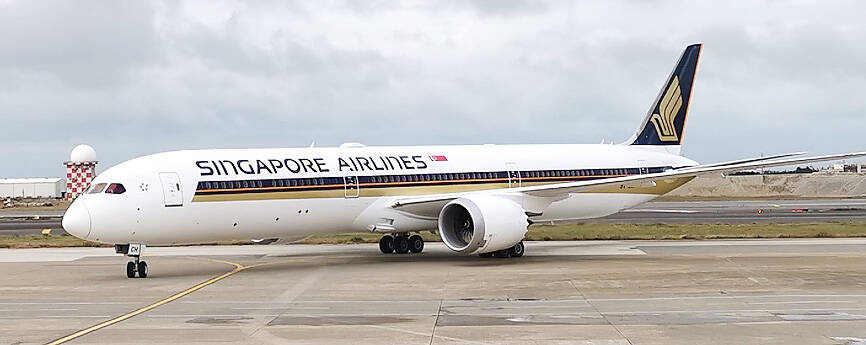
INCREASED CAPACITY: The flights on Mondays, Wednesdays, Fridays and Sundays would leave Singapore in the morning and Taipei in the afternoon Singapore Airlines is adding four supplementary flights to Taipei per week until May to meet increased tourist and business travel demand, the carrier said on Friday. The addition would raise the number of weekly flights it operates to Taipei to 18, Singapore Airlines Taiwan general manager Timothy Ouyang (歐陽漢源) said. The airline has recorded a steady rise in tourist and business travel to and from Taipei, and aims to provide more flexible travel arrangements for passengers, said Ouyang, who assumed the post in July last year. From now until Saturday next week, four additional flights would depart from Singapore on Monday, Wednesday, Friday
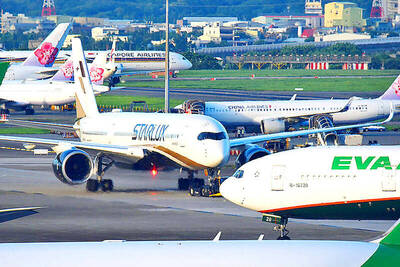
Taiwan’s three major international carriers are increasing booking fees, with EVA Airways having already increased the charge to US$28 per flight segment from US$25, while China Airlines (CAL) and Starlux Airlines are set to follow suit. Booking fees are charged by airlines through a global distribution system (GDS) and passed on to passengers. Carriers that apply the fees include CAL, EVA, Starlux and Tigerair Taiwan. A GDS is a computerized network operated by a company that connects airlines with travel agents and ticketing platforms, allowing reservations to be made and processed in real time. Major players include Amadeus, Sabre and Travelport. EVA Air began

WATCH FOR HITCHHIKERS: The CDC warned those returning home from Japan to be alert for any contagious diseases that might have come back with them People who have returned from Japan following the World Baseball Classic (WBC) games during the weekend are recommended to watch for symptoms of infectious gastroenteritis, flu and measles for two weeks, the Centers for Disease Control (CDC) said. Flu viruses remain the most common respiratory pathogen in Taiwan in the past four weeks and the influenza B virus accounted for 55.7 percent of the tested cases, exceeding the percentage of influenza A (H3N2) infections and becoming the local dominant strain, CDC Epidemic Intelligence Center Deputy Director Lee Chia-lin (李佳琳) said at a news conference on Tuesday. There were 82,187 hospital visits for
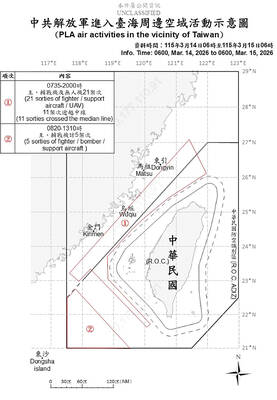
The Ministry of National Defense yesterday reported the return of large-scale Chinese air force activities after their unexplained absence for more than two weeks, which had prompted speculation regarding Beijing’s motives. China usually sends fighter jets, drones and other military aircraft around the nation on a daily basis. Interruptions to such routine are generally caused by bad weather. The Ministry of National Defense said it had detected 26 Chinese military aircraft in the Taiwan Strait over the previous 24 hours. It last reported that many aircraft on Feb. 25, when it spotted 30 aircraft, saying Beijing was carrying out another “joint combat


 RSS
RSS