

Mainland Affairs Council (MAC) Chairman Joseph Wu (吳釗燮) yesterday said the council will soon start to map out "feasible measures" for currency exchange between the Chinese yuan and the NT dollar in Taiwan following instructions from Premier Su Tseng-chang (蘇貞昌).
Related governmental departments are working on drafting measures, Wu said.
He made the remarks yesterday in a report to the Taiwan Solidarity Union (TSU) caucus.
TSU Legislators Lo Chih-ming and Lai Shin-yuan (
The policy's timing is complex and it is not the council that can decide it, said Wu, adding he told Su that if Chinese tourists were permitted to visit Taiwan, the council would allow them to bring about 20,000 yuan to Taiwan which could be a quota of the exchange for Chinese currency here when the exchange policy is opening.
Su, in a separate setting yesterday, stopped short of saying when the government would approve exchange services for the yuan.
"The relevant departments are making preparations and will soon make an announcement," Su said at the Cabinet's year-end news conference.
Last week, central bank governor Perng Fai-nan (
In recent years, Taiwan has allowed a small numbers of Chinese tourists into the nation and plans to loosen restrictions on Chinese tour groups in the near future.
Taiwan bans the use of the yuan. This forces Chinese tourists to bring US dollars to spend in Taiwan.
Many have urged the government to allow yuan-NT dollar exchanges so that they can take the yuan into China, instead of having to change NT dollars into US dollars to take to China to change into yuan.
In related news, Chinese Nationalist Party (KMT) Chairman Ma Ying-jeou (
Ma told an academic conference yesterday afternoon that the government's policies for investment in China remain "too conservative" and are unable to meet the needs of global industrial development given that China has become the major export destination for Taiwanese products.
He added the policies do not conform to WTO principles or regulations, which allow free trade.
The nation should allow the financial industry to invest in China, establish an official cross-strait economic forum and build up a common market between the two nations, he said.
Ma said loosening investment policies was a key to the survival of small countries.
"Although China is a threat to us, it is also an opportunity for us," Ma said. "The key lies in whether we can maximize the opportunity and minimize the threat. This is what we have to work on together."
Additional reporting by Jimmy Chuang and DPA

A Hualien pomelo farmer refused to sell to China after the country announced it would permit more Taiwanese pomelo imports, prompting widespread support from Taiwanese consumers, who rallied to buy his fruit. China’s Taiwan Affairs Office last month said that China’s General Administration of Customs registered an additional 79 Taiwanese pomelo orchards and packing facilities in Hualien County, allowing more Taiwanese producers to export pomelos to China. “I am a Hualien fruit farmer and I refuse to sell to China,” Liu Tzu-hao (劉子豪) from Ruisui Township (瑞穗) said in an online post. Liu is a well-known farmer in the community and has served
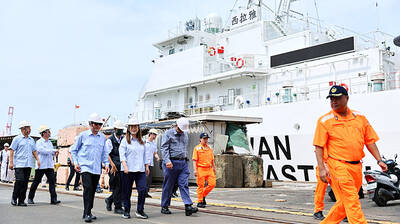
Ocean Affairs Council (OAC) Minister Kuan Bi-ling (管碧玲) on Wednesday said decommissioned coast guard vessels were given to the Philippines to enhance regional rescue capacity and would not affect Taiwanese fishers’ rights and benefits. Kuan made the remarks after confirmation on Tuesday that a 500-tonne Coast Guard Administration (CGA) patrol and rescue vessel would be given to the Philippine Coast Guard. The donation ceremony was reportedly done in Manila, but whether the vessel — previously numbered “CG123” and named Kinmen (金門) — has been handed over has yet to be confirmed. China’s Taiwan Affairs Office (TAO) on Wednesday criticized the donation for “taking
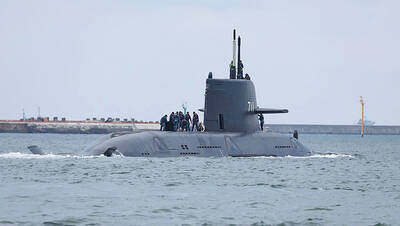
UPDATE: The submarine would need to undergo combined systems testing and crew training for navy personnel before it is ready for mission, an expert said Taiwan’s first domestically built submarine, the Hai Kun (Narwhal, 海鯤), could be delivered to the navy as early as next month, military expert and Taiwan Association for Security and Development chairman Chi Tung-yun (紀東昀) said yesterday. The submarine was yesterday morning observed departing for its 21st sea trial and its 15th submerged test. The vessel missed the initial delivery deadline of November last year due to “testing delays,” its primary contractor, shipbuilder CSBC Corp, Taiwan, said in June. The contractor also cited “political pressure from China” in procuring critical equipment. All testing operations are in the final stages, with the

OCT. 31: The antiviral drugs Tamiflu and Eraflu have been distributed to about 4,000 medical facilities nationwide for people in seven groups who develop flu-like symptoms As the domestic influenza epidemic enters its peak season and continues to escalate, the Centers for Disease Control (CDC) yesterday announced that publicly funded influenza antiviral drugs for seven eligible groups have been extended to Oct. 31, allowing those who develop flu-like symptoms to receive the medication without undergoing a rapid influenza test. The CDC has extended the expanded use of flu antiviral drugs to seven groups: healthcare and influenza-prevention personnel; residents and staff at nursing homes, long-term care facilities and similar institutions; kindergarten and daycare workers and home-based caregivers; students from kindergarten through high school, vocational high school and the


 RSS
RSS