


■ Politics
DPP to deal with Wu
The Democratic Progressive Party (DPP) is expected to deal with a disciplinary violation involving first lady Wu Shu-jen (吳淑珍) later this week, with Wu facing at least a suspension of party membership, a DPP official said yesterday. DPP Deputy Secretary-General Tsai Huang-liang (蔡煌瑯) said the party's Central Review Committee had scheduled another meeting for Thursday on the matter after a meeting last week was canceled because half of the committee did not attend. Tsai said that the party's Central Executive Committee had stipulated that any members indicted on vote-buying or corruption charges would have their membership suspended and would then be expelled if convicted. Tsai denied that the DPP's decision to handle the matter quickly was aimed at boosting the party's campaign in the Dec. 9 mayoral elections in Taipei and Kaohsiung.
■ Drugs
Heroin hidden in plums
Two local men were arrested at Taiwan Taoyuan International Airport on Friday while attempting to smuggle heroin into Taiwan, aviation police authorities said yesterday. The two men, identified by their surnames of Teng and Chen, had hidden the high-grade Cambodian heroin in preserved plums in their checked-in luggage, police said. Customs officials became suspicious after finding the packets of preserved plums in their luggage, since the products generally originate in Hong Kong and would be unlikely to have been brought in from Cambodia. The officials further examined the two men's luggage and discovered 4.6kg of the illicit drug.
■ Economy
Chen urges FTA with Seoul
President Chen Shui-bian (陳水扁) yesterday said that the time was ripe for Taiwan and South Korea to begin talks on signing a free trade agreement (FTA). Chen made the remark while meeting the South Korean delegation to this year's Taiwan-Korea economic conference at the Presidential Office yesterday morning. He said it was time for talks about signing a FTA because South Korea was Taiwan's fifth-largest trading partner, fourth-largest source of imports and sixth-largest export destination. Bilateral trade volume was recorded at US$18.7 billion (NT$584 million) last year and South Korea enjoyed a US$7.6 billion trading surplus, he said. "Based on this solid foundation, it is the right time for the two countries to talk about an FTA," Chen said. In addition to the annual conference, Chen said that he hoped to see top-level officials of the two countries conduct country-to-country consultation meetings on economic and other issues.
■ Environment
EPA scrutinizing batteries
The Environmental Protection Administration (EPA) announced yesterday that it is examining 500 different types of batteries available locally to check if their mercury content falls within legal limits. EPA officials plan to sample batteries from retail stores as well as those stored in warehouses. The testing began yesterday and will continue until the end of next month. Importers and manufacturers of batteries found to contain more than 5ppm of mercury will be asked to withdraw their products from the market immediately. Meanwhile, they will not be able to manufacture, import or sell these illegal batteries anymore. The EPA in September introduced regulations limiting batteries' mercury content to no more than 5ppm.

NATIONAL SECURITY: Authorities are working to confirm the identities of the military personnel involved and investigating possible illegal conduct and regulatory violations Authorities are probing possible national security implications after Kinmen police and immigration officers on Sunday found a Chinese woman allegedly posing as a tourist while engaging in prostitution involving more than 10 military personnel. The woman, surnamed Chen (陳), has since been deported, authorities said, adding that investigators are still working to confirm the identities of those implicated, as the records only listed code names and aliases. The case stemmed from a report received by the Kinmen District Prosecutors’ Office on Friday last week from the Jinhu Precinct of the Kinmen County Police Bureau. On Sunday, police, along with the National Immigration
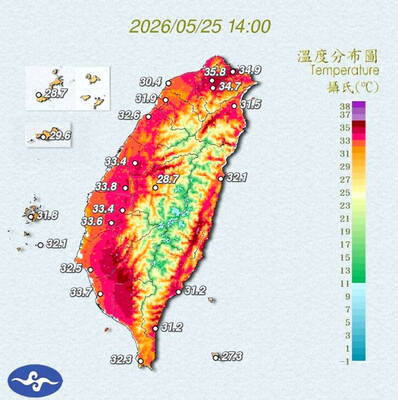
STAY COOL: The HPA recommended that people stay hydrated, use air-conditioning or fans while indoors, wear loose-fitting clothes and walk in the shade while outdoors Employers must implement measures such as installing cooling equipment, and providing drinking water and rest breaks for outdoor workers starting from Monday next week, the Taipei Department of Labor said on Sunday. Employers who fail to comply could face fines of NT$30,000 to NT$300,000 under the Occupational Safety and Health Act (職業安全衛生法), the department said. Businesses in Taipei employing fewer than 100 workers, as well as registered self-employed workers with labor insurance coverage, could receive on-site assessments and guidance from occupational safety consultants to help them apply for central government subsidies to implement or improve heat-protection measures, it said. Under the Ministry of

GLOBALGIVING: ‘ Caving to external pressure is not acceptable for an organization that has cultivated justice reform and human rights for 30 years,’ one NGO said A slew of non-government organizations (NGOs) have withdrawn from the GlobalGiving fundraising platform after it announced it would use “Chinese Taipei” instead of “Taiwan” from next month. The Taiwan Good Rice Association wrote on Facebook on Friday that it was informed on April 28 via a teleconference call of the change, which was made because the platform wanted to operate in China. Taiwan Good Rice is to terminate all cooperative relationships with GlobalGiving in response to the platform’s “unilateral and non-negotiable” decision to remove references to Taiwan, the NGO said. “Taiwan is in the official name of Taiwan Good Rice Association and the
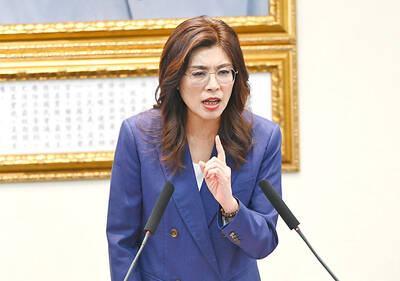
Chinese Nationalist Party (KMT) Chairwoman Cheng Li-wun (鄭麗文) yesterday briefed her party’s Central Standing Committee regarding her scheduled visit to the US between Monday next week and June 16, saying that her purpose would be to persuade the US that the Republic of China (ROC) Constitution was a “one China” constitution that would foster stable and peaceful cross-strait relations. The ROC Constitution is the most important defense for all Taiwanese citizens, as it upholds our democracy and has contributed to our robust economy, which aligns with international and US interests, she said. “We would not be troublemakers and drag the US under,”


 RSS
RSS