


The indictment of first lady Wu Shu-jen (吳淑珍) on corruption and forgery charges in connection with the handling of the president's state affairs fund has sent a political shockwave throughout the country.
President Chen Shui-bian (
Wu has come under fire since May over a spate of allegations ranging from political improprieties to financial irregularities.
Although last month she was cleared of any wrongdoing in connection with Sogo Department Store's controversial transfer of operational control, her indictment on corruption and forgery charges on Friday raises the issue of the first lady's place in governmental affairs.
Wu, who has charmed the public with her down-to-earth straightforwardness, was considered a political asset when Chen was elected to the presidency in 2000.
She has since turned into a liability for Chen, however, with some criticizing her for having too much influence on policy.
It is an open secret that the couple disagreed over the replacement of then Tainan County commissioner Mark Chen (
President Chen had originally planned to recruit Mark Chen to head the National Science Council.
While President Chen had wanted Mark Chen's deputy to take over the commissioners' position left vacant, Wu preferred Su Huan-chih (
Mark Chen later turned down the offer and decided to complete his term.
In a phone interview with the Taipei Times yesterday, Su said he believed Wu is innocent, taking into account Wu's family background.
Born into a well-off family in Madou (麻豆), Tainan County, in 1952, Wu did not know her life would change so dramatically after she started dating Chen in college.
Despite her family's objections, Wu married the then impoverished Chen in February 1975.
While the couple thought they would live a peaceful life with Chen practicing law, the 1979 "Kaohsiung Incident" altered their destiny and changed the course of Taiwan's democracy movement.
Wu encouraged Chen to commit himself to Taiwan's democratic development and supported his volunteering to defend Huang Hsin-chieh (
Chen Shui-bian quit his law practice to enter politics in 1981 when he was elected as a Taipei City councilor.
In 1985, Chen Shui-bian lost a Tainan County commissioner election and shortly thereafter Wu was paralyzed from the waist down after being repeatedly run over by a truck in an assassination attempt whose perpetrator was never found.
In 1986, not long after Wu was discharged from hospital and at a time when she desperately needed the support of her family, Chen Shui-bian was sentenced to a year in prison for libel for publishing an article in the pro-democracy Formosa magazine in which he claimed that later New Party lawmaker Elmer Feng's (
That same year, Wu ran in the legislative election and won. When Chen Shui-bian was released in February 1987, he served as Wu's legislative assistant until he himself was elected as a legislator in 1989.
Describing Wu as a direct, passionate and optimistic woman, DPP Legislator Lan Mei-chin (
"I'm sure she knows where to draw the line," she said.
Lan is the wife of former national policy adviser to the President Huang Tien-fu (
Lan has developed a close relationship with Wu since both of their husbands were sent to jail in 1986.
Lan said she was most impressed by Wu's courage in the face of illness.
"I remember one time after her tragic accident, she told me not to cry when I saw how she suffered," Lan said.
Former senior adviser to the president Wu Li-pei (

The Ministry of Finance this afternoon announced the winning numbers for the March-April uniform invoice lottery. The winning number for the NT$10 million (US$318,060) special prize is 19531471, and the winning number for the NT$2 million grand prize is 85941329. Three numbers were drawn for the NT$200,000 first prize: 07225810, 20231230 and 83518781. Those with receipts matching the last seven digits of any of the first-prize numbers will win the NT$40,000 second prize, while those matching the last six digits will win the NT$10,000 third prize. Those whose receipts match the last five digits of the first-prize numbers can claim the NT$4,000 fourth prize,
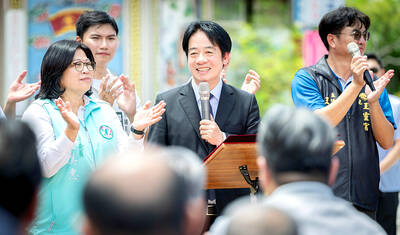
SIX SUBSIDIES: The monthly allowance for older farmers is to increase to NT$10,000, and NT$5,000 is to be given to homemakers under the national pension system, Lai said The government is to implement major welfare policies for disadvantaged groups, including raising the monthly allowance for older farmers to NT$10,000 and providing homemakers with NT$5,000 per month, President William Lai (賴清德) said yesterday. Lai made the remarks during a visit to Wangling Temple in Chiayi County, saying that the planned increases were being introduced amid economic growth and an increase in tax revenue. Touting a policy, in which the government plans to provide a monthly allowance of NT$5,000 for every child under the age of 18 in a bid to address Taiwan’s low birthrate, Lai said that if received for the
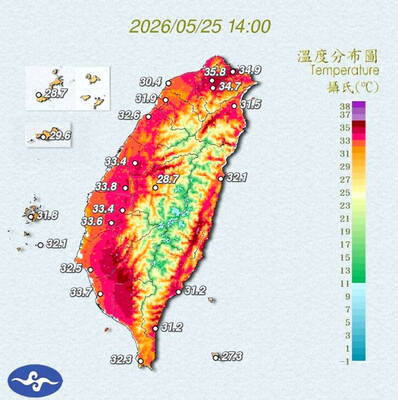
STAY COOL: The HPA recommended that people stay hydrated, use air-conditioning or fans while indoors, wear loose-fitting clothes and walk in the shade while outdoors Employers must implement measures such as installing cooling equipment, and providing drinking water and rest breaks for outdoor workers starting from Monday next week, the Taipei Department of Labor said on Sunday. Employers who fail to comply could face fines of NT$30,000 to NT$300,000 under the Occupational Safety and Health Act (職業安全衛生法), the department said. Businesses in Taipei employing fewer than 100 workers, as well as registered self-employed workers with labor insurance coverage, could receive on-site assessments and guidance from occupational safety consultants to help them apply for central government subsidies to implement or improve heat-protection measures, it said. Under the Ministry of

NATIONAL SECURITY: Authorities are working to confirm the identities of the military personnel involved and investigating possible illegal conduct and regulatory violations Authorities are probing possible national security implications after Kinmen police and immigration officers on Sunday found a Chinese woman allegedly posing as a tourist while engaging in prostitution involving more than 10 military personnel. The woman, surnamed Chen (陳), has since been deported, authorities said, adding that investigators are still working to confirm the identities of those implicated, as the records only listed code names and aliases. The case stemmed from a report received by the Kinmen District Prosecutors’ Office on Friday last week from the Jinhu Precinct of the Kinmen County Police Bureau. On Sunday, police, along with the National Immigration


 RSS
RSS