


The Environmental Protection Administration (EPA) and the British Trade and Cultural Office (BTCO) in Taiwan yesterday jointly addressed the potentially dire consequences of global climate change.
At a press conference held at the EPA headquarters in Taipei both organizations focused on the conclusions of the Stern Review published in London last month.
The author, Nicholas Stern, head of the UK Government Economic Service, was commissioned by British Chancellor of the Exchequer Gordon Brown to conduct a study correlating global climate change and its impact on the world economy.
BTCO Director Michael Reilly said the review presents "overwhelming" evidence about the reality of climate change and its potential impact but it noted that there remains time to prevent the worst scenarios from happening if action is taken immediately.
According to Reilly, the review estimated that the cost of global climate change could reach the equivalent of 5 percent of global GDP each year. When factoring in the impact of global climate change on human life and the environment, global GDP losses could exceed 20 percent annually.
"In contrast, the cost of action to reduce greenhouse gas emissions to avoid the worst impact of climate change can be limited to around 1 percent of global GDP each year," he said.
Besides the consequences, the review listed three recommendations that governments could implement to handle climate change including setting a carbon-pricing policy, encouraging the development and consumption of low-carbon and high-efficiency products and taking action to remove barriers to energy efficiency.
Reilly also made the point in his presentation that the goal of lowering carbon dioxide emissions is not incompatible with economic growth.
In the UK, for example, the low-carbon industry has helped generate 230,000 jobs. Globally, two million jobs have been created due to the recent growth of the green industry.
Reilly went on to mention how a number of successful companies around the world, such as British Petroleum (BP) and IBM, had witnessed profit growth thanks to measures taken to reduce to greenhouse gas emissions.
At the same event EPA minister Chang Kow-lung (
The bill is now set to be passed in the Legislative Yuan, Chang said, adding that Taiwan will become the first of the non-signatories of the Kyoto Protocol to pass a bill aimed at reducing carbon dioxide emissions.
Global climate change has already begun to affect Taiwan, Chang said.
For example, the mosquitoes responsible for the spread of dengue fever were previously found mainly in regions of Taiwan located below the Tropic of Cancer. Now they are also found above the Tropic of Cancer.
"Global climate change is no longer only an environmental issue," Chang said, "It is an issue of social justice as the poor and the weak will be directly affected by it."

FUKUOKA SITUATION: Japanese media reported that the pathogen is expected to be identified by the summer, while the CDC downplayed the idea that it was hMPV A “mysterious cold-like illness” reported in Japan’s Fukuoka Prefecture does not seem to be a new disease, but Japanese authorities have been asked about the situation, the Centers for Disease Control (CDC) said yesterday. The Fukuoka Prefectural Medical Association on Wednesday told a news conference that a “mystery cold” that has become a hot topic on social media is “highly likely to be caused by some kind of viral infection,” Japan’s KBC News reported. “Many people are experiencing symptoms starting with a sore throat, followed by a runny nose, phlegm and a severe cough,” KBC News reported, citing association officials. Health authorities are

Nvidia Corp CEO Jensen Huang (黃仁勳) arrived in Taiwan yesterday ahead of upcoming AI and technology events, saying he plans to meet with clients and Taiwan Semiconductor Manufacturing Co Chairman C.C. Wei (魏哲家) during his visit. After landing at Taipei Songshan Airport, Huang posed for photos with fans and handed out Yakult drinks to reporters and supporters waiting at the scene, saying he has “a lot to do” during the trip. Asked about reports that Nvidia’s planned headquarters site in Taipei’s Beitou Shilin Technology Park could break ground on May 27, Huang said that if the company holds an event, he would

The Ministry of Finance this afternoon announced the winning numbers for the March-April uniform invoice lottery. The winning number for the NT$10 million (US$318,060) special prize is 19531471, and the winning number for the NT$2 million grand prize is 85941329. Three numbers were drawn for the NT$200,000 first prize: 07225810, 20231230 and 83518781. Those with receipts matching the last seven digits of any of the first-prize numbers will win the NT$40,000 second prize, while those matching the last six digits will win the NT$10,000 third prize. Those whose receipts match the last five digits of the first-prize numbers can claim the NT$4,000 fourth prize,
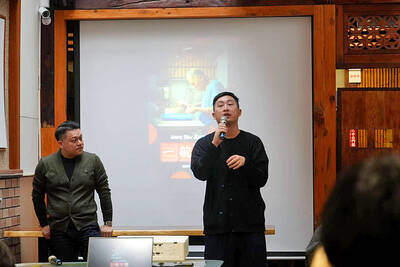
Taiwan Travelogue (臺灣漫遊錄), which earlier this week became the first Taiwanese novel to win the International Booker Prize, is to be adapted into a television series through a Taiwan-Japan coproduction, producer Chang Chen-yu (張辰漁) said yesterday. Chang, a producer at World Softest Production Film Co, wrote on Facebook that the company had been searching for projects with international appeal that retain a strong Taiwanese identity after colleagues and Japanese partners strongly recommended the novel. After reading the book, Chang said he immediately decided to pursue the screen rights. “A great story has the power to transcend time and borders, and connect countless people,”


 RSS
RSS