


A private constitutional reengineering group yesterday unveiled its first version of proposed constitutional amendments, which would give the public the ability to initiate future constitutional revisions and adopt a two-house legislative system.
Currently, only the legislature or the president can initiate constitutional revisions.
The group did not make a recommendation on whether Taiwan should have a presidential or parliamentary system, and avoided the issues of the national title, flag and anthem.
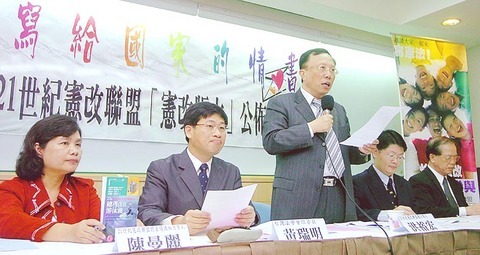
PHOTO: LIU HSIN-DE, TAIPEI TIMES
Houng Yu-houng (洪裕宏), the convener of the Constitutional Reform Alliance, said that the proposed version is not final, and that the alliance welcomes comments from the public.
In a bid to avoid inciting ideological controversy, Houng said the version retains a definition of territorial boundaries that is somewhat obscure as "the area in which the Constitution has power."
The Constitution defines the nation's territory as that within "existing national boundaries" and an interpretation by the Council of Grand Justices in 1993 failed to more precisely define the politically sensitive issue.
The alliance's draft stipulates that constitutional revisions can be introduced by the legislative branch or the people, and that the Constitution can be amended partially or entirely.
The alliance also proposed to adopt a bicameral legislative system consisting of the Senate and House of Representatives, similar to the US system.
The House of Representatives would have 150 to 200 seats and the Senate about 50 seats.
Members of the House of Representatives would be elected from special municipalities, counties, and cities by popular vote and would serve four-year terms. Members would also include Aboriginal representatives. At-large members would be allocated in proportion to the percentage of votes each party garners.
Member of the Senate would be elected from representatives of special municipalities, counties, cities and Aboriginal areas to serve four-year terms. Senators would not be elected by popular vote but by their councils, or by Aboriginal tribes for Aboriginal representatives.
The proposal did not recommend whether the government should be a presidential or parliamentary system, because alliance members failed to see eye to eye on the issue. Instead, the alliance made two alternate proposals for either type of government.
Under its proposal for a parliamentary system, the president would be the chief of state and serve a six-year term. The president would be elected by a college of representatives composed of the Senate, House of Representatives and councilors of special municipalities, counties and cities.
The Senate leader would take over the presidency if the president could not perform his or her duties. If the Senate leader were incapacitated, the head of the House of Representatives would be the next person in line to assume power.
The premier would be the head of the government and be elected by the House of Representatives and appointed by the president. The vice premier and Cabinet officials would be recommended by the premier and appointed by the president.
Under the alliance's proposal for a presidential system, the president would be the chief of state and head of the government.
The president and vice president would be elected by popular vote and serve four-year terms.
The vice president would assume the office of the presidency if the president was not able to perform his or her duties or the office was vacant. If both the president and vice president were not able to carry out their duties or their offices were vacant, the parliament would make a law to regulate who should take over the helm. The Cabinet would be appointed by the president with the approval of parliament.
Presidential Office Secretary-General Mark Chen (
"Constitutional reform should not be a zero-sum game among political parties nor become a power struggle between the pan-blue and pan-green camps," he said. "As a role model for emerging democracies, we don't have any reason to be inactive when most countries are aggressively pushing constitutional re-engineering projects."

Considering that most countries issue more than five denominations of banknotes, the central bank has decided to redesign all five denominations, the bank said as it prepares for the first major overhaul of the banknotes in more than 24 years. Central bank Governor Yang Chin-lung (楊金龍) is expected to report to the Legislative Yuan today on the bank’s operations and the redesign’s progress. The bank in a report sent to the legislature ahead of today’s meeting said it had commissioned a survey on the public’s preferences. Survey results showed that NT$100 and NT$1,000 banknotes are the most commonly used, while NT$200 and NT$2,000

The Centers for Disease Control (CDC) yesterday reported the first case of a new COVID-19 subvariant — BA.3.2 — in a 10-year-old Singaporean girl who had a fever upon arrival in Taiwan and tested positive for the disease. The girl left Taiwan on March 20 and the case did not have a direct impact on the local community, it said. The WHO added the BA.3.2 strain to its list of Variants Under Monitoring in December last year, but this was the first imported case of the COVID-19 variant in Taiwan, CDC Deputy Director-General Lin Ming-cheng (林明誠) said. The girl arrived in Taiwan on

South Korea is planning to revise its controversial electronic arrival card, a step Taiwanese officials said prompted them to hold off on planned retaliatory measures, a South Korean media report said yesterday. A Yonhap News Agency report said that the South Korean Ministry of Foreign Affairs is planning to remove the “previous departure place” and “next destination” fields from its e-arrival card system. The plan, reached after interagency consultations, is under review and aims to simplify entry procedures and align the electronic form with the paper version, a South Korean ministry official said. The fields — which appeared only on the electronic form

The Ministry of Foreign Affairs (MOFA) is suspending retaliation measures against South Korea that were set to take effect tomorrow, after Seoul said it is updating its e-arrival system, MOFA said today. The measures were to be a new round of retaliation after Taiwan on March 1 changed South Korea's designation on government-issued alien resident certificates held by South Korean nationals to "South Korea” from the "Republic of Korea," the country’s official name. The move came after months of protests to Seoul over its listing of Taiwan as "China (Taiwan)" in dropdown menus on its new online immigration entry system. MOFA last week


 RSS
RSS