


Laser beams lit up the sky and blazing lanterns dotted the city as the 2006 Taipei Lantern Festival began at the Chiang Kai-shek Memorial yesterday, with tens of thousands of people gathering last night to celebrate the official mark of the end of the Lunar New Year holiday.
In celebration of the Year of the Dog, the festival's opening event told the story of Kokai, a boy from the Tao Aboriginal tribe of Lanyu, and his dog "Wang Wang" and their journey in search of Wang Wang's missing sister "Fu Fu."
At the end of the narrative, a 22m lantern swirled around at one end of the Chiang Kai-shek Memorial, blazing with colors and featuring depictions of Aboriginal song and dance. Surrounding lanterns featured 12 of the city's attractions, including the Taipei 101 skyscraper, the Miramar shopping mall and Yangmingshan.

PHOTO: CHANG CHUNG-YI, TAIPEI TIMES
Good weather yesterday attracted a large crowd to the memorial long before the event began. A long line had formed at 9am for free hand-held dog lanterns provided by the Taipei City Government.
"The design of this year's lantern is cute, and I think this would make a very nice memento for the Year of the Dog," said one girl surnamed Huang, who waited for an hour to receive her lantern.
There will be a lantern show every 30 minutes nightly between 7pm and 11pm during the festival, which runs until Feb. 19.
Lantern festivals began in other parts of the country yesterday. The 2006 Taiwan Lantern Festival was held in Tainan City, with a lantern narrative entitled "Pan Hu Recreates the Heavens," while President Chen Shui-bian (
"We should give Hsieh credit for contributing to the development of Kaohsiung ... My friendship with Hsieh remains the same whether he is in the government or not," Chen said.
In Taichung, Snoopy was featured as a lantern theme for the city's Lantern Festival, with free hand-held Snoopy lanterns a popular draw.
The chaotic Yenshui Beehive Rockets Festival in Yenshui Township (鹽水), Tainan County, meanwhile, attracted a large crowd dressed to protect themselves against injury by the large number of fireworks that were fired at statues of local deities in palanquins.

Fast food chain McDonald's is to raise prices by up to NT$5 on some products at its restaurants across Taiwan, starting on Wednesday next week, the company announced today. The prices of all extra value meals and sharing boxes are to increase by NT$5, while breakfast combos and creamy corn soup would go up by NT$3, the company said in a statement. The price of the main items of those meals, if ordered individually, would remain the same. Meanwhile, the price of a medium-sized lemon iced tea and hot cappuccino would rise by NT$3, extra dipping sauces for chicken nuggets would go up
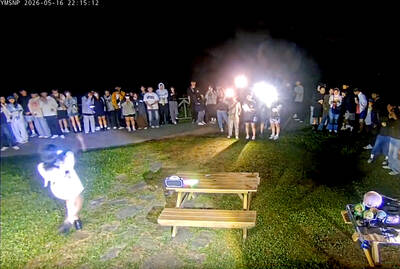
Yangmingshan National Park’s Qingtiangang (擎天崗) nature area has gone viral after a park livestream camera observed a couple in the throes of intimate congress, which was broadcast live on YouTube, drawing large late-night crowds and sparking a backlash over noise, bright lights and disruption to wildlife habitat. The area’s livestream footage appeared to show a couple engaging in sexual activity on a picnic table in the park on Friday last week, with the uncensored footage streamed publicly online. The footage quickly spread across social media, prompting a tide of visitors to travel to the site to “check in” and recreate the

Minister of Digital Affairs Lin Yi-ching (林宜敬) yesterday cited regulatory issues and national security concerns as an expert said that Taiwan is among the few Asian regions without Starlink. Lin made the remarks on Facebook after funP Innovation Group chief executive officer Nathan Chiu (邱繼弘) on Friday said Taiwan and four other countries in Asia — China, North Korea, Afghanistan and Syria — have no access to Starlink. Starlink has become available in 166 countries worldwide, including Ukraine, Malaysia, the Philippines and Vietnam, in the six years since it became commercial, he said. While China and North Korea block Starlink, Syria is not
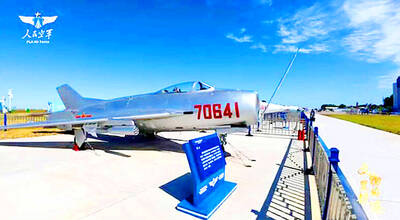
GROUNDED: A KMT lawmaker proposed eliminating drone development programs and freezing funding for counterdrone systems, despite China’s adoption of the technology China has deployed attack drones at air bases near the Taiwan Strait in a strategy aimed at overwhelming Taiwan’s air defense systems through saturation attacks, the Mainland Affairs Council (MAC) said. The council’s latest quarterly report on China said that satellite imagery and open-source intelligence indicate that the Chinese People’s Liberation Army (PLA) had converted retired J-6 fighter jets into J-6W drones, which the PLA has stationed at six air bases near Taiwan, five in China’s Fujian Province and one in Guangdong Province. The report cited J. Michael Dahm, a senior fellow at the US-based Mitchell Institute, as saying that China has


 RSS
RSS