


The political future of the People First Party (PFP) is facing an increasingly crucial test, with more of its members holding public office planning to switch allegiance to the Chinese Nationalist Party (KMT).
So far, nine PFP legislators have left their party and joined the KMT, including the four legislators -- Lee Yung-ping (
PFP Legislator Kao Su-po (高思博) indicated that same day that he would join the KMT before the legislature opens its next session. Two days earlier, PFP Legislator Lin Yu-fang (林郁方) confirmed that he had switched allegiance to the KMT.
During the past year, four other legislators -- Lee Ching-hua (
Taipei City Councilor Wang Hsin-yi (
After the latest wave of defections, the KMT now controls 85 legislative seats, compared with 26 for the PFP, 88 for the Democratic Progressive Party (DPP), 12 for the Taiwan Solidarity Union and eight for the Non-Partisan Solidarity Union.
A new regulation announced by the KMT in January is believed to have had a "magnetic effect" on PFP members by requiring all KMT members seeking public office through party primaries and elections to have been a party member for at least the last four months.
Lee Ching-an has already announced her intention to seek the KMT nomination for the Taipei mayoral election at the end of this year. Chiu is keeping the possibility open of his being a candidate in the Kaohsiung mayoral election.
The others said they left the PFP mainly to comply with the wishes of their supporters who have been anxious for a merger between the KMT and the PFP.
An even stronger magnetic force is seen in the new leadership provided by Taipei Mayor Ma Ying-jeou (
Media reports in the past few days said that five more PFP public officials might quit thee party and join the KMT after the Lunar New Year holiday.
Some core members of the PFP still remaining in the party have brushed aside the walkouts as "nothing unusual in politics," while others have acknowledged that the series of departures by PFP legislators may seriously affect future cooperation with the KMT.
Some radical PFP members have even suggested that the PFP should support a draft law by the DPP legislative caucus that would ask the KMT to return its "inappropriately obtained" party assets to the national coffers.
Analysts have pointed out that the PFP is facing a crucial test on whether the party would remain a political force to be reckoned with after the 1997 legislative elections or disappear from the political scene.
With the number of seats in the legislature to be slashed by half in the 2008 elections from the current 225 seats, the new electoral system of "single constituency, two votes," with each voter casting one vote for his favored candidate and another vote for his favored political party, will place a small political party like the PFP at a serious disadvantage.
Meanwhile, the KMT has adopted a low profile about the new blood that has joined the party. Ma has welcomed the newcomers, but said he would not encourage more PFP members to follow suit.
KMT legislators appear reluctant to discuss how the PFP walkouts would affect future cooperation between the two parties in the legislature and during elections.

FUKUOKA SITUATION: Japanese media reported that the pathogen is expected to be identified by the summer, while the CDC downplayed the idea that it was hMPV A “mysterious cold-like illness” reported in Japan’s Fukuoka Prefecture does not seem to be a new disease, but Japanese authorities have been asked about the situation, the Centers for Disease Control (CDC) said yesterday. The Fukuoka Prefectural Medical Association on Wednesday told a news conference that a “mystery cold” that has become a hot topic on social media is “highly likely to be caused by some kind of viral infection,” Japan’s KBC News reported. “Many people are experiencing symptoms starting with a sore throat, followed by a runny nose, phlegm and a severe cough,” KBC News reported, citing association officials. Health authorities are

Nvidia Corp CEO Jensen Huang (黃仁勳) arrived in Taiwan yesterday ahead of upcoming AI and technology events, saying he plans to meet with clients and Taiwan Semiconductor Manufacturing Co Chairman C.C. Wei (魏哲家) during his visit. After landing at Taipei Songshan Airport, Huang posed for photos with fans and handed out Yakult drinks to reporters and supporters waiting at the scene, saying he has “a lot to do” during the trip. Asked about reports that Nvidia’s planned headquarters site in Taipei’s Beitou Shilin Technology Park could break ground on May 27, Huang said that if the company holds an event, he would

The Ministry of Finance this afternoon announced the winning numbers for the March-April uniform invoice lottery. The winning number for the NT$10 million (US$318,060) special prize is 19531471, and the winning number for the NT$2 million grand prize is 85941329. Three numbers were drawn for the NT$200,000 first prize: 07225810, 20231230 and 83518781. Those with receipts matching the last seven digits of any of the first-prize numbers will win the NT$40,000 second prize, while those matching the last six digits will win the NT$10,000 third prize. Those whose receipts match the last five digits of the first-prize numbers can claim the NT$4,000 fourth prize,
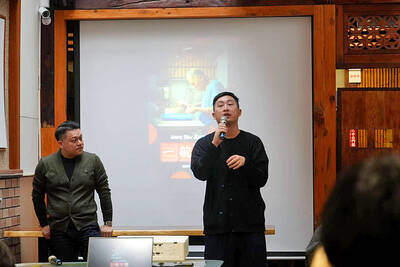
Taiwan Travelogue (臺灣漫遊錄), which earlier this week became the first Taiwanese novel to win the International Booker Prize, is to be adapted into a television series through a Taiwan-Japan coproduction, producer Chang Chen-yu (張辰漁) said yesterday. Chang, a producer at World Softest Production Film Co, wrote on Facebook that the company had been searching for projects with international appeal that retain a strong Taiwanese identity after colleagues and Japanese partners strongly recommended the novel. After reading the book, Chang said he immediately decided to pursue the screen rights. “A great story has the power to transcend time and borders, and connect countless people,”


 RSS
RSS