


Despite the shadow of the deadly avian flu virus, this year's Taipei Birdwatching Fair kicked off yesterday at Guandu Nature Park, as birdwatching groups and conservationists from 10 countries worldwide joined the two-day event to promote the joys of birdwatching and assure the public of the safety of such activities.
The panic over the avian flu, however, has dissuaded many bird lovers from participating in the event this year and caused a 70-percent slump in the crowd from last year.
While disappointed by the number of participants this year, Liu Hsin-bai (劉新白), director-general of the Wild Bird Society of Taipei (WBST), remained passionate about the annual fair hosted by the organization as he greeted participants and patiently clarified some "unjustified fears" and "misunderstandings" about birdwatching to the media.
"Birdwatchers keep dozens of meters away from wild birds, and so it is almost impossible to be infected with the avian flu ? It is actually safer and healthier to participate in such outdoor activities than to stay home," he said.
Liu said that the Agriculture Council and several birdwatching societies in Taiwan have been working together since 1997 to monitor the activities of migratory birds and take dropping samples. So far they haven't found any evidence of the avian flu virus in wild birds.
"We are doing our job as front-line monitors, and I think it is the government's responsibility to take preventive measures, provide correct information, and not to discourage people from attending activities such as these," he added.
Echoing Liu's comments, Siraprapa Boonlue, a representative from the Bird Conservation Society of Thailand, said although there were two to three human deaths from the avian flu last year in northern Thailand, birdwatching activities have continued unaffected in national parks and wetlands.
"We work with universities to monitor wild birds, and hold seminars and training to disseminate correct information," she said.
In Israel, which has a reputation as one of the best birdwatching destinations with over 540 species migrating to the country every year, the avian flu even helped boost birdwatching activities.
"We [ecologists and ornithologists] spoke to the press and managed to make things clear very early ? We explained that there is absolutely no danger involved in watching wild birds, and we even managed to promote [birdwatching events] through the media," Yoav Perlman, an ornithologist from the Israel Ornithological Center, told the Taipei Times.
Willie Foo, secretary of the bird group at the Nature Society of Singapore, said the Singaporean government has put a great deal of effort into preventing an avian flu outbreak by applying strict rules to the poultry industry and even buying back domestic birds from private poultry farms.
"But birdwatching is different because it is very unlikely that birdwatchers will get infected with the flu, and we will continue to provide the public with correct information," he said.
About 1 million migratory birds fly to Taiwan every year, and the Taipei Birdwatching Fair had attracted more than 6,000 visitors on average in previous years. The 2005 Taipei Birdwatching Fair ends today, but related events run until December. For more information, visit the WBST Web site at www.wbst.org.tw, Guandu Nature Park at www.gd_park.org.tw or call 02-2858-7471.
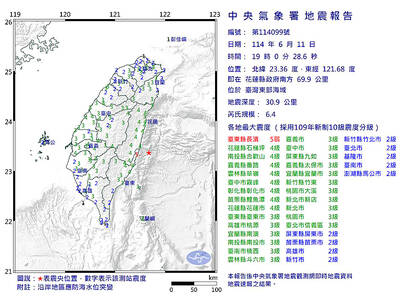
A magnitude 6.4 earthquake struck off the coast of Hualien County in eastern Taiwan at 7pm yesterday, the Central Weather Administration (CWA) said. The epicenter of the temblor was at sea, about 69.9km south of Hualien County Hall, at a depth of 30.9km, it said. There were no immediate reports of damage resulting from the quake. The earthquake’s intensity, which gauges the actual effect of a temblor, was highest in Taitung County’s Changbin Township (長濱), where it measured 5 on Taiwan’s seven-tier intensity scale. The quake also measured an intensity of 4 in Hualien, Nantou, Chiayi, Yunlin, Changhua and Miaoli counties, as well as

STAY AWAY: An official said people should avoid disturbing snakes, as most do not actively attack humans, but would react defensively if threatened Taitung County authorities yesterday urged the public to stay vigilant and avoid disturbing snakes in the wild, following five reported snakebite cases in the county so far this year. Taitung County Fire Department secretary Lin Chien-cheng (林建誠) said two of the cases were in Donghe Township (東河) and involved the Taiwan habus, one person was bit by a Chinese pit viper near the South Link Railway and the remaining two were caused by unidentified snakes. He advised residents near fields to be cautious of snakes hiding in shady indoor areas, especially when entering or leaving their homes at night. In case of a

Credit departments of farmers’ and fishers’ associations blocked a total of more than NT$180 million (US$6.01 million) from being lost to scams last year, National Police Agency (NPA) data showed. The Agricultural Finance Agency (AFA) said last week that staff of farmers’ and fishers’ associations’ credit departments are required to implement fraud prevention measures when they serve clients at the counter. They would ask clients about personal financial management activities whenever they suspect there might be a fraud situation, and would immediately report the incident to local authorities, which would send police officers to the site to help, it said. NPA data showed

ENERGY RESILIENCE: Although Alaska is open for investments, Taiwan is sourcing its gas from the Middle East, and the sea routes carry risks, Ho Cheng-hui said US government officials’ high-profile reception of a Taiwanese representative at the Alaska Sustainable Energy Conference indicated the emergence of an Indo-Pacific energy resilience alliance, an academic said. Presidential Office Secretary-General Pan Men-an (潘孟安) attended the conference in Alaska on Thursday last week at the invitation of the US government. Pan visited oil and gas facilities with senior US officials, including US Secretary of the Interior Doug Burgum, US Secretary of Energy Chris Wright, Alaska Governor Mike Dunleavy and US Senator Daniel Sullivan. Pan attending the conference on behalf of President William Lai (賴清德) shows a significant elevation in diplomatic representation,


 RSS
RSS