


■ Diplomacy
Team heads to Honduras
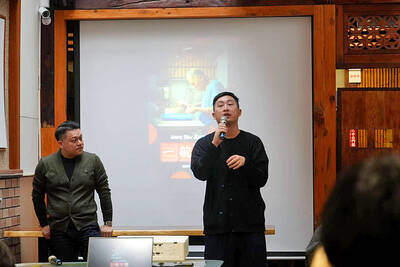
After a month-long search for three representatives to be sent to Honduras to inspect projects in the region, the International Cooperation and Development Fund (ICDF) yesterday announced that Kung Kuo-wei (宮國威), a teacher familiar with Latin American affairs, Lin Shih-yin (林詩音), an employee at Taiwan Fertilization Co and Wu Chia-yin (吳佳音), a media representative, had been chosen out of 149 applicants. The group, headed by author Wu Dan-ru (吳淡如), left on a 10-day trip to Honduras yesterday. ICDF secretary-general Chen Cheng-chung (陳正忠) said that this marked the first time for a civic group to assess an ICDF project. Chen hoped that through the group's trip, the public would understand the importance of development assistance abroad.
■ Health
Officials warn on smuggling
Quarantine officials warned the public yesterday not to smuggle animals and plants from China into Taiwan and urged people to refuse to purchase a product if its origin cannot be determined, as reinforced measures were taken to prevent infectious diseases from being brought into the country. The Bureau of Animal and Plant Health Inspection and Quarantine under the Council of Agriculture recently killed 20 dogs smuggled from China in an effort to prevent rabies from entering Taiwan, bureau officials said. Rabies is endemic in China but Taiwan is rabies-free. According to bureau statistics, a total of 96 dogs smuggled from China had been seized up to the end of this month. The bureau also called on people to inform officials of animal and plant smuggling activity by calling a telephone hot line at 0800-039-131.
■ Tourism
Official proposes exchange
Chinese National Tourism Administration Director Shao Qiwei (邵琪偉) yesterday proposed that Taipei's National Palace Museum enhance its exchanges with Beijing's Palace Museum to attract more Chinese tourists. Shao, who arrived in Taiwan the day earlier as the head of a 66-member delegation, made the proposal during a visit to the National Palace Museum, where a wealth of precious Chinese antiquities are displayed. Shao later visited Sun Yat-sen Memorial Hall and the holiday flower market in Taipei, located under the Chienkuo overpass. Shao was invited by the Taiwan Visitors Association to visit Taiwan in his capacity as president of the Chinese National Travel Association. Beijing announced earlier this year that it will allow more Chinese tourists to visit Taiwan and it is widely believed that Shao's visit is aimed at paving the way for this policy.
■ Infrastructure
Train tests to 300kph
A test train on the high-speed railway achieved 300kph, the highest test speed so far, over a distance of around 25km yesterday, the Taiwan High-Speed Rail Corp (THSRC) announced in a press release yesterday. The test took place on the Kueijen (歸仁) village section of the railway in Tainan County. THSRC officials said the tests are done mainly to check the trains' acceleration and braking systems, and their integration with the track, machinery and electronics system. When the new 345km railway is inaugurated, a trip from Taipei to Kaohsiung will take less than 90 minutes. The high-speed railway will form the backbone of western Taiwan's transport network and will connect eight metropolitan areas between the nation's two largest cities.

FUKUOKA SITUATION: Japanese media reported that the pathogen is expected to be identified by the summer, while the CDC downplayed the idea that it was hMPV A “mysterious cold-like illness” reported in Japan’s Fukuoka Prefecture does not seem to be a new disease, but Japanese authorities have been asked about the situation, the Centers for Disease Control (CDC) said yesterday. The Fukuoka Prefectural Medical Association on Wednesday told a news conference that a “mystery cold” that has become a hot topic on social media is “highly likely to be caused by some kind of viral infection,” Japan’s KBC News reported. “Many people are experiencing symptoms starting with a sore throat, followed by a runny nose, phlegm and a severe cough,” KBC News reported, citing association officials. Health authorities are

Nvidia Corp CEO Jensen Huang (黃仁勳) arrived in Taiwan yesterday ahead of upcoming AI and technology events, saying he plans to meet with clients and Taiwan Semiconductor Manufacturing Co Chairman C.C. Wei (魏哲家) during his visit. After landing at Taipei Songshan Airport, Huang posed for photos with fans and handed out Yakult drinks to reporters and supporters waiting at the scene, saying he has “a lot to do” during the trip. Asked about reports that Nvidia’s planned headquarters site in Taipei’s Beitou Shilin Technology Park could break ground on May 27, Huang said that if the company holds an event, he would

The Ministry of Finance this afternoon announced the winning numbers for the March-April uniform invoice lottery. The winning number for the NT$10 million (US$318,060) special prize is 19531471, and the winning number for the NT$2 million grand prize is 85941329. Three numbers were drawn for the NT$200,000 first prize: 07225810, 20231230 and 83518781. Those with receipts matching the last seven digits of any of the first-prize numbers will win the NT$40,000 second prize, while those matching the last six digits will win the NT$10,000 third prize. Those whose receipts match the last five digits of the first-prize numbers can claim the NT$4,000 fourth prize,
Taiwan Travelogue (臺灣漫遊錄), which earlier this week became the first Taiwanese novel to win the International Booker Prize, is to be adapted into a television series through a Taiwan-Japan coproduction, producer Chang Chen-yu (張辰漁) said yesterday. Chang, a producer at World Softest Production Film Co, wrote on Facebook that the company had been searching for projects with international appeal that retain a strong Taiwanese identity after colleagues and Japanese partners strongly recommended the novel. After reading the book, Chang said he immediately decided to pursue the screen rights. “A great story has the power to transcend time and borders, and connect countless people,”


 RSS
RSS