


China's first white paper on democracy, published last Wednesday, was nothing more than "propaganda," and it actually tells the international community to stop daydreaming about democracy in China, officials and analysts said yesterday.
A private forum held by the Ministry of Foreign Affairs (MOFA) affiliated Taiwan Foundation for Democracy, discussed the recently published white paper, China analysts said the propaganda-style white paper revealed how little the Chinese authorities know about democracy, as it insisted on making a distinction between Western style democracy and that practiced in China.
The 74-page white paper, entitled Building of Political Democracy in China emphasized China's insistence on developing its own system of democracy as "the situations differ from one country to another, the paths the people of different countries take to win and develop democracy are different." The paper said that China's path is one of "socialist democracy with its own characteristics," which has "realized the Chinese people's demand to be masters of their own country."
MOFA Spokesperson Michel Lu (呂慶龍) yesterday said "the white paper is merely a piece of propaganda. It reflects its intention to create a theory on democracy to justify the demands from the outside world to open up to political democracy," the ministry spokesman said.
Ruan Ming (阮銘), a national policy adviser to the president said during the forum, "China's democracy white paper is actually very offensive in the sense that it tells the international community, which still hold hopes for democracy in China, to stop dreaming of such an idea."
Ruan said China's purpose in issuing the white paper is to strengthen Chinese President Hu Jintao's (胡錦濤) ambition to become a hegemon.
Ming Chu-cheng (
"The reason Hu found it possible to make his way to the top is because he has shown he has the nerve to kill people," Ming said, referring to Hu's record of ordering numerous bloody suppressions of Tibetans and Chinese dissidents.
"It is wrong to have any hope of Hu carrying out political reforms in China," Ming said, adding that the kind of democratic definition China claims in line with its own national and social characteristics is not true democracy at all.
Tung Li-wen (董立文), director of the Democratic Progressive Party's International Affairs Department, said the white paper revealed the worrying tendency that political reform in China is likely to be postponed, as well as beijing's attempt to build up of an "anti-democracy" discourse in the country.

Fast food chain McDonald's is to raise prices by up to NT$5 on some products at its restaurants across Taiwan, starting on Wednesday next week, the company announced today. The prices of all extra value meals and sharing boxes are to increase by NT$5, while breakfast combos and creamy corn soup would go up by NT$3, the company said in a statement. The price of the main items of those meals, if ordered individually, would remain the same. Meanwhile, the price of a medium-sized lemon iced tea and hot cappuccino would rise by NT$3, extra dipping sauces for chicken nuggets would go up
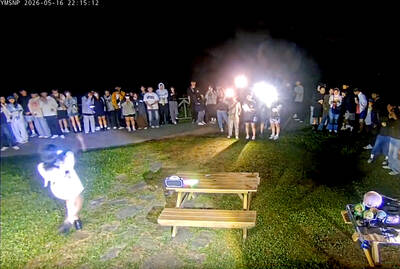
Yangmingshan National Park’s Qingtiangang (擎天崗) nature area has gone viral after a park livestream camera observed a couple in the throes of intimate congress, which was broadcast live on YouTube, drawing large late-night crowds and sparking a backlash over noise, bright lights and disruption to wildlife habitat. The area’s livestream footage appeared to show a couple engaging in sexual activity on a picnic table in the park on Friday last week, with the uncensored footage streamed publicly online. The footage quickly spread across social media, prompting a tide of visitors to travel to the site to “check in” and recreate the

Minister of Digital Affairs Lin Yi-ching (林宜敬) yesterday cited regulatory issues and national security concerns as an expert said that Taiwan is among the few Asian regions without Starlink. Lin made the remarks on Facebook after funP Innovation Group chief executive officer Nathan Chiu (邱繼弘) on Friday said Taiwan and four other countries in Asia — China, North Korea, Afghanistan and Syria — have no access to Starlink. Starlink has become available in 166 countries worldwide, including Ukraine, Malaysia, the Philippines and Vietnam, in the six years since it became commercial, he said. While China and North Korea block Starlink, Syria is not
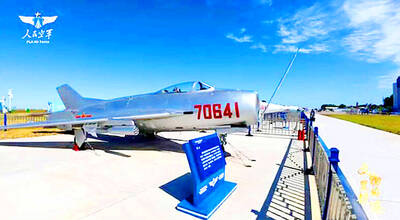
GROUNDED: A KMT lawmaker proposed eliminating drone development programs and freezing funding for counterdrone systems, despite China’s adoption of the technology China has deployed attack drones at air bases near the Taiwan Strait in a strategy aimed at overwhelming Taiwan’s air defense systems through saturation attacks, the Mainland Affairs Council (MAC) said. The council’s latest quarterly report on China said that satellite imagery and open-source intelligence indicate that the Chinese People’s Liberation Army (PLA) had converted retired J-6 fighter jets into J-6W drones, which the PLA has stationed at six air bases near Taiwan, five in China’s Fujian Province and one in Guangdong Province. The report cited J. Michael Dahm, a senior fellow at the US-based Mitchell Institute, as saying that China has


 RSS
RSS