


Given that the Democratic Prog-ressive Party's (DPP) candidate for the Taipei County commissioner position, Luo Wen-jia's (羅文嘉) "new DPP movement" is gaining ground, judging by Luo's rising popularity, the party has to face the scenario that the movement will not only be a campaign topic but also a real issue for it in the next phase of political reform, political analysts said.
Luo's "new DPP movement," which aims to rejuvenate the party's founding spirit and revitalize its core values of freedom, democracy, justice and integrity, has caused ripples in the DPP and elicited responses for and against the movement.
People opposed to the idea have called Luo a self-seeking politician who just wanted to boost his own election momentum, while supporters said it was a timely mechanism to scrutinize the maladies propgated over the past six years.
DPP Legislator Lee Wen-chung (李文忠) has launched a signature drive to solicit support for the campaign and about 70 lawmakers have endorsed Luo's reform proposal.
According to the internal poll conducted by Luo's campaign team, support for him apparently increased after the new DPP movement was proposed. Nonetheless, his top campaign strategist was not willing to make any rash connections by saying that it was all because of the new discourse.
"It is true that Luo's support went up significantly," acting Taipei County Commissioner Lin Hsi-yao (
"But we still wonder if it is because of Luo's wide exposure in the mass media or because of his new proposal. This needs to be observed for a while," he said.
Lin is Luo's campaign manager and is in charge of Luo's campaign schedule.
Seeing that Luo's election prospects are on the rise, DPP Chairman Su Tseng-chang (
Su promised to conduct reforms in the DPP at a rally celebrating the establishment of Luo's campaign headquarters on Saturday.
"As far as I know, as far as the DPP is concerned, whether other candidates should follow Luo's new DPP movement and take up the idea as part of their campaign platforms is still under eval-uation," Hsu Yung-ming (徐永明), a political analyst and a research fellow at Academia Sinica, said yesterday.
At present, several DPP candidates who are competing against Chinese Nationalist Party (KMT) nominees still need more solid elements to their campaigns -- including Taichung City mayoral candidate Lin Chia-lung (
"If the new DPP movement dominates the campaign and turns out to be an effective strategy, then this new political discourse will have much more influence than the original proposers expected and the DPP will have to deal with the discourse in a serious manner," Hsu said.
Although many people have spurned the new movement as nothing but a campaign gimmick, political commentator Yang Hsien-hung (楊憲宏) thinks of it as a typical model of the DPP's development, which is "progress, conflict and compromise."
"This is how the DPP grew up -- it thrives on the process of learning by trial and error," Yang said.
"Maybe Luo's proposal is like the flutter of a butterfly's wing, which might cause a most unexpected outcome that none could foresee," he said.
Given that integrity is the key element of this movement, Hsu said, the presidential candidates in 2008 will have to take up handling this problem, which will not be an easy task.
In this regard, Luo's opponent, the KMT candidate for Taipei County commissioner, Chou Hsi-wei (
"Therefore, Chen's reaction to the new DPP movement and his handling of Chou's aggression will become a significant factor determining the election result," Hsu said.
And if Luo wins the year-end election, the outcome also means that the Student Movement Generation can become the successors to the "Lawyer Generation" or "Kaohsiung Incident Generation," which referred to Chen, Premier Frank Hsieh (謝長廷) and Su.
Shih Cheng-feng (
"What people expect from the DPP will not only be that it replaces the KMT's rule," Shih said.
"People want to see the concrete contents of the reforms and their [DPP's] honest reflection upon mistakes and correcting them," he said.
"Otherwise, nothing can save the DPP from decay no matter how many new movements are launched," Shih said.
"These would only be considered as mere instruments for campaigning purposes, which will not bring the DPP and the people of Taiwan anywhere," he said.
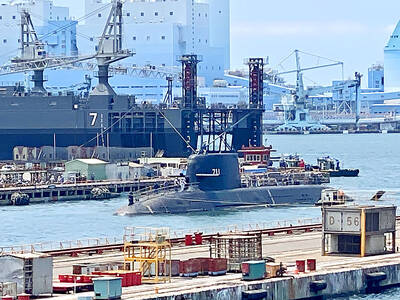
AGING: While Japan has 22 submarines, Taiwan only operates four, two of which were commissioned by the US in 1945 and 1946, and transferred to Taiwan in 1973 Taiwan would need at least 12 submarines to reach modern fleet capabilities, CSBC Corp, Taiwan chairman Chen Cheng-hung (陳政宏) said in an interview broadcast on Friday, citing a US assessment. CSBC is testing the nation’s first indigenous defense submarine, the Hai Kun (海鯤, Narwhal), which is scheduled to be delivered to the navy next month or in July. The Hai Kun has completed torpedo-firing tests and is scheduled to undergo overnight sea trials, Chen said on an SET TV military affairs program. Taiwan would require at least 12 submarines to establish a modern submarine force after assessing the nation’s operational environment and defense
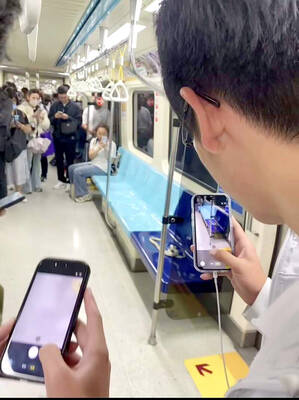
A white king snake that frightened passengers and caused a stir on a Taipei MRT train on Friday evening has been claimed by its owner, who would be fined, Taipei Rapid Transit Corp (TRTC) said yesterday. A person on Threads posted that he thought he was lucky to find an empty row of seats on Friday after boarding a train on the Bannan (Blue) Line, only to spot a white snake with black stripes after sitting down. Startled, he jumped up, he wrote, describing the encounter as “terrifying.” “Taipei’s rat control plan: Release snakes on the metro,” one person wrote in reply, referring
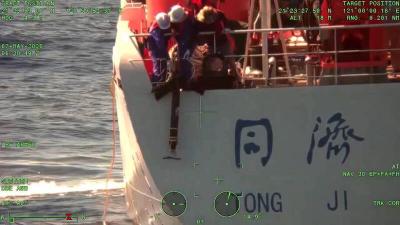
The coast guard today said that it had disrupted "illegal" operations by a Chinese research ship in waters close to the nation and driven it away, part of what Taipei sees a provocative pattern of China's stepped up maritime activities. The coast guard said that it on Thursday last week detected the Chinese ship Tongji (同濟號), which was commissioned only last year, 29 nautical miles (54km) southeast of the southern tip of Taiwan, although just outside restricted waters. The ship was observed lowering ropes into the water, suspected to be the deployment of scientific instruments for "illegal" survey operations, and the coast
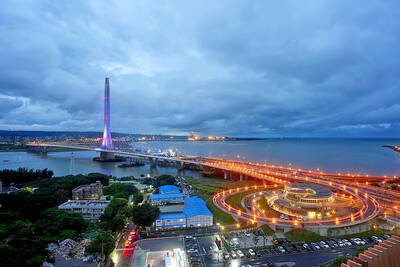
An inauguration ceremony was held yesterday for the Danjiang Bridge, the world’s longest single-mast asymmetric cable-stayed bridge, ahead of its official opening to traffic on Tuesday, marking a major milestone after nearly three decades of planning and construction. At the ceremony in New Taipei City attended by President William Lai (賴清德), Premier Cho Jung-tai (卓榮泰), Minister of Transportation and Communications Chen Shih-kai (陳世凱) and New Taipei City Mayor Hou Yu-ih (侯友宜), the bridge was hailed as both an engineering landmark and a long-awaited regional transport link connecting Tamsui (淡水) and Bali (八里)


 RSS
RSS