


The sharp increase in suicides and suicide attempts in recent years has triggered widespread concern.
In preparation for the opening of a national suicide-prevention center, social workers and psychiatric experts gathered yesterday to discuss strategies.
According to statistics provided at the seminar, the number of suicides nationwide has been steadily rising since 1993, from 6.4 suicides per 100,000 people to 14.16 per100,000 people. Suicide is now the ninth largest cause of death in the nation.
The statistics show that while 3,000 or so people succeed in committing suicide every year -- another 30,000 try.
Cheng Tai-an (鄭泰安), a professor at National Taiwan University's College of Public Health, said a nationwide suicide-prevention center has been in the works since 2003 but the details have to be finalized.
"Prevention of suicide should be the top priority of public health services in Taiwan, and strategies should be settled as soon as possible," Cheng said.
Making reference to his expertise in suicide-preventative strategies used in Europe and the US, Cheng said the strategies used in Finland and England would be very valuable, since those places have about about the same population as Taiwan.
One important factor is the government's restrictions on substances that are often used in suicide bids, Cheng said, which would include pesticides and charcoal.
Cheng stressed the importance of improving the quality of mental-health care, citing research that showed 80 to 100 percent of people who have committed suicide suffered from a mental illness, particularly chronic depression.
"In Finland there are 1,000 psychiatric health-care workers for every 5 million people. In comparison, there are about the same number [of health-care workers] for Taiwan's entire population," Cheng said.
Other participants noted that each country has its own problems and resources.
"The effectiveness of suicide-prevention strategies depends a lot on each place, as each country has different resources and different needs," said Lee Ming-been (李明賓), president of the Taiwan Association against Depression.
Lee said decreasing the number of suicides should not be taken as an isolated goal but that experts in public health, mental health and psycho-social health should work together to address the issue.
"Suicide is not an isolated problem. It is an unfortunate end product of a process of psychiatric treatment," Lee said.
Lee said medical expertise should not be taken out of the equation when considering what suicide-prevention strategies should be offered, because mental illnesses can be very complicated.
The World Health Organization (WHO) has predicted that by 2020 suicide will be the ninth most likely cause of death worldwide. It has ranked suicide second among the top 10 "acute diseases and injuries."
Also see story:

EXCUSES: Beijing is using government and research vessels as a pretext to harass the nation and enter its EEZ, and engage in ‘hegemonic expansion,’ the coast guard said The Coast Guard Administration yesterday said it drove away Chinese oceanographic research vessel Xiang Yang Hong 22 (向陽紅33) from restricted waters after warning it that it was in Taiwan’s exclusive economic zone (EEZ). The Chinese vessel entered restricted waters off the coast of Yilan County’s Suao (蘇澳) at 11:35pm on Thursday, the coast guard said, adding that it dispatched the Lanyu patrol vessel and the boat PP-10077 to shadow the Chinese ship and issue radio warnings ordering it to leave. China has no sovereignty over waters off Taiwan’s east coast, Lanyu’s crew told Xiang Yang Hong 22 over the radio, and demanded

BAIT AND SWITCH: Allowing KMT-run counties to sell to China while the threat of abrupt cancelations hangs overhead is another form of coercion, officials said Beijing is using agricultural purchase offers announced during the Straits Forum to deepen Taiwan’s dependence on the Chinese market, a Taiwanese official said yesterday as they criticized the Taitung County commissioner’s participation in the initiative. During the Straits Forum held in Xiamen on Saturday, Chinese officials announced a sales and purchase agreement for agricultural products from some counties led by the Chinese Nationalist Party (KMT). Taitung County Commissioner Yao Ching-ling (饒慶鈴), who was barred from attending the event in person by the Mainland Affairs Council, participated via video. Under the agreement, China would purchase atemoyas, pomeloes, tea and grouper harvested in Taitung,
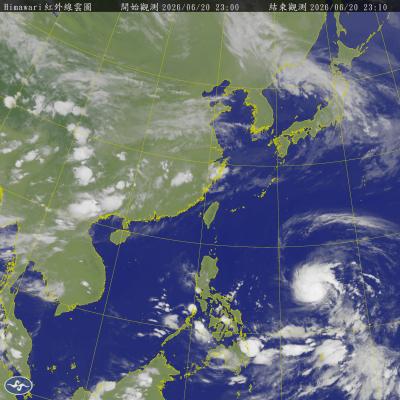
Tropical Storm Mekkhala is forecast to strengthen into a typhoon tomorrow and could come close enough to Taiwan later in the week to prompt a sea warning, the Central Weather Administration (CWA) said yesterday. As of 2 pm, the storm was located 1,870 kilometers southeast of Taiwan's southern tip and moving west- northwest at 23 km per hour. CWA forecaster Cheng Chieh-jen (鄭傑仁) said Mekkhala is expected to continue moving west-northwest through Tuesday under the influence of the Pacific high- pressure system before gradually turning north toward waters east of Taiwan or south of the Ryukyu Islands. The timing and angle of the

Four Taiwanese universities have been ranked among the world's top 200 institutions in the Quacquarelli Symonds (QS) World University Rankings for next year, the highest Taiwan has ever placed in the category, with National Taiwan University (NTU) achieving its best performance at 54th globally and 17th in Asia. The four Taiwanese institutions in the global top 200 are NTU (54th), National Tsing Hua University (142nd), National Yang Ming Chiao Tung University (177th) and National Cheng Kung University (191st), the rankings showed. All four universities achieved their highest-ever global rankings this year, QS data showed. National Cheng Kung University entered the top 200 for


 RSS
RSS