


A former senior US official suggested Taiwan should work to strengthen its communication mechanism with high-ranking US officials, and not rely solely on the American Insititute in Taiwan (AIT) as the medium to convey messages to the US government, according to a Central News Agency (CNA) article yesterday.
That way, Washington can better understand the Democratic Progressive Party (DPP) government and its efforts to promote such issues as the special arms procurement budget bill, former deputy secretary of state Richard Armitage said, according to CNA.
Armitage made the remarks during a meeting with President Chen Shui-bian (陳水扁), who was in Miami en route to Latin America. Aside from Armitage, Chen also received visits from a number of former high-ranking US officials during his transit in Miami.
According to the CNA report, Armitage said that part of the reason Taiwan-US relations were not so smooth was because the Bush administration did not know the DPP government nor the party's culture very well.
Because the US government had been dealing with Chinese Nationalist Party (KMT) government in the past, it didn't understand that DPP officials mostly had a history of being activists, and are very different from KMT officials, Armitage was reported as saying during his meeting with Chen.
Given that the current Bush administration group of officials in charge of cross-strait affairs is new, Armitage suggested Taiwanese government officials, including national security staff members, should establish a diverse and frequent coordination system. Dependence on AIT as Taiwan's sole channel of communication would not be very helpful if Taiwan wanted to form closer ties with the US government.
He said that the Bush administration, immediately after taking office, passed the arms procurement case in 2001 in an attempt to stabilize cross-strait relations, because the was concerned about China's attitude toward Taiwan after the DPP administration came to power.
To expedite the passage of the arms procurement package in the Legislative Yuan, moving the items from the special budget into the general budget would be a good way, Armitage said.
Armitage stressed that the DPP government should explain its efforts to promote the arms procurement package to the US government, so that it understands DPP government's intention to maintain a peaceful cross-strait relationship.
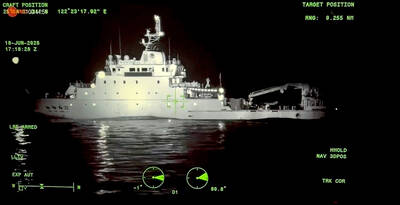
EXCUSES: Beijing is using government and research vessels as a pretext to harass the nation and enter its EEZ, and engage in ‘hegemonic expansion,’ the coast guard said The Coast Guard Administration yesterday said it drove away Chinese oceanographic research vessel Xiang Yang Hong 22 (向陽紅33) from restricted waters after warning it that it was in Taiwan’s exclusive economic zone (EEZ). The Chinese vessel entered restricted waters off the coast of Yilan County’s Suao (蘇澳) at 11:35pm on Thursday, the coast guard said, adding that it dispatched the Lanyu patrol vessel and the boat PP-10077 to shadow the Chinese ship and issue radio warnings ordering it to leave. China has no sovereignty over waters off Taiwan’s east coast, Lanyu’s crew told Xiang Yang Hong 22 over the radio, and demanded
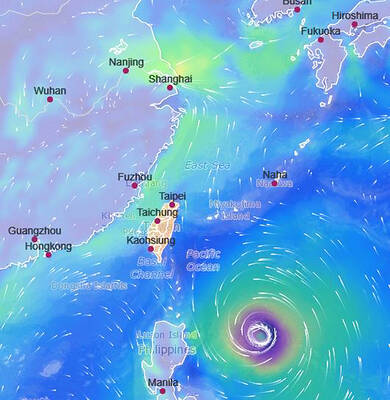
Typhoon Mekkhala is likely to come closest to Taiwan on Thursday, according to the Central Weather Administration (CWA), which forecast localized rain or thundershowers in western and northeastern parts of the country for that day. As of 2pm yesterday, the eye of the storm was 770km southeast of Oluanpi (鵝鑾鼻), the southernmost point of Taiwan, as it continued to move toward waters east of the Philippines, the agency said. Mekkhala was expected to become a severe typhoon last night, CWA forecaster Lai Hsin-kuo (賴欣國) said. A severe typhoon has maximum wind speeds of more than 184kph, compared with 118kph to 183kph for a
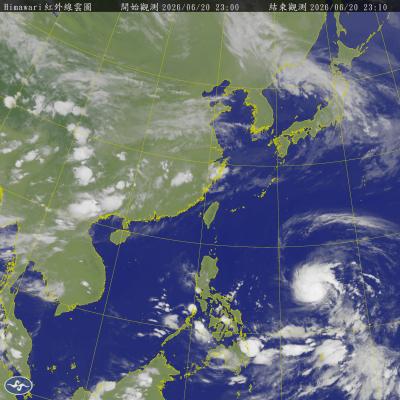
Tropical Storm Mekkhala is forecast to strengthen into a typhoon tomorrow and could come close enough to Taiwan later in the week to prompt a sea warning, the Central Weather Administration (CWA) said yesterday. As of 2 pm, the storm was located 1,870 kilometers southeast of Taiwan's southern tip and moving west- northwest at 23 km per hour. CWA forecaster Cheng Chieh-jen (鄭傑仁) said Mekkhala is expected to continue moving west-northwest through Tuesday under the influence of the Pacific high- pressure system before gradually turning north toward waters east of Taiwan or south of the Ryukyu Islands. The timing and angle of the

RISING POPULARITY: Enhanced flight connectivity and a visa waiver trial program are among the motivations that have boosted travel to Taiwan by Filipinos, the agency said The Tourism Administration said yesterday that it is stepping up efforts to attract tourists from the Philippines following strong growth during the first quarter. The agency’s data showed the nation welcomed 210,000 Filipino visitors from January to March, marking a 43 percent increase compared with the same period last year. The Philippines is Taiwan’s top source of inbound tourists among the Southeast Asian nations, data showed. With a population of 116 million and national median age of 26, the Philippines boasts a young demographic with strong travel potential, the Tourism Administration said. Outbound travel demand in the Philippines continues to rise amid robust


 RSS
RSS