


In a bid to cement their role as leading contenders for the 2008 presidential elections, Taipei Mayor Ma Ying-jeou (
Although Ma seems to have secured his grip to be the KMT's nominee for the 2008 poll by winning a landslide victory over Legislative Speaker Wang Jin-pyng (
MENDING FENCES
"Ma will have a hard time reconciling with most of the party members and tackling the tough work of integrating the pan-blues, including the People First Party [PFP], said Hsu Yung-ming (徐永明), a political analyst at Academia Sinica.
Other analysts predicted that Ma may end up with a Pyrrhic victory if he doesn't straighten out his difficulties with Wang.
"Ma will have big troubles if he can't appease Wang," said Chien Yu-yen (簡余晏), a political reporter and TV commentator.
"Ma has to be aware of the fact that Wang is capable of making him a mere figurehead in the KMT given Wang's experience and familiarity with party affairs," Chien said.
Hsu said Ma will have to fight hand-to-hand with the DPP, including President Chen Shui-bian (
There is no doubt that Ma and Su are the two main hopefuls for the 2008 election at this moment. Their first head-to-head fight will be the December elections for county commissioners and mayors in which they will be campaign for their party's nominees.
The election result will have a direct impact on their positions in their parties and will determine whether they will be considered qualified to represent the parties in 2008.
If Ma can calm the internal unrest in the KMT and get other key members to help him win the year-end elections, then his status as a "common leader" in the pan-blue camp will be certain and his winning the nomination for 2008 a given, analysts said.
SU'S LEARNING CURVE
The same is true for Su. While Su may be his party's chief, he does not have many government resources -- at least not as many as his main rival within the DPP, Premier Frank Hsieh (謝長廷).
Su has said that he took the DPP chairmanship to "prepare himself" for 2008. In fact, each local election is crucial to Su in terms of building up his power and cachet, as well as increasing his chance of capturing the 2008 nomination. The year-end elections are the only stage that Su has at this point, analysts said.
If Su messes up the year-end elections, then he will have to say goodbye to the Presidential Office for good," Chien said.
"The New Tide Faction (
Coincidentally, both Ma and Su both have to compete with strong opponents in governmental posts for the 2008 nominations.
Ma has to contend with Wang and Su must outperform Hsieh.
GOOD REPORTS
Both Ma and Su have won praise for their handing of local governments.
Su earned a pretty good reputation for his efficiency when he was Taipei County commissioner.
Despite the occasional criticism of his performance as Taipei mayor, Ma has largely enjoyed unflagging support in Taipei.
"It is not a controversial evaluation that Su has outshone Ma in terms of local government achievements. However, political achievements usually do not equal voters' support in Taiwan's elections," Chien said.
"Voters sometimes cast their ballots depending on whether they like or dislike a candidate as well as many other factors," he said.
"In terms of this point, I think the one who can win those voters who take a more neutral stance [middle-of-the-road voters] will stand out in 2008," he said.

NATIONAL SECURITY: Authorities are working to confirm the identities of the military personnel involved and investigating possible illegal conduct and regulatory violations Authorities are probing possible national security implications after Kinmen police and immigration officers on Sunday found a Chinese woman allegedly posing as a tourist while engaging in prostitution involving more than 10 military personnel. The woman, surnamed Chen (陳), has since been deported, authorities said, adding that investigators are still working to confirm the identities of those implicated, as the records only listed code names and aliases. The case stemmed from a report received by the Kinmen District Prosecutors’ Office on Friday last week from the Jinhu Precinct of the Kinmen County Police Bureau. On Sunday, police, along with the National Immigration

GLOBALGIVING: ‘ Caving to external pressure is not acceptable for an organization that has cultivated justice reform and human rights for 30 years,’ one NGO said A slew of non-government organizations (NGOs) have withdrawn from the GlobalGiving fundraising platform after it announced it would use “Chinese Taipei” instead of “Taiwan” from next month. The Taiwan Good Rice Association wrote on Facebook on Friday that it was informed on April 28 via a teleconference call of the change, which was made because the platform wanted to operate in China. Taiwan Good Rice is to terminate all cooperative relationships with GlobalGiving in response to the platform’s “unilateral and non-negotiable” decision to remove references to Taiwan, the NGO said. “Taiwan is in the official name of Taiwan Good Rice Association and the
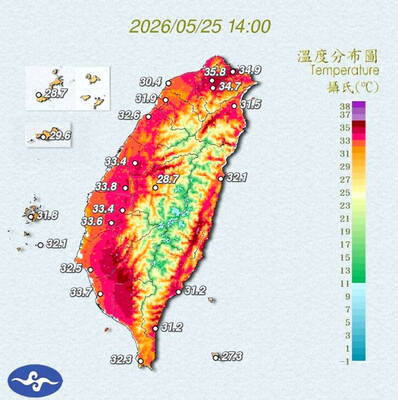
STAY COOL: The HPA recommended that people stay hydrated, use air-conditioning or fans while indoors, wear loose-fitting clothes and walk in the shade while outdoors Employers must implement measures such as installing cooling equipment, and providing drinking water and rest breaks for outdoor workers starting from Monday next week, the Taipei Department of Labor said on Sunday. Employers who fail to comply could face fines of NT$30,000 to NT$300,000 under the Occupational Safety and Health Act (職業安全衛生法), the department said. Businesses in Taipei employing fewer than 100 workers, as well as registered self-employed workers with labor insurance coverage, could receive on-site assessments and guidance from occupational safety consultants to help them apply for central government subsidies to implement or improve heat-protection measures, it said. Under the Ministry of

Chinese Nationalist Party (KMT) Chairwoman Cheng Li-wun (鄭麗文) yesterday briefed her party’s Central Standing Committee regarding her scheduled visit to the US between Monday next week and June 16, saying that her purpose would be to persuade the US that the Republic of China (ROC) Constitution was a “one China” constitution that would foster stable and peaceful cross-strait relations. The ROC Constitution is the most important defense for all Taiwanese citizens, as it upholds our democracy and has contributed to our robust economy, which aligns with international and US interests, she said. “We would not be troublemakers and drag the US under,”


 RSS
RSS