


A fire on a Cheng Kung Class frigate docked at Kaohsiung naval base burned for more than 2.5 hours on Saturday evening, but caused limited damage to the ship.
"The serial number 1110 Cheng Kung Class frigate caught fire in a cabin in the warship's stern where some sailors' clothes and covers were stored. The location of the fire was some distance from the oil tank and main weapons on the warship, so the fire did not cause significant damage or danger," Wu Gi-fung (
"No one was hurt in the accident," Wu said.
"The warship is equipped with weapons such as Hsiung Feng II missiles and Standard I missiles, but these incurred no damage in the accident and are able to function," Wu said.
On Saturday, the navy said it took four ships one hour to keep the fire under control, according to the Central News Agency.
Wu said that on Friday afternoon the frigate completed a patrol mission in the Taiwan Strait and returned to Kaohsiung naval base. At 6:35pm on Saturday, sailors discovered that the stern of the warship was filled with smoke. At 7pm, sailors identified a cabin used to store sailors' clothes and covers as the source of the smoke.
Wu said firefighters would have been able to open the door of the cabin, but were concerned that if they did so, more oxygen would enter the cabin and increase the size of the fire.
Firefighters also worried that an explosion might occur if more oxygen entered the cabin, Wu said.
Wu said the firefighters decided to monitor the fire from outside the cabin. An hour later, at about 8pm, the blaze appeared to getting smaller and at that point firefighters broke down the door, entered the cabin. They gained control of the fire at 9pm.
According to Wu, navy investigators initially identified some welding work done by some sailors outside the cabin on Saturday afternoon as the cause of the blaze. Because the sailors had not set up protective insulation, the heat from the welding likely sparked a fire in the cabin.
Wu said the sailors were probably responsible for the accident, but that an investigation into the cause was continuing.
Wu said the warship would be removed from service until it was completely repaired.
Wu said the frigate, constructed by Chinese Marine Corp, was put into service last March. The navy currently has eight 4200-tonne Cheng Kung Class frigates.
The frigates are equipped with Hsiung Feng II missiles, Standard I missiles and MK-32 torpedoes, Wu said.

Considering that most countries issue more than five denominations of banknotes, the central bank has decided to redesign all five denominations, the bank said as it prepares for the first major overhaul of the banknotes in more than 24 years. Central bank Governor Yang Chin-lung (楊金龍) is expected to report to the Legislative Yuan today on the bank’s operations and the redesign’s progress. The bank in a report sent to the legislature ahead of today’s meeting said it had commissioned a survey on the public’s preferences. Survey results showed that NT$100 and NT$1,000 banknotes are the most commonly used, while NT$200 and NT$2,000

The Centers for Disease Control (CDC) yesterday reported the first case of a new COVID-19 subvariant — BA.3.2 — in a 10-year-old Singaporean girl who had a fever upon arrival in Taiwan and tested positive for the disease. The girl left Taiwan on March 20 and the case did not have a direct impact on the local community, it said. The WHO added the BA.3.2 strain to its list of Variants Under Monitoring in December last year, but this was the first imported case of the COVID-19 variant in Taiwan, CDC Deputy Director-General Lin Ming-cheng (林明誠) said. The girl arrived in Taiwan on

ANNUAL EVENT: Two massive Pokemon balloons are to be set up in Daan Park, with an event zone operating from 10am to 6pm This year’s Taipei Floral Picnic is to be held at Daan Park today and tomorrow, featuring an exclusive Pokemon Go event, a themed food market, a coffee rave picnic area and stage performances, the Taipei Department of Information and Tourism said yesterday. Two massive Pokemon balloons are to be set up in the park as attractions, with an exclusive event zone operating from 10am to 6pm, it said. Participants who complete designated tasks on-site would have a chance to receive limited-edition souvenirs, it added. People could also try the newly launched game Pokemon Pokopia in the trial area, the department said. Three PokeStops are
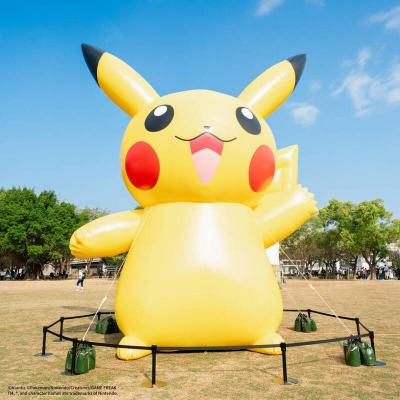
This year’s Taipei Floral Picnic is to be held at Daan Park this weekend, featuring an exclusive Pokemon Go event, a theme food market, a coffee rave picnic area and stage performances. Pokemon Go Two massive Pokemon balloons are to be set up in the park as photo attractions, with an exclusive event zone operating from 10am to 6pm. Participants who complete designated tasks on-site would have a chance to receive limited-edition souvenirs. Pokemon trainers could also experience the newly launched game Pokemon Pokopia in the trial area. Three PokeStops are to be set up in the park. Trainers are invited to take


 RSS
RSS