


Taipei Times: Chinese Nationalist Party (KMT) Chairman Lien Chan (
Ruan Ming (
The other day President Chen Shui-bian (
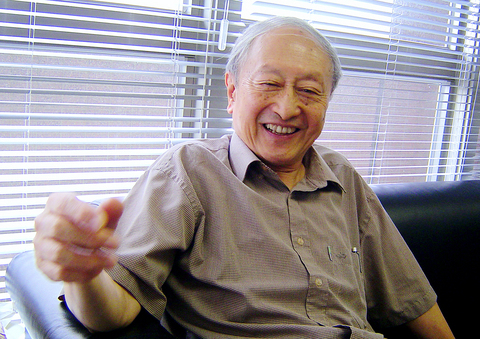
PHOTO: TAIPEI TIMES
China practices a system where multiple parties cooperate under the leadership of the CCP. They are the so-called "eight democratic political parties." These subordinate parties all abide by three rules: accepting the CCP's leadership, adhering to the same views as the CCP, and assisting the CCP in its united front strategy to further the goal of unification.
The first among these eight "political parties" is the Chinese Nationalist Party Revolution Committee. Its mission is to use on Taiwan tactics that are a part of the united front strategy. It has not achieved much during the past 50 years, but, Lien's trip outperformed it.
The media reported that Lien spoke of the Republic of China [ROC] while in China. But when I read reports more carefully, the ROC he spoke of was actually the early ROC when it was in power. Lien said that Sun Yat-Sen (
Let's look at Lien's speech at the Peking University. In the latter half of his speech he highlighted the "Chung hua min tzu" (the Chinese people). When Lien spoke of present situation, he did not mention Taiwan's freedom or democratic achievements -- only the "Chunghua min tzu," and nationalism. Such talks falls in line with the current position of [Chinese President] Hu Jintao's (
In China nowadays, no one believes in Communism or Marxism any more, so Hu's regime instead engages in nationalism and "Chung hua min tzu" -- examples of which were well demonstrated during the anti-Japanese protests that took place not so long ago. Lien's speech at Peking University echoed China's "Chung hua min tzu" nationalism.
The KMT chairman in the past also used to speak of "one China under the Constitution" and everyone thought he meant the Constitution of ROC. This time it was apparent that the constitution he spoke of in his speech at Peking University was the Constitution of People's Republic of China (PRC).
In his speech Lien said that "there are democratic elections in designated areas [in China]," and that "the Constitution mentioned the right to property as a basic human right. I believe all these are correct historical directions."
Lien was mentioning Hu's Constitution, which he amended last year to add in protection of private property as a basic human right.
Taiwan is a democratic system while China is a communist dictatorial system. This is what [late Straits Exchange Foundation chairman] Koo Cheng-fu (
While meeting with Jiang in 1998, Koo made two points. The first related to national sovereignty -- that one side of the Strait does not belong to the other side. The second points was that democratic and communist systems are vastly different.
Jiang then said to Koo: "we have democracy too, we hold elections." Koo replied to Jiang that a democratic system requires opposition parties.
So the difference between the two sides of the Strait lies not on the issue of unification or independence but on competing systems. The controversy over the issue of unification or independence in reality does not exist; what exists is the conflict between a free democratic system and a dictatorial communist one.
In the agreement reached between Lien and Hu, "both parties unanimously agree on basis of the `1992 consensus' and are against Taiwan independence." Lien himself even made clear the need to "join the communists to work against Taiwan independence."
In other words, Lien basically overruled the two points Koo had made. Instead, Lien followed Hu's lead, praised the communist system and slandered Taiwan's democracy as mere populism.
Thus, the KMT can be called the CCP's vassal party -- and its leader does the job of a subordinate party leader very well.
TT: What do you think was in Lien's mind as to the purpose of his visit to China? What did he gain?
Ruan: The purpose of Lien's China visit was just as he said, "to league together with the communists to work against Taiwan independence."
Some say Lien was duped by China's trickery, but this isn't true. As the old Chinese saying goes: "The weasel who pays New Year's greetings to the chicken is up to no good." Lien is the weasel, wanting to be in join with the other weasels in China to eat Taiwan -- the chicken -- alive.
In the past, Lien was often seen as harmless, but now we see his true face. In China, he had let out his true emotions, which had long been suppressed while in Taiwan. He has never been so high-spirited in Taiwan as he was in China during his trip.
In Taiwan, he spoke of "one China is the ROC" and that "the 1992 consensus is one China with each side having its own interpretation."
In China, Lien didn't make his own interpretation "one China." Hu Jintao did. Hu said that one China is the PRC, and Lien didn't rebut him.
TT: What's your view on the five-point "vision for cross-strait peace" agreement reached between Lien and Hu?
Ruan: Their so-called five-point plan, founded on the "1992 consensus" that both the CCP and the KMT agreed to oppose Taiwan's independence.
Given that Taiwan and China are of two different governmental systems and are antagonistic toward each other in light of the missiles China has pointed at Taiwan, enactment of its "Anti-Secession" Law, it is amazing that there was no discrepancies of points of contention in the statement released by Lien and Hu.
TT: As far as Lien's China trip goes, would it then be correct to say that Hu is the biggest winner?
Ruan: Absolutely.
The US and Japan are opposed to [the law] and in Taiwan, we had the protest on March 26 against the law which the whole world witnessed.
But now the whole world bewildered and has no clue what Taiwan is doing or where it stands. Many are wondering why after it staged a massive protest against the Anti-Secession Law that now its key political leaders are all making trips to China and endorsing the law?
The Anti-Secession Law pushes for unification by peaceful means and by non-peaceful means. Peaceful means involve the united front strategy to disunite Taiwan's political system and then take control of it.
Aside from the law, the recent anti-Japanese protests in China turned off many countries since they were opposed to the use of violence in protests. Lien's visit to China shifted attention of the world's media, and now everyone is talking about historic meeting between the KMT and the CCP and the formal end of hostilities.
To China, Lien's visit was tantamount to showing support for Hu's leadership and his oppression of voices within China calling for democracy. Take Peking University professor Jiao Guobiao (
[Former US President] Clinton, considered one of the most pro-China presidents, still talked about democracy and human rights during his visit to China. He had then said that China is on the wrong side of history in terms of democracy and human rights. Yet here we see Lien speaking not about democracy but nationalism and puffed up about communism.
Lien claimed its five-point agreement with Hu paved the way for cross-strait peace. But the thing is that there are two kinds of peace: genuine and false.
Democratic peace is the genuine peace. To seek peace under a totalitarian system only results in war and disaster. For instance, in 1973, then-US secretary of state Henry Kissinger and Le Duc Tho, a member of the Vietnamese Communist Party's Politburo, negotiated a ceasefire between the US and North Vietnam, for which they were awarded the Nobel Peace Prize the following year.
After that however the North Vietnamese broke the peace agreement and by 1975 had captured all of Vietnam.
All communist countries are dictatorships. If you want peace within it, you need to conform to its ways, hence, it is like peace through slavery. And peace through slavery always results in bloodshed, as we saw in the 1989 Tiananmen Square massacre, when the students called for freedom.
TT: People First Party (PFP) Chairman James Soong (
Ruan: I think it is China's plan, by using Lien and Soong, to draw Chen into the ring to recognize the "1992 consensus." Recognize it means you accept the "one China" principle. If Chen did, he could sign some kind of midterm agreement with China to maintain the cross-strait status quo for, say, 30 to 50 years. I don't think Chen will be so foolish as to agree to something like this.
Such an agreement is what the Clinton administration had in mind, when it tried to get Lee Teng-hui (
If Chen recognizes the "1992 consensus" and signs an agreement, Taiwan will be doomed and war will definitely follow, because the people of Taiwan will not accept it. Chen should therefore understand this. If he doesn't, then his legacy will be that of a historical sinner.
Frankly, Lien and Soong have no qualifications to "sell out Taiwan" and be historical sinner because Taiwan does not belong to them, but to its 23 million people. Bu if Chen signs such a treaty in his capacity as president, he would be the one responsible for bringing catastrophe to Taiwan.
Such an agreement basically ties the "one China" principle around your neck.
In Jiang's eight-point proposal on the "Taiwan question," the first step is to sign a so-called midterm agreement with Taiwan to maintain the cross-strait status quo for 30 to 50 years. The second step in his plan is unification.
Should Taiwan sign such an agreement, the 30 or 50 years would be no more than a transitional period before it is unified with China. Signing the agreement is tantamount to putting a person sentenced to death in prison for 30 to 50 years before actually executing him.
Today, Taiwan is an independent country. It will no longer be if it agrees to the such agreement.
TT: President Chen said he is in favor of establishment of a military confidence-building mechanism in the Taiwan Strait. What do you think of this?
Ruan: There is one prerequisite in establishing a military confidence-building mechanism. You and I recognize each other an independent state, and we both have no intention of attacking each other. The establishment of a military confidence-building mechanism is therefore needed to prevent any military misjudgments.
But China, in this case, has so obviously stated its desire to attack if necessary and has a law codifying the use of non-peaceful means against you. What then is the point of a military confidence-building mechanism? Agreements of this nature do not apply to cross-strait relations.
TT: Some people are concerned that President Chen might fall unwittingly into China's united front trap. What are your thoughts on this? As a policy advisor to Chen, have you spoken to the president on these issues?
Ruan: I think Chen should have someone around to remind him of this threat. I can't help it if he doesn't listen to my view. I haven't met with the president for almost a year now.
I think national security agencies should do more in-depth research on the CCP to learn more of an understanding of it.
TT: What's your opinion of Hu now that he is the Chinese president?
Ruan: Hu's stance toward Taiwan is obvious, as was showed in the Anti-Secession Law. He wants to resolve the "Taiwan issue" by 2020 and will attack if Taiwan doesn't surrender.
So in view of the situation, Taiwan should be united as a nation and ally itself with other democratic countries. But what we see now is that our relations with the US are not so good. In the past, you wanted even the lousy weapons it would sell you, but now, the US wants to sell Taiwan quality weapon, but we don't want them.
It seems that all is now going in accordance with China's liking and Taiwan is not guarding its freedom.
Hu is more aggressive and more willing to take risks. This was true before he was the president, but now Hu is even more aggressive. I don't think it is possible that he will walk the path of democracy.
The key to beating China's united front strategy is a united Taiwan and sound diplomatic work with democratic members of the international community.
TT: Some have said the Chen administration has been too cooperative with the pan-blue camp. Do you agree with this?
Ruan: Yes. As a president, Chen should not talk too much. And when he does talk, it should be on important issues that carry serious weight.
The government has its priorities wrong. In terms of Taiwan's situation, the number one priority should be its domestic affairs, then diplomatic affairs and then cross-strait affairs.
Only when you manage your domestic affairs well can you win the respect of the world. The problem with the government now is that it doesn't attend to matters it supposedly says it does, and attends to others that need not be.

NATIONAL SECURITY: Authorities are working to confirm the identities of the military personnel involved and investigating possible illegal conduct and regulatory violations Authorities are probing possible national security implications after Kinmen police and immigration officers on Sunday found a Chinese woman allegedly posing as a tourist while engaging in prostitution involving more than 10 military personnel. The woman, surnamed Chen (陳), has since been deported, authorities said, adding that investigators are still working to confirm the identities of those implicated, as the records only listed code names and aliases. The case stemmed from a report received by the Kinmen District Prosecutors’ Office on Friday last week from the Jinhu Precinct of the Kinmen County Police Bureau. On Sunday, police, along with the National Immigration

GLOBALGIVING: ‘ Caving to external pressure is not acceptable for an organization that has cultivated justice reform and human rights for 30 years,’ one NGO said A slew of non-government organizations (NGOs) have withdrawn from the GlobalGiving fundraising platform after it announced it would use “Chinese Taipei” instead of “Taiwan” from next month. The Taiwan Good Rice Association wrote on Facebook on Friday that it was informed on April 28 via a teleconference call of the change, which was made because the platform wanted to operate in China. Taiwan Good Rice is to terminate all cooperative relationships with GlobalGiving in response to the platform’s “unilateral and non-negotiable” decision to remove references to Taiwan, the NGO said. “Taiwan is in the official name of Taiwan Good Rice Association and the

HEAVY WEATHER: Typhoon Jangmi is due to crash straight into the Ryukyus as airlines look to shift flights to larger aircraft or cancel flights to Okinawa entirely Taiwan’s international air carriers announced flight adjustments over the weekend as Typhoon Jangmi is forecast to hit the Ryukyu Islands today and tomorrow. The Central Weather Administration (CWA) upgraded Jangmi from a tropical storm to a typhoon at 8am yesterday, with the eye located 580km south of Naha city. It was moving north at 19kph. Today, China Airlines’ CI-120, CI-121, CI-122 and CI-123 flights between Taoyuan and Naha, Okinawa, have been canceled as well as CI-132 and CI-133 between Kaohsiung and Naha. EVA Air’s BR-112, BR-113, BR-186 and BR-185 flights between Taoyuan and Naha are also canceled. Low-cost carrier Tigerair Taiwan canceled IT-230,
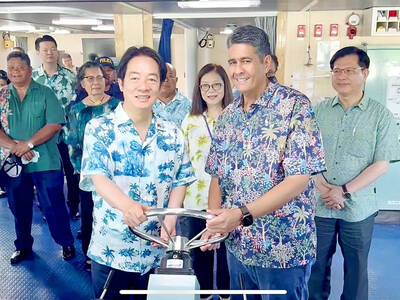
MULTIPRONGED APPROACH: China has sought to pressure Palau across a number of fronts, but the island nation has staunchly resisted overtures to ditch Taiwan Palau has been firm in backing Taiwan despite Chinese pressure that uses tourism economics, cyberattacks and criminal infiltration as tools to threaten the Pacific ally into renouncing its recognition of Taiwan as a sovereign state. The Presidential Office yesterday announced that Vice President Hsiao Bi-khim (蕭美琴) would visit Palau from Saturday to Wednesday next week at the invitation of Palauan President Surangel Whipps Jr. Whipps in April said in an interview that China had outspokenly asked Palau to “denounce Taiwan.” “And we have said: ‘We have no enemies, but nobody tells us who our friends are,’” he said. Whipps has told reporters multiple times


 RSS
RSS