


Local officials yesterday seemed unimpressed with China's promise that it would send two pandas to Taiwan and make concessions on agricultural trade and tourism, moving instead to revive the standing request to negotiate about the implementation of cross-strait cargo flights.
"We are confused. The government has repeatedly proposed cross-strait cargo flights, but [Beijing] has yet to respond," the Executive Yuan said in a statement issued yesterday.
"We've never retracted this proposal, and we've always set it as our number-one priority. We've been consistent on this," a high-ranking Mainland Affairs Council (MAC) official said.
"If China responds positively to cargo flights, then we can move on to the next step, and then the next, until we are sitting at the negotiating table," the official said.
He added that a demonstration of good will on cargo flights would be beneficial to cooperation on other matters.
"Following [Chinese Nationalist Party (KMT) Chairman] Lien Chan (連戰) and [Chinese President] Hu Jintao's (胡錦濤) meeting, there has been talk of China's good will. But looking at [Beijing's] press conference yesterday, we really don't see any good will," the official said.
Wang Zaixi (
The Cabinet's statement called on Beijing to "prove its sincerity" by substantiating its rhetoric with action and noted that Taiwan was prepared to conduct negotiations on cargo flights in accordance with the precedent set by the talks that brought about the Lunar New Year charter flights.
These talks, which were held in January, had been held by business representatives under the supervision and guidance of government officials.
The Executive Yuan stressed the need for concrete action, and that negotiation would be needed to iron out the details.
The statement was an official response to Beijing's recent decision to bestow upon Taiwan a pair of endangered giant pandas, to lift travel restrictions on Chinese touring Taiwan, and to increase access for Taiwanese fruits and agricultural products to the Chinese market by expanding the number of items that can be exported to China, revoking tariffs on selected fruits and expediting export processes.
"China should propose concrete measures, including the specific fruits to which the zero-tariff policy would apply, how export processes are to be expedited, the sale of fruit in China, and the new fruits that could be exported to China," the Executive Yuan's statement read.
While the media has speculated that papayas, guavas, bananas, grapefruits, wax apples, pineapples and betel nuts would be eligible for tariff cuts, Beijing has yet to announce the details of its new policies.
The Executive Yuan added that matters concerning agricultural trade between Taiwan and China should be dealt with within the framework of the World Trade Organization, of which both countries are members.
"[Beijing's Taiwan Affairs Office director] Chen Yunlin (陳雲林) says policies will be relaxed, but we haven't seen anything in writing. These policies will require procedures for visa applications, emergency response, illegal immigration and identification verification, among others. All of these need to be discussed," MAC Chairman Joseph Wu (吳釗燮) said.

NATIONAL SECURITY: Authorities are working to confirm the identities of the military personnel involved and investigating possible illegal conduct and regulatory violations Authorities are probing possible national security implications after Kinmen police and immigration officers on Sunday found a Chinese woman allegedly posing as a tourist while engaging in prostitution involving more than 10 military personnel. The woman, surnamed Chen (陳), has since been deported, authorities said, adding that investigators are still working to confirm the identities of those implicated, as the records only listed code names and aliases. The case stemmed from a report received by the Kinmen District Prosecutors’ Office on Friday last week from the Jinhu Precinct of the Kinmen County Police Bureau. On Sunday, police, along with the National Immigration

GLOBALGIVING: ‘ Caving to external pressure is not acceptable for an organization that has cultivated justice reform and human rights for 30 years,’ one NGO said A slew of non-government organizations (NGOs) have withdrawn from the GlobalGiving fundraising platform after it announced it would use “Chinese Taipei” instead of “Taiwan” from next month. The Taiwan Good Rice Association wrote on Facebook on Friday that it was informed on April 28 via a teleconference call of the change, which was made because the platform wanted to operate in China. Taiwan Good Rice is to terminate all cooperative relationships with GlobalGiving in response to the platform’s “unilateral and non-negotiable” decision to remove references to Taiwan, the NGO said. “Taiwan is in the official name of Taiwan Good Rice Association and the

HEAVY WEATHER: Typhoon Jangmi is due to crash straight into the Ryukyus as airlines look to shift flights to larger aircraft or cancel flights to Okinawa entirely Taiwan’s international air carriers announced flight adjustments over the weekend as Typhoon Jangmi is forecast to hit the Ryukyu Islands today and tomorrow. The Central Weather Administration (CWA) upgraded Jangmi from a tropical storm to a typhoon at 8am yesterday, with the eye located 580km south of Naha city. It was moving north at 19kph. Today, China Airlines’ CI-120, CI-121, CI-122 and CI-123 flights between Taoyuan and Naha, Okinawa, have been canceled as well as CI-132 and CI-133 between Kaohsiung and Naha. EVA Air’s BR-112, BR-113, BR-186 and BR-185 flights between Taoyuan and Naha are also canceled. Low-cost carrier Tigerair Taiwan canceled IT-230,
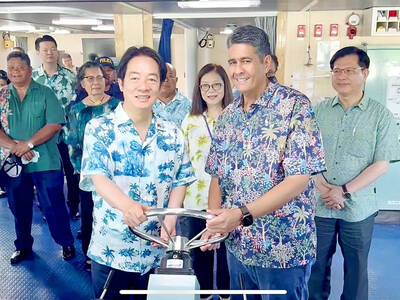
MULTIPRONGED APPROACH: China has sought to pressure Palau across a number of fronts, but the island nation has staunchly resisted overtures to ditch Taiwan Palau has been firm in backing Taiwan despite Chinese pressure that uses tourism economics, cyberattacks and criminal infiltration as tools to threaten the Pacific ally into renouncing its recognition of Taiwan as a sovereign state. The Presidential Office yesterday announced that Vice President Hsiao Bi-khim (蕭美琴) would visit Palau from Saturday to Wednesday next week at the invitation of Palauan President Surangel Whipps Jr. Whipps in April said in an interview that China had outspokenly asked Palau to “denounce Taiwan.” “And we have said: ‘We have no enemies, but nobody tells us who our friends are,’” he said. Whipps has told reporters multiple times


 RSS
RSS