


■ Politics
Rally not `off-limits': KMT
The Chinese Nationalist Party (KMT) said yesterday that it will leave the decision of whether to join today's march against China's "Anti-Secession" Law up to individual members."This is an event organized by the Democratic Progressive Party [DPP]. The political platform, national ideology and stance on cross-strait relations are all different from the KMT. If there are party members that want to participate in the rally, then the KMT is unable to prevent them from joining. However, we trust the judgement of our party members," KMT spokesman Chang Jung-kung (張榮恭) said. He added that if there are KMT party members who attend to show their support of the Republic of China and call upon President Chen Shui-bian (陳水扁) to uphold his "four noes" policy, then the KMT will not "hinder" them. Legislative Speaker Wang Jin-pyng (王金平), a KMT vice chairman, said yesterday that he was unsure whether or he would attend.
■ Fisheries
Seminar set for Monday
A seminar on deep-sea fishing manpower issues will be held on Monday as part of the government's efforts to formulate new policy and strategies for sustainable fishery industry development, a Council of Agriculture official said yesterday. The seminar, to be organized by the council's Fishery Administration, will focus on the supply and demand of fishing manpower, upgrading the quality of the industry's workforce and improvement of the shipboard working environment, the official said. The one-day seminar will bring together officials from city and county governments, representatives of fishing industry associations, academics and experts to explore manpower-related problems faced by fishing-boat owners and feasible measures to resolve them, the official said. The seminar will be the first of a series of forums to be held this year on issues affecting the fishing industry.
■ Politics
KMT revises nominee list
The KMT has released a list on Thursday night of three principles it will use when considering who it will nominate for the National Assembly Representatives' election on May 14. It said it would rank Chen Chin-jang (陳金讓), the party's nominee for the assembly's speaker, as No.1, while city mayors and county commissioners are to be ranked outside of the number the party expects to win seats. Chen is a former National Assembly speaker. Taipei Mayor Ma Ying-jeou (馬英九) was originally ranked No.1 in the party's original list of nominees but on the new list he is ranked 135 out of 160. Penghu County Commissioner Lai Feng-wei (賴峰偉 ) is No.126 on the new list, the highest of any local official. The statement said the changes reflect the party's emphasis on academics and youth.
■ National security
Official punished
The Judicial Yuan announced yesterday that the president's former chief aide-de-camp, Lieutenant General Chen Tsai-fu (陳再福), would be barred for one year from working in government for failing in his responsibilities in connection with the March 19 assassination attempt on President Chen Shui-bian (陳水扁) and Vice President Annette Lu (陳水扁). The report said Chen Tsai-fu's poor leadership contributed to the incident. The report said Chen Tsai-fu failed to ask the president and vice-president to put on bullet-proof vests and he broke rules regarding motorcade formation, which resulted in the failure to properly guard the two leaders.


UPGRADE: The Kang Ding-class frigate is replacing its Chaparall missiles with Tien Chien II and Hua Yang VLS, which would provide it with long-range, 360° air defense Taiwan plans to produce 1,200 to 1,376 Hai Chien II missiles (海劍二, Sea Sword II) — also known as TC-2N — to serve as the standard air defense system of the navy’s surface combatant fleet, a source said yesterday. Last week, the Hai Chien II, the naval version of the Tien Kung II missile (天劍二, Sky Sword II), completed a live-fire test in waters off the National Chungshan Institute of Science and Technology’s Jiupeng facility (九鵬) in Pingtung County’s Manjhou Township (滿州). The MIM72 Chaparral and other dated air defense missiles that currently arm Taiwanese ships have inadequate range to combat Chinese

REASONS FOR TRAVEL: An assistant professor said that proposed amendments to penalize drivers if they used drugs overseas would not deter people from traveling People who operate a motor vehicle under the influence of marijuana would have their driver’s license revoked, even if they used the substance while overseas, the Ministry of Transportation and Communications said yesterday, citing proposed amendments to the Road Traffic Management and Penalty Act (道路交通管理處罰條例). The amendments would also authorize the government to revoke the licenses of people determined to have used Category 1 or Category 2 narcotics, even if they were not operating a vehicle while under the influence of drugs, as well as ban them from taking the license test for three years, the ministry said. People aged 18 or
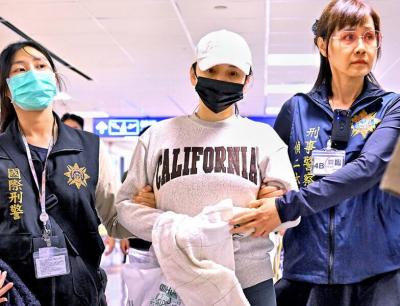
Johanne Liou (劉喬安), a Taiwanese woman who shot to unwanted fame during the Sunflower movement protests in 2014, returned to Taiwan last night after being deported from the US. She is to stand trial in Taiwan for charges involving embezzlement, fraud and drug crimes. The Criminal Investigation Bureau (CIB) said it took her into custody at Taiwan Taoyuan International Airport and would first question her before transferring her to the New Taipei District Prosecutors’ Office. She was arrested upon disembarking a flight from San Francisco that landed shortly before 7pm. Liou absconded to the US in 2019 after jumping bail
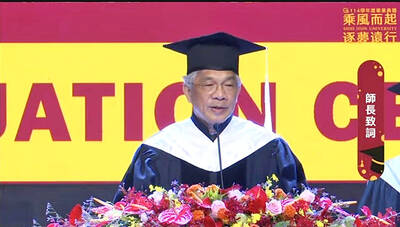
Shih Hsin University President Chen Ching-he (陳清河) yesterday issued a public apology for comments made in his commencement speech last week, stating that he has asked the school to suspend his duties and halt his wages for two months as a show of contrition. At the commencement ceremony on May 30, Chen said, “If you don’t manage your time well, or your own emotions, or your health, then I am telling every one of you — put a quick end to ‘you,’ because the world has no need for ‘you.’” The comments have sparked significant controversy online, and Chen through an open


 RSS
RSS