


The four noes pledges that President Chen Shui-bian (
According to Hsu Yung-ming (
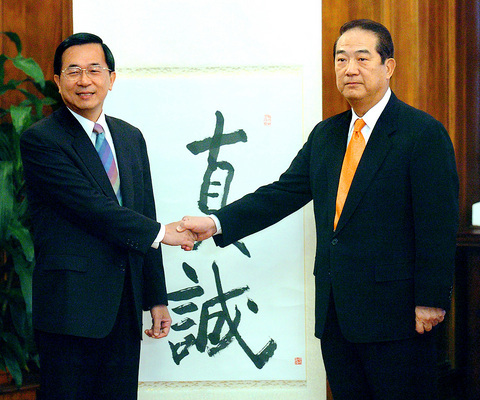
PHOTO: GEORGE TSORNG, TAIPEI TIMES
"It might be a new trend that `peace' will be a demand that transcends the call for sovereignty in Taiwan in the near future," Hsu said.
As Beijing's proposed anti-secession law is pending and is to be unveiled in March, Hsu pointed out that the outcome of the Chen-Soong meeting could be observed in that context. He doubted that Chen's repetition of his four noes pledge made in his inauguration ceremony in 2000 was made as a condition linked to the recent US-Japan pact.
"My take is that Chen took advantage of the meeting to show his appreciation to the US for including the Taiwan Strait in the security pact with Japan and once again stressed that he won't be the one who escalates tensions in the Strait," Hsu said. "It seems that Chen decided to make a `soft' move to deal with Beijing's anti-secession law by seeking the US' assistance other than launching referendums or making a retaliatory law."
"According to the memorandum signed by Chen and Soong, I believe that the arms sales bill will soon be passed in the coming legislative session," Hsu added. "Now, the problem goes back to China again."
However, the reiteration of the four noes pledge is a double-edged sword, which will also likely cut the Democratic Progressive Party's (DPP) connection with pro-independence groups.
"The pan-green camp is going to be divided by this Chen-Soong meeting since Chen made it clear that he will not promote Taiwan's independence or rectifying the country's official name," Hsu said.
"However, Chen will not be the one who has to deal with this dissent because he won't join in campaign elections after he steps down from the presidency," Hsu said. "Those perspective candidates who plan to run for the 2008 presidency will have to deal with this knotty problem of Taiwan's orientation in sovereignty."
"Soong is the biggest winner of the meeting," Hsu added.
World United Formosans for Independence Chairman Ng Chiau-tong (黃昭堂) yesterday also said sarcastically that Soong won an overwhelming victory in this meeting and he was "very disappointed" by the ten points of consensus that were reached in the meeting, including Chen's "four noes" promises made in 2000 and Chen's vow to obey the Constitution of the Republic of China.
"I would like to congratulate Soong," Huang said sarcastically. "I think that President Chen has yielded to his insistence on the sovereignty of Taiwan in his meeting with Soong," Huang said. "And I believe that China must be pleased with the outcome of the Chen-Soong meeting."
Huang said he suspected that the US government might have intervened in Taiwan's current political situation. Otherwise Chen would not have to reiterate the four noes pledge at this moment -- particularly given that Chen won his re-election bid.
"Chen sacrificed his campaign commitments and fell short of voters' expectations," Huang said.
But not every pro-independence supporter was pessimistic about the meeting result like Huang.
"I don't think that any new messages came out of the Chen-Soong meeting. The ten points were stitched together from what the two leaders have [already] said," said Chen I-Shen (
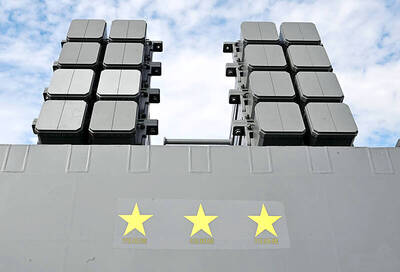
UPGRADE: The Kang Ding-class frigate is replacing its Chaparall missiles with Tien Chien II and Hua Yang VLS, which would provide it with long-range, 360° air defense Taiwan plans to produce 1,200 to 1,376 Hai Chien II missiles (海劍二, Sea Sword II) — also known as TC-2N — to serve as the standard air defense system of the navy’s surface combatant fleet, a source said yesterday. Last week, the Hai Chien II, the naval version of the Tien Kung II missile (天劍二, Sky Sword II), completed a live-fire test in waters off the National Chungshan Institute of Science and Technology’s Jiupeng facility (九鵬) in Pingtung County’s Manjhou Township (滿州). The MIM72 Chaparral and other dated air defense missiles that currently arm Taiwanese ships have inadequate range to combat Chinese

REASONS FOR TRAVEL: An assistant professor said that proposed amendments to penalize drivers if they used drugs overseas would not deter people from traveling People who operate a motor vehicle under the influence of marijuana would have their driver’s license revoked, even if they used the substance while overseas, the Ministry of Transportation and Communications said yesterday, citing proposed amendments to the Road Traffic Management and Penalty Act (道路交通管理處罰條例). The amendments would also authorize the government to revoke the licenses of people determined to have used Category 1 or Category 2 narcotics, even if they were not operating a vehicle while under the influence of drugs, as well as ban them from taking the license test for three years, the ministry said. People aged 18 or
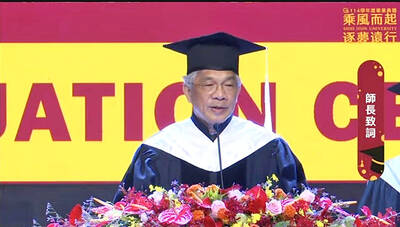
Shih Hsin University President Chen Ching-he (陳清河) yesterday issued a public apology for comments made in his commencement speech last week, stating that he has asked the school to suspend his duties and halt his wages for two months as a show of contrition. At the commencement ceremony on May 30, Chen said, “If you don’t manage your time well, or your own emotions, or your health, then I am telling every one of you — put a quick end to ‘you,’ because the world has no need for ‘you.’” The comments have sparked significant controversy online, and Chen through an open
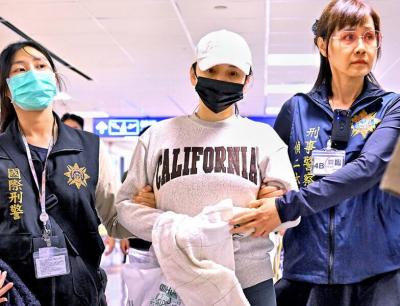
Johanne Liou (劉喬安), a Taiwanese woman who shot to unwanted fame during the Sunflower movement protests in 2014, returned to Taiwan last night after being deported from the US. She is to stand trial in Taiwan for charges involving embezzlement, fraud and drug crimes. The Criminal Investigation Bureau (CIB) said it took her into custody at Taiwan Taoyuan International Airport and would first question her before transferring her to the New Taipei District Prosecutors’ Office. She was arrested upon disembarking a flight from San Francisco that landed shortly before 7pm. Liou absconded to the US in 2019 after jumping bail


 RSS
RSS