


The military yesterday continued its promotion of the NT$610 billion (US$18.8 billion) arms procurement budget in the hope that lawmakers would transfer the proposal to a military committee for review and approval. But lawmakers disappointed them by declining the proposal again.
The proposal was transferred to the regular legislative meeting again in the first action on the bill since Saturday's legislative election drama.
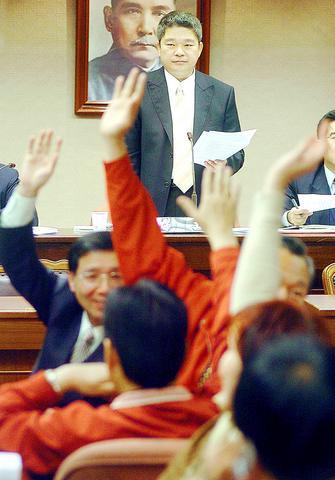
PHOTO: CHEN TSEH-MING, TAIPEI TIMES
The pan-blue camp yesterday afternoon again took advantage of its legislative majority to veto the budget.
"I am still hoping that the public will support us, support the budget and pass it as soon as possible. It is a pure need that concerns national security and is based on our professional evaluation. Please do not mix it up with politics," Vice Minister of National Defense Lieutenant General Hu Chen-pu (胡鎮埔) said.
Decreasing Reliance
Hu said that the proposed arms purchase, which includes the procurement of 384 Patriot Advanced Capability-3 (PAC-3) missiles, 12 P-3C maritime patrol aircraft and eight diesel submarines, was necessary to strengthen the country's self-defense capabilities and decrease reliance on the US government's help in case of a military conflict in the Taiwan Strait.
"Heaven helps those who help themselves," Hu said.
"The US government pays attention to peace in the Strait, but remember, Americans are not res-ponsible for fighting for Taiwan," he said.
"If there is a war, it will not be their war," he said.
Hu said that if legislators are not satisfied with the proposed procurement amount, negotiating within a range of NT$100 billion was possible.
"But we do need to buy these weapons for the sake of national security," he said.
Hu said that it was both pointless and impossible for the ministry to amend the proposal and send it back to the Legislative Yuan again before the deadline of Feb. 1 next year.
"It is simply too late and meaningless," Hu said.
"The proposal is the result of our professional assessments. It is meaningless to change a few numbers or digits in the proposal just to please lawmakers," he said.
Enough Money
Asked whether the ministry would consider a priority list for the three items if lawmakers do not allow enough money for the entire procurement package, Hu said that it would not be possible to divide up the equipment.
"These three items are bound to each other. We will not sacrifice any of them, because we need to buy them all at the same time," Hu said.
Hu said that the country is facing serious military threats from China and that this was the main reason behind the composition of the proposed package.
"The biggest military threat from China is its submarines. The second threat is its missiles," he said.
"Their submarines are capable of carrying out missions as far as Guam and their missiles can land on any spot in Taiwan," he said.
He then gave an assurance that Taiwan will not be the first to launch an attack.
"First of all, we will only fight back if they [China] attack us. Also, we will only attack their military sites, not innocent people," Hu said.
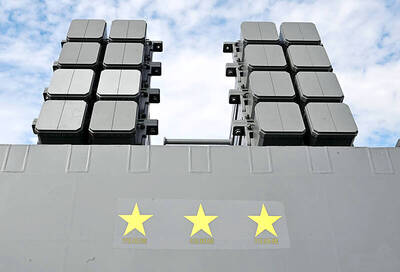
UPGRADE: The Kang Ding-class frigate is replacing its Chaparall missiles with Tien Chien II and Hua Yang VLS, which would provide it with long-range, 360° air defense Taiwan plans to produce 1,200 to 1,376 Hai Chien II missiles (海劍二, Sea Sword II) — also known as TC-2N — to serve as the standard air defense system of the navy’s surface combatant fleet, a source said yesterday. Last week, the Hai Chien II, the naval version of the Tien Kung II missile (天劍二, Sky Sword II), completed a live-fire test in waters off the National Chungshan Institute of Science and Technology’s Jiupeng facility (九鵬) in Pingtung County’s Manjhou Township (滿州). The MIM72 Chaparral and other dated air defense missiles that currently arm Taiwanese ships have inadequate range to combat Chinese

REASONS FOR TRAVEL: An assistant professor said that proposed amendments to penalize drivers if they used drugs overseas would not deter people from traveling People who operate a motor vehicle under the influence of marijuana would have their driver’s license revoked, even if they used the substance while overseas, the Ministry of Transportation and Communications said yesterday, citing proposed amendments to the Road Traffic Management and Penalty Act (道路交通管理處罰條例). The amendments would also authorize the government to revoke the licenses of people determined to have used Category 1 or Category 2 narcotics, even if they were not operating a vehicle while under the influence of drugs, as well as ban them from taking the license test for three years, the ministry said. People aged 18 or
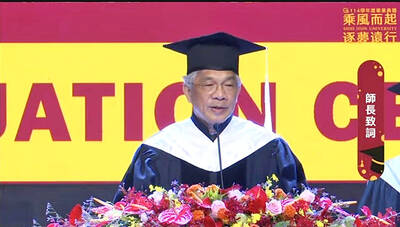
Shih Hsin University President Chen Ching-he (陳清河) yesterday issued a public apology for comments made in his commencement speech last week, stating that he has asked the school to suspend his duties and halt his wages for two months as a show of contrition. At the commencement ceremony on May 30, Chen said, “If you don’t manage your time well, or your own emotions, or your health, then I am telling every one of you — put a quick end to ‘you,’ because the world has no need for ‘you.’” The comments have sparked significant controversy online, and Chen through an open
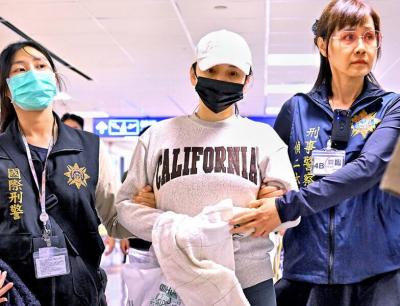
Johanne Liou (劉喬安), a Taiwanese woman who shot to unwanted fame during the Sunflower movement protests in 2014, returned to Taiwan last night after being deported from the US. She is to stand trial in Taiwan for charges involving embezzlement, fraud and drug crimes. The Criminal Investigation Bureau (CIB) said it took her into custody at Taiwan Taoyuan International Airport and would first question her before transferring her to the New Taipei District Prosecutors’ Office. She was arrested upon disembarking a flight from San Francisco that landed shortly before 7pm. Liou absconded to the US in 2019 after jumping bail


 RSS
RSS