


Taiwan will closely monitor discussions at the 10th annual conference of the UN Framework Convention on Climate Change being held in Buenos Aires, paying special attention to how the implementation of the Kyoto Protocol is applied to the country's competitors such as Japan and South Korea, environmental and economics officials said yesterday.
Environmental experts and government policy-makers from nearly 200 countries on Monday began discussing the future of the fight against global warming at the conference on climate change.
The annual UN-sponsored gathering is the last conference before the Feb. 16 implementation of the Kyoto Protocol, a landmark agreement requiring 30 of the world's developed nations to reduce greenhouse gas emissions by 2012.
Thousands of participants in the two-week meeting will be looking at new methods of limiting heat-trapping greenhouse gases in the atmosphere and developing strategies to persuade more nations to curb their greenhouse emissions.
"Strategies for further reduction of emissions will become clearer at the meeting. Taiwan has to know what kind of responsibility other newly-industrialized countries will shoulder after 2012," Lin Ta-hsiung (
A Taiwanese delegation will attend the conference, which draws to a close on Dec. 17, under the auspices of the EPA.
Senior officials from the EPA and the Ministry of Economic Affairs, including Lin and the Industrial Development Bureau's Deputy Director General Kuo Nien-hsiung (
Officials of the bureau's Sustainable Development Division told the Taipei Times yesterday that Taiwan has to be fully aware of strategies adopted by Japan, which has a target of reducing greenhouse gas emissions by up to 6 percent of 1990 levels by 2012.
The approach Japan takes could point the way for Taiwan in boosting its economic competitiveness while reducing greenhouse gas emissions.
Bureau officials said that Taiwan will have to pay attention to discussions on the allocation of expertise and funds in newly industrialized countries, as well as countries with rapid economic growth, such as South Korea, China, India and Mexico.
They said that South Korea faces a bigger challenge than Taiwan, because it is ranked the world's ninth-largest producer of greenhouse gases, while Taiwan is ranked 22nd.
The officials said that Taiwan especially needs to learn more about how the Kyoto Protocol would apply to island countries, which are particularly vulnerable to extreme weather and rising sea levels.
Global warming has been blamed for more violent storms, rising sea levels and shrinking animal habitats.
Gloria Hsu (
"Waiting for solid research results on the local impact of climate change could take a long time. Adjusting industrial structures and encouraging energy conservation to avoid negative social and economic impacts are urgent," Hsu said.
Meanwhile, the availability of visas for some delegation members, including high-ranking officials, remains uncertain. Argentina's Trade and Cultural Office yesterday declined to respond to a query from the Taipei Times, saying that information about its issuance of visas is confidential.
Also see story:

The military has spotted two Chinese warships operating in waters near Penghu County in the Taiwan Strait and sent its own naval and air forces to monitor the vessels, the Ministry of National Defense (MND) said. Beijing sends warships and warplanes into the waters and skies around Taiwan on an almost daily basis, drawing condemnation from Taipei. While the ministry offers daily updates on the locations of Chinese military aircraft, it only rarely gives details of where Chinese warships are operating, generally only when it detects aircraft carriers, as happened last week. A Chinese destroyer and a frigate entered waters to the southwest
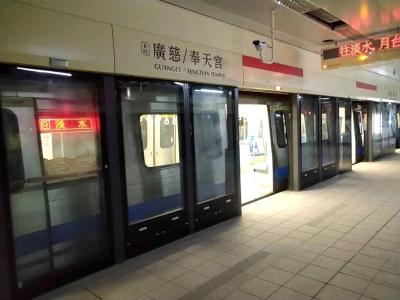
The eastern extension of the Taipei MRT Red Line could begin operations as early as late June, the Taipei Department of Rapid Transit Systems said yesterday. Taipei Rapid Transit Corp said it is considering offering one month of free rides on the new section to mark its opening. Construction progress on the 1.4km extension, which is to run from the current terminal Xiangshan Station to a new eastern terminal, Guangci/Fengtian Temple Station, was 90.6 percent complete by the end of last month, the department said in a report to the Taipei City Council's Transportation Committee. While construction began in October 2016 with an
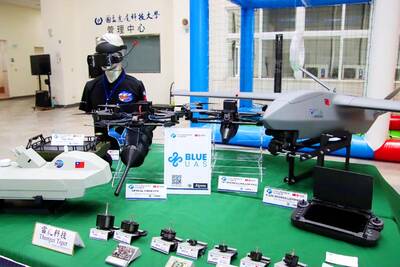
NON-RED SUPPLY: Boosting the nation’s drone industry is becoming increasingly urgent as China’s UAV dominance could become an issue in a crisis, an analyst said Taiwan’s drone exports to Europe grew 41.7-fold from 2024 to last year, with demand from Ukraine’s fight against Russian aggression the most likely driver of growth, a study showed. The Institute for Democracy, Society and Emerging Technology (DSET) in a statement on Wednesday said it found that many of Taiwan’s uncrewed aerial vehicle (UAV) sales were from Poland and the Czech Republic. These countries likely transferred the drones to Ukraine to aid it in its fight against the Russian invasion that started in 2022, it said. Despite the gains, Taiwan is not the dominant drone exporter to these markets, ranking second and fourth

Japanese Prime Minister Sanae Takaichi’s comment last year on Tokyo’s potential reaction to a Taiwan-China conflict has forced Beijing to rewrite its invasion plans, a retired Japanese general said. Takaichi told the Diet on Nov. 7 last year that a Chinese naval blockade or military attack on Taiwan could constitute a “survival-threatening situation” for Japan, potentially allowing Tokyo to exercise its right to collective self-defense. Former Japan Ground Self-Defense Force general Kiyofumi Ogawa said in a recent speech that the remark has been interpreted as meaning Japan could intervene in the early stages of a Taiwan Strait conflict, undermining China’s previous assumptions


 RSS
RSS