


Although Kaohsiung City is perhaps the most steadfast turf of the pan-green camp, Kaohsiung Mayor Frank Hsieh (
"I think the pan-green candidates have been more united and have a kept a broader mind than the pan-blue candidates once they were asked to share their votes with fellow candidates," Hsieh said. "For candidates, accepting the vote-allocation strategy is just like staking all of their money on a risky business -- they will either win or lose it all."
As the legislative election campaign enters the homestretch and passions are raised to an extreme pitch by both political camps, Hsieh said that the vote allocation strategy was a sensitive topic, and all the candidates are tense about the possibility of losing their elections -- even though those who have stable poll figures.
However, in order to achieve the goal of winning a majority in the legislature, Hsieh said that he had persuaded former Kaohsiung City Government spokeswoman Kuan Pi-ling (
"It is commendable that Kuan agreed to share her votes with other pan-green candidates, as she is in the leading group," Hsieh said. "But the DPP has to win with teamwork. Only through cooperation can we control the legislature and pass bills that are beneficial to all the people."
But Kuan said that she was worried the vote allocation would make all of the candidates lose the election if any mistakes happened.
"However, now that I've promised to do it, I will just go all out and promote it with my supporters. But just remember not to make me come in last in the election list!" Kuan said with smile.
In the northern constituency of Kaohsiung City, Kuan, Lee Kun-tse (李昆澤) and Lin Chin-hsing (林進興) are conducting a united campaign with TSU candidate Tsenng Tsan-teng (曾燦燈). In the southern constituency, the DPP's nominees, Tang Chin-chuan (湯金全), Huang Chao-hui (黃昭輝) and Kuo Wen-chen (郭玟成), will run a campaign with the TSU's Lo Chih-ming (羅志明), who is leading in the polls and was willing to offer his ballots to others.
All eight candidates have campaigned together in support of the vote-allocation and united campaign strategies.
Lo said that Hsieh has successfully extended the domain of the pan-green camp because of his impressive municipal achievements in Kaohsiung City.
"The recent poll found that Mayor Hsieh won 81.3 percent of citizens' support, yet Taipei Mayor Ma Ying-jeou's (
Chao Wen-nan (
However, Chao also admitted the election situation in Kaohisung is not entirely optimistic, since the KMT has only nominated one candidate in southern Kaohsiung and only three candidates in northern Kaohsiung, which will could spread the pan-green camp's votes relatively thin.
But Hsieh was still confident of the pan-green's election prospects, and thought that the DPP's final campaign theme "peace and happiness" had successfully differentiated the party from the pan-blue camp.
"The pan-blue camp is eating its own bitter fruit, since it has refused to concede its failure in the presidential election and its poll results are sharply declining," Hsieh said. "Lien and Soong, who have been cursing Taiwan with groundless and irrational remarks, have brought themselves bad luck because of their hatred. People don't need hatred. People need hope and happiness, which is a commitment that the DPP is willing to make to all the people of Taiwan."

The Ministry of Finance this afternoon announced the winning numbers for the March-April uniform invoice lottery. The winning number for the NT$10 million (US$318,060) special prize is 19531471, and the winning number for the NT$2 million grand prize is 85941329. Three numbers were drawn for the NT$200,000 first prize: 07225810, 20231230 and 83518781. Those with receipts matching the last seven digits of any of the first-prize numbers will win the NT$40,000 second prize, while those matching the last six digits will win the NT$10,000 third prize. Those whose receipts match the last five digits of the first-prize numbers can claim the NT$4,000 fourth prize,

SIX SUBSIDIES: The monthly allowance for older farmers is to increase to NT$10,000, and NT$5,000 is to be given to homemakers under the national pension system, Lai said The government is to implement major welfare policies for disadvantaged groups, including raising the monthly allowance for older farmers to NT$10,000 and providing homemakers with NT$5,000 per month, President William Lai (賴清德) said yesterday. Lai made the remarks during a visit to Wangling Temple in Chiayi County, saying that the planned increases were being introduced amid economic growth and an increase in tax revenue. Touting a policy, in which the government plans to provide a monthly allowance of NT$5,000 for every child under the age of 18 in a bid to address Taiwan’s low birthrate, Lai said that if received for the
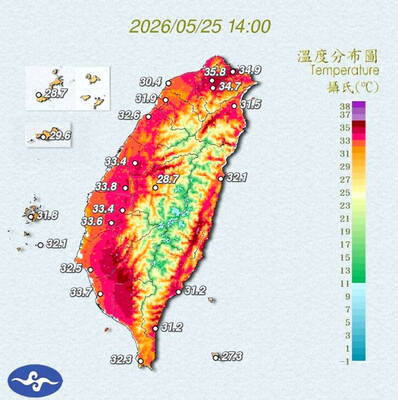
STAY COOL: The HPA recommended that people stay hydrated, use air-conditioning or fans while indoors, wear loose-fitting clothes and walk in the shade while outdoors Employers must implement measures such as installing cooling equipment, and providing drinking water and rest breaks for outdoor workers starting from Monday next week, the Taipei Department of Labor said on Sunday. Employers who fail to comply could face fines of NT$30,000 to NT$300,000 under the Occupational Safety and Health Act (職業安全衛生法), the department said. Businesses in Taipei employing fewer than 100 workers, as well as registered self-employed workers with labor insurance coverage, could receive on-site assessments and guidance from occupational safety consultants to help them apply for central government subsidies to implement or improve heat-protection measures, it said. Under the Ministry of

NATIONAL SECURITY: Authorities are working to confirm the identities of the military personnel involved and investigating possible illegal conduct and regulatory violations Authorities are probing possible national security implications after Kinmen police and immigration officers on Sunday found a Chinese woman allegedly posing as a tourist while engaging in prostitution involving more than 10 military personnel. The woman, surnamed Chen (陳), has since been deported, authorities said, adding that investigators are still working to confirm the identities of those implicated, as the records only listed code names and aliases. The case stemmed from a report received by the Kinmen District Prosecutors’ Office on Friday last week from the Jinhu Precinct of the Kinmen County Police Bureau. On Sunday, police, along with the National Immigration


 RSS
RSS