


The pan-blue caucuses are divided again on a major issue: whether to allow President Chen Shui-bian (陳水扁) to proceed with the first-ever state-of-the-nation address in the Legislative Yuan.
While the People First Party (PFP) has shown enthusiasm about the issue for the past two days, climaxing with party Chairman James Soong (
"The KMT caucus basically welcomes the president to deliver a state-of-the-nation address in the Legislative Yuan, but the address has to be constitutional and legal, and it has to take place after the legislative elections," KMT caucus whip Tseng Yung-chuan (
"The Constitution stipulates that the Legislative Yuan can invite the president to make a state-of-the-nation address every year, and that means the right and the decision to initiate such a report lies with the Legislative Yuan," he said.
"So it may be unconstitutional for President Chen to initiate such a request," he said.
Tseng also said that the caucus would request a constitutional interpretation on Chen's request.
"The existing laws do not stipulate how the president should proceed with the address or how the president should interact with lawmakers, and we should amend the laws to regulate how these things should proceed," Tseng said.
Tseng said that before the Legislative Yuan goes into recess at the beginning of November, the lawmakers have to question the premier and review the annual budget, and there was no time left for the president.
"So if the president wants to give his address, he has to wait until after the election," Tseng said.
Even Legislative Speaker Wang Jin-pyng (王金平), despite being scheduled to host an inter-party negotiation between the caucuses tomorrow to discuss the issue, rejected Presidential Office Secretary-General Su Tseng-chang's (蘇貞昌) request two days ago to meet and discuss the technical aspects of the address.
"It is unknown whether the Legislative Yuan will accept the president's request, and Su doesn't have to come now to talk about this. We can discuss the issue only after the Legislative Yuan invites the president to deliver the address," he said.
Contrary to the KMT's cool attitude, the PFP has even decided to have an incumbent legislator-at-large, Legislator Lee Tung-hao (
Soong said earlier this month that he was willing to become a legislator-at-large in order to debate with Chen on policies.
But the prerequisite for Soong's appearance in the Legislative Yuan would be that Chen must interact and be questioned by lawmakers after the address, the PFP said.
Although PFP shared a similar attitude with the KMT on the constitutionality and legality of the issue, PFP caucus whip Liu Weng-hsiung (
The Democratic Progressive Party caucus, meanwhile, defended the validity of the president's request.
"According to the Constitution, President Chen can take the initiative to request a state-of-the-nation address. Even if the pan-blue camp requests a constitutional interpretation of the request, it won't affect the delivery of the address," DPP caucus whip Ker Chien-ming (柯建銘) said.
"How the address should proceed can be decided simply by inter-party negotiations, and there is no need for an amendment to the laws," he said.
The DPP caucus also said that for the president to deliver the address, the Legislative Yuan only needs to arrange an extra sitting on one day, which won't affect the question-and-answer session with the premier and the review of the annual budget.

Yangmingshan National Park authorities yesterday urged visitors to respect public spaces and obey the law after a couple was caught on a camera livestream having sex at the park’s Qingtiangang (擎天崗) earlier in the day. The Shilin Police Precinct in Taipei said it has identified a suspect and his vehicle registration number, and would summon him for questioning. The case would be handled in accordance with public indecency charges, it added. The couple entered the park at about 11pm on Thursday and began fooling around by 1am yesterday, the police said, adding that the two were unaware of the park’s all-day live
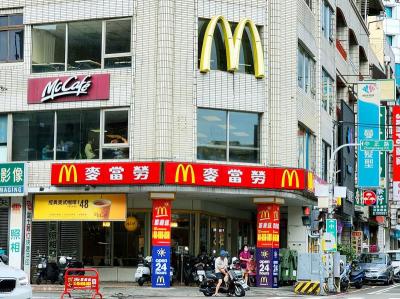
Fast food chain McDonald's is to raise prices by up to NT$5 on some products at its restaurants across Taiwan, starting on Wednesday next week, the company announced today. The prices of all extra value meals and sharing boxes are to increase by NT$5, while breakfast combos and creamy corn soup would go up by NT$3, the company said in a statement. The price of the main items of those meals, if ordered individually, would remain the same. Meanwhile, the price of a medium-sized lemon iced tea and hot cappuccino would rise by NT$3, extra dipping sauces for chicken nuggets would go up
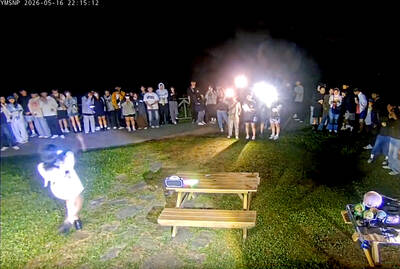
Yangmingshan National Park’s Qingtiangang (擎天崗) nature area has gone viral after a park livestream camera observed a couple in the throes of intimate congress, which was broadcast live on YouTube, drawing large late-night crowds and sparking a backlash over noise, bright lights and disruption to wildlife habitat. The area’s livestream footage appeared to show a couple engaging in sexual activity on a picnic table in the park on Friday last week, with the uncensored footage streamed publicly online. The footage quickly spread across social media, prompting a tide of visitors to travel to the site to “check in” and recreate the

Minister of Digital Affairs Lin Yi-ching (林宜敬) yesterday cited regulatory issues and national security concerns as an expert said that Taiwan is among the few Asian regions without Starlink. Lin made the remarks on Facebook after funP Innovation Group chief executive officer Nathan Chiu (邱繼弘) on Friday said Taiwan and four other countries in Asia — China, North Korea, Afghanistan and Syria — have no access to Starlink. Starlink has become available in 166 countries worldwide, including Ukraine, Malaysia, the Philippines and Vietnam, in the six years since it became commercial, he said. While China and North Korea block Starlink, Syria is not


 RSS
RSS