


Thousands of protesters from opposition parties and civil organizations yesterday marched on Taipei City to oppose the Democratic Progressive Party (DPP) government's proposed NT$610 billion (US$18 billion) arms procurement plan with the US, saying the policy will lead to an arms race with China and lead to war.
"The slogan of opposing the arms purchase deal absolutely represents the majority of Taiwanese people, especially since the government is mired in financial problems," said Hsu Hsin-liang (許信良), a former DPP chairman and now an outspoken anti-DPP activist.
"The smartest course of action would be to avoid a war because Taiwan would lose," he said. "The DPP government's policy is pushing the nation to the edge of war."
The protest, entitled "Love Taiwan, oppose the arms-deal" began at 2pm at the Sun Yat-shen Memorial Hall. Participants marched toward Ketagelan Boulevard and held a "Love and Peace, Pray for Taiwan" rally in front of the Presidential Office.
Anti-Arms Purchasing Alliance convener Chang Ya-chung (
The government expects to win the approval of the Legislative Yuan for the arms purchase before the end of the current session in January.
A number of protesters carried anti-US slogans, while one person was dressed as a monster-like Uncle Sam, cavorting with another protester wearing a mask of President Chen Shui-bian (
The the Anti-Arms Purchasing Alliance, along with the Democratic Advancement Alliance (DAA) claimed the protest was not tied to a specific political party.
Many People First Party (PFP) and New Party (NP) candidates for the year-end legislative elections attended the protest.
Independent Legislator Sisy Chen (
Members representing labors rights groups, education reform and gender equality organizations attended the protest.
"The country has so many important issues that need to be solved immediately, such as the high unemployment rate, education and women's rights. We can't let the government send money to the US and leave a huge debt for the next generation," said Tang Shu (唐曙), leader of the Labor Rights Association.
According to the Cabinet, the arms deal package includes eight diesel-powered submarines, Patriot III anti-missile systems and 12 P3-C anti-submarine aircraft over a 15-year period beginning in 2005.
"One P3-C aircraft costs NT$5.9 billion, and we only need NT$1 billion to ensure that every primary student can eat a free breakfast at school," Tang said.
"The money to be used for the P3-missile could be used to feed primary students a free lunch for next 10 years," Tang added.
Meanwhile, at the KMT National Party Congress today, Chairman Lien Chan (
"While the KMT supports strong national defenses, the massive arms budget is not the key to a stable future," Lien said.
"The KMT does support a certain level of military expenditure, however, we think that the government should cut most of the arms procurement budget to allocate money to education and social welfare," he added.
"Besides taking on national loans and selling national land, what other ways are there [to pay for the arms budget]?" Lien said, without elaborating.
ADDITIONAL REPORTING BY CAROLINE HONG
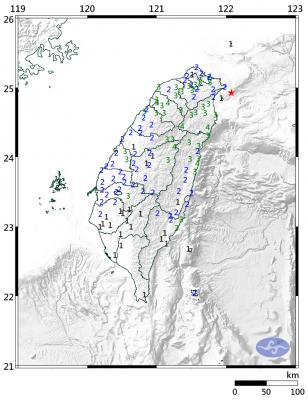
A magnitude 6.1 earthquake struck off the coast of Yilan County at 8:39pm tonight, the Central Weather Administration (CWA) said, with no immediate reports of damage or injuries. The epicenter was 38.7km east-northeast of Yilan County Hall at a focal depth of 98.3km, the CWA’s Seismological Center said. The quake’s maximum intensity, which gauges the actual physical effect of a seismic event, was a level 4 on Taiwan’s 7-tier intensity scale, the center said. That intensity level was recorded in Yilan County’s Nanao Township (南澳), Hsinchu County’s Guansi Township (關西), Nantou County’s Hehuanshan (合歡山) and Hualien County’s Yanliao (鹽寮). An intensity of 3 was
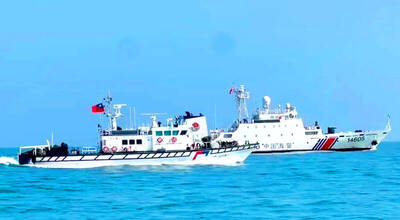
Instead of focusing solely on the threat of a full-scale military invasion, the US and its allies must prepare for a potential Chinese “quarantine” of Taiwan enforced through customs inspections, Stanford University Hoover fellow Eyck Freymann said in a Foreign Affairs article published on Wednesday. China could use various “gray zone” tactics in “reconfiguring the regional and ultimately the global economic order without a war,” said Freymann, who is also a nonresident research fellow at the US Naval War College. China might seize control of Taiwan’s links to the outside world by requiring all flights and ships entering or leaving Taiwan
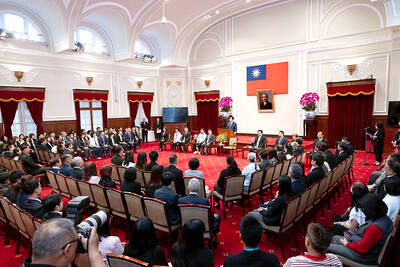
The next minimum wage hike is expected to exceed NT$30,000, President William Lai (賴清德) said yesterday during an award ceremony honoring “model workers,” including migrant workers, at the Presidential Office ahead of Workers’ Day today. Lai said he wished to thank the awardees on behalf of the nation and extend his most sincere respect for their hard work, on which Taiwan’s prosperity has been built. Lai specifically thanked 10 migrant workers selected for the award, saying that although they left their home countries to further their own goals, their efforts have benefited Taiwan as well. The nation’s industrial sector and small businesses lay
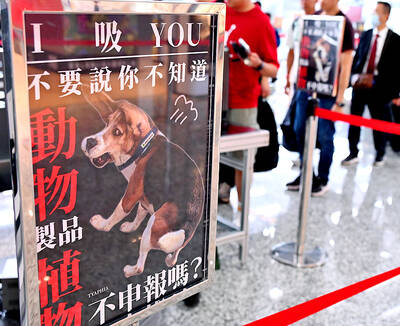
Quarantine awareness posters at Taiwan Taoyuan International Airport have gone viral for their use of wordplay. Issued by the airport branch of the Animal and Plant Health Inspection Agency, the posters feature sniffer dogs making a range of facial expressions, paired with advisory messages built around homophones. “We update the messages for holidays and campaign needs, periodically refreshing materials to attract people’s attention,” quarantine officials said. “The aim is to use the dogs’ appeal to draw focus to quarantine regulations.” A Japanese traveler visiting Taiwan has posted a photo on X of a poster showing a quarantine dog with a


 RSS
RSS