


The Democratic Progressive Party (DPP) yesterday condemned the passage of the pan-blue camp's version of a statue to regulate the investigative committee on the March 19 shooting, saying the committee has seriously overridden the judicial power and infringed on the Constitution.
On the final day of the extra legislative sitting yesterday, the legislature passed the pan-blue's proposal for a special investigative committee -- which would use an independent prosecutor system -- to probe the March 19 assassination attempt on President Chen Shui-bian (陳水扁) and Vice President Annette Lu (呂秀蓮). The DPP's proposal to ask the Control Yuan, the government's watchdog agency to direct the committee's operations was snuffed out.

PHOTO: WANG YI-SUNG, TAIPEI TIMES
DPP officials said yesterday that the Cabinet will propose renewed discussions in a bid to reverse the legislation. If it can not be vetoed, the DPP legislative caucus will file for a constitutional interpretation of the new law. If either action fails to stop the operations of the committee, the DPP will not rule out the possibility of withdrawing from the investigation panel to oppose the pan-blue camp's committee legislation.
Presidential Office Secretary General Su Tseng-chang (蘇貞昌) said yesterday the pan-blue camp used its legislative majority to force the passage of the bill, which infringed the independence of the judicial power. The statue also has been widely criticized by private judicial-reform groups and academics, especially a clause which states that representation on the committee must reflect the number of legislators each party has in the Legislative Yuan.
"The statue is basically a product of the pan-blues' legislative violence," Su said yesterday in the party headquarters after a closed-door meeting of the Central Executive Committee.
Liang Wen-chieh (梁文傑), deputy director of DPP's Policy Research and Coordinating Committee said the pan-blue camp's statue -- which gives committee members the power to investigate, discern evidence and prosecute without the permission from the judiciary -- is unacceptable.
"It is ridiculous that committee members can use their political judgment to decide who is guilty and then mete out charges against them, totally disregarding the Code of Criminal Procedure (刑事訴訟法). We have seen many prosecutors voice protests on the Web site of the Ministry of Justice," Liang said.
"These prosecutors said they would refuse to cooperate if asked by the committee," he said.
The DPP yesterday also released a public opinion poll regarding the pan-blue's shooting committee. The poll found that 57 percent of the public thought the committee should be free of political interference; 15.1 percent of the interviewees supported the pan-blue's committee legislation; and 27.9 percent had no opinion on the issue.
In other developments, the CEC members also agreed yesterday on a proposal that would require a direct election by all party members in choosing a new party chairman. The proposal is a revision to a 2002 party regulation which requires the president serve concurrently as the party chairman. The revision will be submitted to the party congress for final approval on Sept. 26. The 2002 party regulation which says the party can choose up to three vice chairmen was also canceled as well.

Actor Darren Wang (王大陸) was sentenced to six months in prison, commutable to a fine, by the New Taipei District Court today for contravening the Personal Data Protection Act (個人資料保護法) in a case linked to an alleged draft-dodging scheme. Wang allegedly paid NT$3.6 million (US$114,380) to an illegal group to help him evade mandatory military service through falsified medical documents, prosecutors said. He transferred the funds to Chen Chih-ming (陳志明), the alleged mastermind of a draft-evasion ring, although he lost contact with him as he was already in detention on fraud charges, they said. Chen is accused of helping a

SECURITY: Starlink owner Elon Musk has taken pro-Beijing positions, and allowing pro-China companies to control Taiwan’s critical infrastructure is risky, a legislator said Starlink was reluctant to offer services in Taiwan because of the nation’s extremely high penetration rates in 4G and 5G services, the Ministry of Digital Affairs said yesterday. The ministry made the comments at a meeting of the legislature’s Transportation Committee, which reviewed amendments to Article 36 of the Telecommunications Management Act (電信管理法). Article 36 bans foreigners from holding more than 49 percent of shares in public telecommunications networks, while shares foreigners directly and indirectly hold are also capped at 60 percent of the total, unless specified otherwise by law. The amendments, sponsored by Chinese Nationalist Party (KMT) Legislator Ko
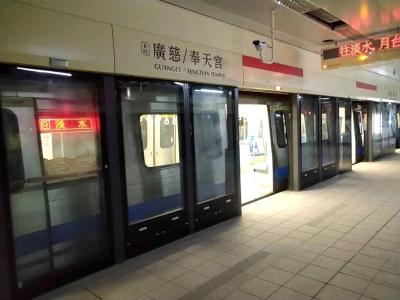
The eastern extension of the Taipei MRT Red Line could begin operations as early as late June, the Taipei Department of Rapid Transit Systems said yesterday. Taipei Rapid Transit Corp said it is considering offering one month of free rides on the new section to mark its opening. Construction progress on the 1.4km extension, which is to run from the current terminal Xiangshan Station to a new eastern terminal, Guangci/Fengtian Temple Station, was 90.6 percent complete by the end of last month, the department said in a report to the Taipei City Council's Transportation Committee. While construction began in October 2016 with an
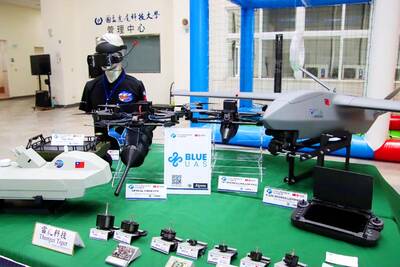
NON-RED SUPPLY: Boosting the nation’s drone industry is becoming increasingly urgent as China’s UAV dominance could become an issue in a crisis, an analyst said Taiwan’s drone exports to Europe grew 41.7-fold from 2024 to last year, with demand from Ukraine’s fight against Russian aggression the most likely driver of growth, a study showed. The Institute for Democracy, Society and Emerging Technology (DSET) in a statement on Wednesday said it found that many of Taiwan’s uncrewed aerial vehicle (UAV) sales were from Poland and the Czech Republic. These countries likely transferred the drones to Ukraine to aid it in its fight against the Russian invasion that started in 2022, it said. Despite the gains, Taiwan is not the dominant drone exporter to these markets, ranking second and fourth


 RSS
RSS