


A new book entitled Taiwan's First Seeing-Eye Dog: I was Proud to Walk By Your Side by Ke Ming-chi (柯明期) tells the tale of her dog Aggie, the first seeing-eye dog in Taiwan and her turbulent journey toward greater urban mobility.
According to dog trainer Lee Hsin-yi (李欣怡) at the HuiKuang Guide Dog Center, the right of passage for seeing-eye dogs through Taipei's public transportation system has been a long time in coming for Aggie and her owner.
"We started lobbying for laws allowing seeing-eye dogs to enter all buses, trains, and MRT stations nine years ago, when Aggie was only one year old," Lee said.
This June, the Legislative Yuan finally approved the proposal.
Yet Aggie, with the prime of her life behind her, has retired from seeing-eye dog duties. An elderly man, who asked to be known only as Dr. Wang, adopted the dog for her remaining years.
Figures from the Taiwan Guide Dog Association indicate that there are only 10 trained seeing-eye dogs in the nation. The concept of seeing-eye dogs is a foreign idea to most Taiwanese, officials at the association said. Blind Taiwanese people traditionally rely on walking sticks or family members' guidance, they said.
Former president Lee Teng-hui (李登輝) worked with the Committee for the Blind of Taiwan beginning in 1991 to bring in seeing-eye dogs to the nation after seeing them in action on a visit to San Francisco.
As the first seeing-eye dog in Taiwan, Australian-born Aggie had to receive training in Japan before hitting the streets of Taipei in 1996. Specialized personnel at HuiKaung had to receive training in New Zealand before they were qualified to train new puppies because at the time, no such program existed here.
According to Lee Hsin-yi, seeing-eye dogs are easily recognizable by their harnesses, but are often forcibly deterred from entering stores or MRT stations.
"Public consciousness of the dogs is low, so people often prevent them from doing their duty," Lee said.
Rough handling of the dogs may confuse them and endanger their blind owners, she added.
HuiKaung staff members say that all their dogs are gentle Labradors with carefully chosen pedigrees. Young dogs under a year old go through comprehensive training in host families. Wearing clearly marked red vests, the puppies are taken on test walks through different environments.
Lee said that all dogs are housebroken before they are taken into the city, and urged store owners obey the law and not to obstruct the training process.

UPGRADE: The Kang Ding-class frigate is replacing its Chaparall missiles with Tien Chien II and Hua Yang VLS, which would provide it with long-range, 360° air defense Taiwan plans to produce 1,200 to 1,376 Hai Chien II missiles (海劍二, Sea Sword II) — also known as TC-2N — to serve as the standard air defense system of the navy’s surface combatant fleet, a source said yesterday. Last week, the Hai Chien II, the naval version of the Tien Kung II missile (天劍二, Sky Sword II), completed a live-fire test in waters off the National Chungshan Institute of Science and Technology’s Jiupeng facility (九鵬) in Pingtung County’s Manjhou Township (滿州). The MIM72 Chaparral and other dated air defense missiles that currently arm Taiwanese ships have inadequate range to combat Chinese

REASONS FOR TRAVEL: An assistant professor said that proposed amendments to penalize drivers if they used drugs overseas would not deter people from traveling People who operate a motor vehicle under the influence of marijuana would have their driver’s license revoked, even if they used the substance while overseas, the Ministry of Transportation and Communications said yesterday, citing proposed amendments to the Road Traffic Management and Penalty Act (道路交通管理處罰條例). The amendments would also authorize the government to revoke the licenses of people determined to have used Category 1 or Category 2 narcotics, even if they were not operating a vehicle while under the influence of drugs, as well as ban them from taking the license test for three years, the ministry said. People aged 18 or
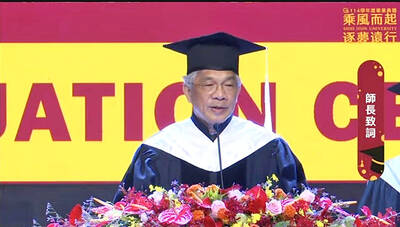
Shih Hsin University President Chen Ching-he (陳清河) yesterday issued a public apology for comments made in his commencement speech last week, stating that he has asked the school to suspend his duties and halt his wages for two months as a show of contrition. At the commencement ceremony on May 30, Chen said, “If you don’t manage your time well, or your own emotions, or your health, then I am telling every one of you — put a quick end to ‘you,’ because the world has no need for ‘you.’” The comments have sparked significant controversy online, and Chen through an open
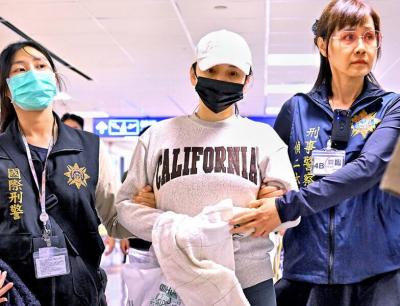
Johanne Liou (劉喬安), a Taiwanese woman who shot to unwanted fame during the Sunflower movement protests in 2014, returned to Taiwan last night after being deported from the US. She is to stand trial in Taiwan for charges involving embezzlement, fraud and drug crimes. The Criminal Investigation Bureau (CIB) said it took her into custody at Taiwan Taoyuan International Airport and would first question her before transferring her to the New Taipei District Prosecutors’ Office. She was arrested upon disembarking a flight from San Francisco that landed shortly before 7pm. Liou absconded to the US in 2019 after jumping bail


 RSS
RSS