


The NT$610.8 billion (US$18.25 billion) arms budget the Cabinet is seeking from the legislature is necessary to prevent Beijing from launching a military assault against the island, Premier Yu Shyi-kun said yesterday.
"Of course we'd like to see the military budget take up as little of the annual budget as possible, but the premise has to be that national security is not in jeopardy," Yu told reporters yesterday in Chiufen.
The armed forces need more advanced US equipment if the nation aspires to maintain peace in the Asia-Pacific region, Yu said.
"How do we expect to safeguard the country if we're not well-armed?" the premier said. "We cannot solely rely on the US to protect us once Beijing launches a military attack."
While Taiwan has been cutting military spending, Yu said that China has made double-digit increases in its military budget every year since 1995.
The nation's military expenditures accounted for 24.3 percent of the total budget in 1994. They accounted for only 16.5 percent last year and dwindled to 15.1 percent in next year's annual budget proposed by the Cabinet.
Out of the Cabinet's proposed special budget of NT$610.8 billion, NT$412 billion would go for eight diesel-electric submarines, NT$145 billion would be allocated for six Patriot anti-missile systems and NT$53 billion for 12 P-3C anti-submarine aircraft. The money will be spent over the next 15 years.
The Cabinet has specified that Taiwanese companies be involved in building the eight submarines, though the US has said that doing so would drive up the cost substantially.
During a visit to the US in June to discuss Taiwan's arms procurement projects, Legislative Speaker Wang Jin-pyng (
Yu, who is scheduled to embark on a 12-day visit next Thursday to three diplomatic allies in Central America, said that it would be difficult for him to discuss the arms procurement plan with US officials during his upcoming trip because of the short length of his transit stopover in the US.
Although Yu said that it was a diplomatic norm to hear different viewpoints from opposition parties regarding the arms procurement plan, he said he felt sorry for opposition lawmakers who did not dare to criticize Beijing's military intimidation but berated the Cabinet for its budget proposal.
Yu cited recent examples of Beijing's bullying behavior against Taiwan, mentioning the Aboriginal pop diva Chang Hui-mei (
A-mei had originally cancelled a concert due to protests by students from Zhejiang University, who accused her of supporting Taiwan's independence.
A-mei eventually performed a controversial concert in Beijing last Saturday, where hecklers brought her to tears onstage.
Lee conducted a low-profile private visit to the nation in June before taking up his new role as Singapore's prime minister. China later threatened to delay talks on a free trade deal with Singapore in retaliation for Lee's visit.
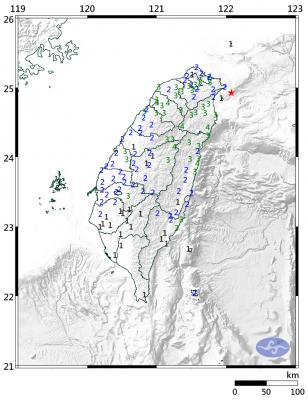
A magnitude 6.1 earthquake struck off the coast of Yilan County at 8:39pm tonight, the Central Weather Administration (CWA) said, with no immediate reports of damage or injuries. The epicenter was 38.7km east-northeast of Yilan County Hall at a focal depth of 98.3km, the CWA’s Seismological Center said. The quake’s maximum intensity, which gauges the actual physical effect of a seismic event, was a level 4 on Taiwan’s 7-tier intensity scale, the center said. That intensity level was recorded in Yilan County’s Nanao Township (南澳), Hsinchu County’s Guansi Township (關西), Nantou County’s Hehuanshan (合歡山) and Hualien County’s Yanliao (鹽寮). An intensity of 3 was
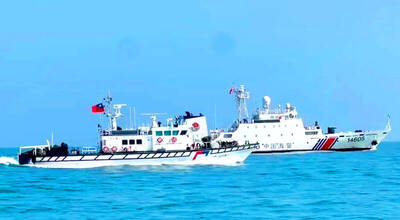
Instead of focusing solely on the threat of a full-scale military invasion, the US and its allies must prepare for a potential Chinese “quarantine” of Taiwan enforced through customs inspections, Stanford University Hoover fellow Eyck Freymann said in a Foreign Affairs article published on Wednesday. China could use various “gray zone” tactics in “reconfiguring the regional and ultimately the global economic order without a war,” said Freymann, who is also a nonresident research fellow at the US Naval War College. China might seize control of Taiwan’s links to the outside world by requiring all flights and ships entering or leaving Taiwan
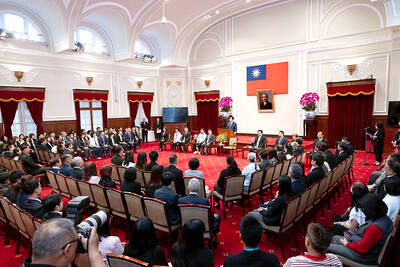
The next minimum wage hike is expected to exceed NT$30,000, President William Lai (賴清德) said yesterday during an award ceremony honoring “model workers,” including migrant workers, at the Presidential Office ahead of Workers’ Day today. Lai said he wished to thank the awardees on behalf of the nation and extend his most sincere respect for their hard work, on which Taiwan’s prosperity has been built. Lai specifically thanked 10 migrant workers selected for the award, saying that although they left their home countries to further their own goals, their efforts have benefited Taiwan as well. The nation’s industrial sector and small businesses lay
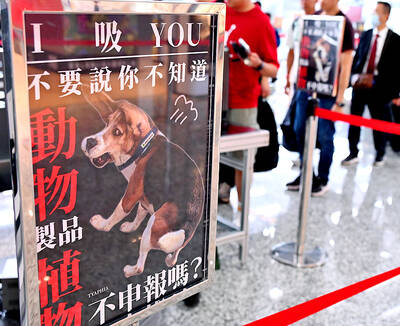
Quarantine awareness posters at Taiwan Taoyuan International Airport have gone viral for their use of wordplay. Issued by the airport branch of the Animal and Plant Health Inspection Agency, the posters feature sniffer dogs making a range of facial expressions, paired with advisory messages built around homophones. “We update the messages for holidays and campaign needs, periodically refreshing materials to attract people’s attention,” quarantine officials said. “The aim is to use the dogs’ appeal to draw focus to quarantine regulations.” A Japanese traveler visiting Taiwan has posted a photo on X of a poster showing a quarantine dog with a


 RSS
RSS