


The Chinese Nationalist Party (KMT) launched a campaign in Washington last month to challenge the legitimacy of President Chen Shui-bian's (陳水扁) re-election, government sources told the Taipei Times.
"The KMT's representative in Washington, Jason Yuan (袁健生), mailed a 20-page booklet entitled Bulletgate to every US senator and House representative last month," the source said. "The pan-blue alliance is obviously intending to attach the `Taiwan issue' to the US presidential election."
The booklet lists pan-blue alliance suspicions relating to the election, including suggestions that the assassination attempt on March 19 was staged by Chen, that the ballot-counting process was fraudulent and that the referendum held on election day was a trick to evade the law.
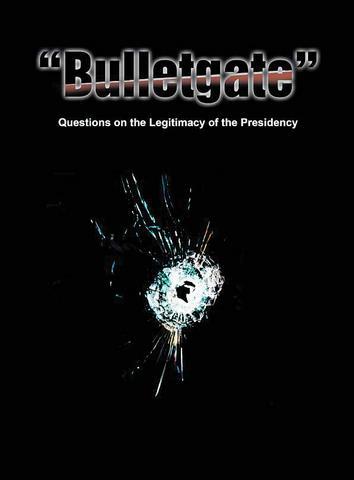
The booklet also alleges that a "national security mechanism" triggered after the shooting prevented many soldiers from returning home to vote, and that illegal radio stations spread rumors that the shooting was a pan-blue alliance conspiracy.
"The mysterious shots caused a groundswell of sympathy votes for the pan-green ticket," the booklet says.
On May 20, the day of the presidential inauguration, advertisements without attribution ran in English-language newspapers referring to "Bulletgate" and inviting readers to call a telephone number for more information. The Bulletgate booklet was then sent to those callers who left their details.
The source said that a number of US congresspeople friendly to Taiwan transferred the booklet to Taiwanese officials.
"[The congresspeople] were surprised that Taiwan's opposition would try to spoil the country's democratic achievement," the source said.
A National Security Council official told the Taipei Times yesterday that the council had not received any report on the matter from the Taipei Economic and Cultural Representative Office, Taiwan's de facto embassy in the US.
But such a campaign could only harm the nation's image as well as the reputations of opposition politicians, the official said.
"It is a pity that the entire opposition alliance continues to wallow in the swamp [of losing]," the official said. "Its leaders are unable to look ahead, instead stalling at the day of [the presidential election]."
Su Chi (蘇起), former Mainland Affairs Council chairman during KMT rule and now a top international liaison aide to KMT Chairman Lien Chan (連戰), confirmed that the National Policy Foundation, a KMT think tank, had produced Bulletgate and sent it to Yuan.
"We authorized Yuan to deal with the document. Now we are just in charge of collecting data and updating the latest situation in Taiwan into the booklet," Su said.
"At the very least, Yuan has sent the letter twice to every US congressmen since June," he said.
Su stressed that many friends in foreign countries were concerned about the nation's democracy and wanted to understand what happened during the presidential election. Therefore, he said, the KMT had to provide an account of it to the international community.
"We hope that the US heavyweights will not just listen to remarks that are made by the Chen administration," Su said.
Asked if the letter would meet the alliance's expectations of bringing pressure to bear on Chen's administration from overseas, Su said that his organization was not capable of tracking the reactions of every US congressman.

NATIONAL SECURITY: Authorities are working to confirm the identities of the military personnel involved and investigating possible illegal conduct and regulatory violations Authorities are probing possible national security implications after Kinmen police and immigration officers on Sunday found a Chinese woman allegedly posing as a tourist while engaging in prostitution involving more than 10 military personnel. The woman, surnamed Chen (陳), has since been deported, authorities said, adding that investigators are still working to confirm the identities of those implicated, as the records only listed code names and aliases. The case stemmed from a report received by the Kinmen District Prosecutors’ Office on Friday last week from the Jinhu Precinct of the Kinmen County Police Bureau. On Sunday, police, along with the National Immigration

GLOBALGIVING: ‘ Caving to external pressure is not acceptable for an organization that has cultivated justice reform and human rights for 30 years,’ one NGO said A slew of non-government organizations (NGOs) have withdrawn from the GlobalGiving fundraising platform after it announced it would use “Chinese Taipei” instead of “Taiwan” from next month. The Taiwan Good Rice Association wrote on Facebook on Friday that it was informed on April 28 via a teleconference call of the change, which was made because the platform wanted to operate in China. Taiwan Good Rice is to terminate all cooperative relationships with GlobalGiving in response to the platform’s “unilateral and non-negotiable” decision to remove references to Taiwan, the NGO said. “Taiwan is in the official name of Taiwan Good Rice Association and the

HEAVY WEATHER: Typhoon Jangmi is due to crash straight into the Ryukyus as airlines look to shift flights to larger aircraft or cancel flights to Okinawa entirely Taiwan’s international air carriers announced flight adjustments over the weekend as Typhoon Jangmi is forecast to hit the Ryukyu Islands today and tomorrow. The Central Weather Administration (CWA) upgraded Jangmi from a tropical storm to a typhoon at 8am yesterday, with the eye located 580km south of Naha city. It was moving north at 19kph. Today, China Airlines’ CI-120, CI-121, CI-122 and CI-123 flights between Taoyuan and Naha, Okinawa, have been canceled as well as CI-132 and CI-133 between Kaohsiung and Naha. EVA Air’s BR-112, BR-113, BR-186 and BR-185 flights between Taoyuan and Naha are also canceled. Low-cost carrier Tigerair Taiwan canceled IT-230,

REASONS FOR TRAVEL: An assistant professor said that proposed amendments to penalize drivers if they used drugs overseas would not deter people from traveling People who operate a motor vehicle under the influence of marijuana would have their driver’s license revoked, even if they used the substance while overseas, the Ministry of Transportation and Communications said yesterday, citing proposed amendments to the Road Traffic Management and Penalty Act (道路交通管理處罰條例). The amendments would also authorize the government to revoke the licenses of people determined to have used Category 1 or Category 2 narcotics, even if they were not operating a vehicle while under the influence of drugs, as well as ban them from taking the license test for three years, the ministry said. People aged 18 or


 RSS
RSS