


The influence of Taiwan, the first Chinese democracy, depends upon its status as a beacon of democracy in Asia, said Carl Gershman, president of the National Endowment for Democracy, at the first anniversary of the establishment of the Taiwan Foundation for Democracy (TFD) yesterday.
"As a new democracy, Taiwan has a distinctive role to play. There is great interest in Asia, Latin America and other regions in Taiwan's success in making the transition from authoritarianism to a democracy that is vibrant and economically vigorous," Gershman said.
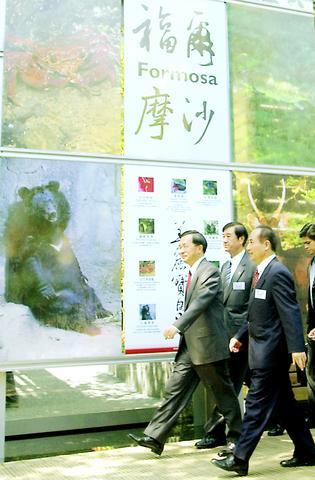
PHOTO: SEAN CHAO, TAIPEI TIMES
The Washington-based National Endowment for Democracy was created in 1983 with a mission to strengthen democratic institutions around the world through non-governmental efforts. It has been a major instrument in the establishment of the Taiwan Foundation for Democracy. Formed in June last year, the TFD is the first international foundation promoting democracy to be established in Asia.
The foundation's anniversary celebrations, along with the ribbon-cutting ceremony for the official opening of its headquarters, were attended by dignitaries including President Chen Shui-bian (陳水扁), Legislative Speaker Wang Jin-pyng (王金平), Minister of Foreign Affairs Mark Chen (陳唐山) and Vice Minister of Foreign Affairs Michael Kau (高英茂). Gershman and Charles Zorgbibe, director of the Center for International Politics at the University of Paris, Sorbonne, delivered speeches to commemorate the anniversary.
Struggles to establish democracy in many countries and regions cannot be ignored, but the National Endowment for Democracy needs friends and allies to help nurture these democracies, Gershman said.
"We were therefore delighted when President Chen Shui-bian sent a message to the Second Assembly of the World Movement for Democracy in Sao Paulo, Brazil, in November 2000, declaring Taiwan's intention to establish a democracy foundation," he said.
Gershman said the National Endowment for Democracy acknowledges the courage of those who have fought to achieve democracy in Taiwan, and the organization was honored when it presented its Democracy Service Medal to Taiwan's first lady, Wu Shu-chen (
Chen Shui-bian said that the founding of the TFD and the inauguration of its headquarters were milestones in Taiwan's democratization. These milestones "beckon us to commemorate the valuable support and assistance from countries worldwide and peoples everywhere."
"It is our hope, as well as the TFD's most imperative mission, that the universal values Taiwan shares with the US, Japan and other international allies -- namely, freedom, democracy, human rights and peace -- will form the basis of a `value alliance,'" Chen Shui-bian said.
The president lauded the foundation's major accomplishments, including a training program for legislative assistance, research on referendum mechanisms and collaboration with other democracy foundations.

Considering that most countries issue more than five denominations of banknotes, the central bank has decided to redesign all five denominations, the bank said as it prepares for the first major overhaul of the banknotes in more than 24 years. Central bank Governor Yang Chin-lung (楊金龍) is expected to report to the Legislative Yuan today on the bank’s operations and the redesign’s progress. The bank in a report sent to the legislature ahead of today’s meeting said it had commissioned a survey on the public’s preferences. Survey results showed that NT$100 and NT$1,000 banknotes are the most commonly used, while NT$200 and NT$2,000

The Centers for Disease Control (CDC) yesterday reported the first case of a new COVID-19 subvariant — BA.3.2 — in a 10-year-old Singaporean girl who had a fever upon arrival in Taiwan and tested positive for the disease. The girl left Taiwan on March 20 and the case did not have a direct impact on the local community, it said. The WHO added the BA.3.2 strain to its list of Variants Under Monitoring in December last year, but this was the first imported case of the COVID-19 variant in Taiwan, CDC Deputy Director-General Lin Ming-cheng (林明誠) said. The girl arrived in Taiwan on

South Korea is planning to revise its controversial electronic arrival card, a step Taiwanese officials said prompted them to hold off on planned retaliatory measures, a South Korean media report said yesterday. A Yonhap News Agency report said that the South Korean Ministry of Foreign Affairs is planning to remove the “previous departure place” and “next destination” fields from its e-arrival card system. The plan, reached after interagency consultations, is under review and aims to simplify entry procedures and align the electronic form with the paper version, a South Korean ministry official said. The fields — which appeared only on the electronic form

The Ministry of Foreign Affairs (MOFA) is suspending retaliation measures against South Korea that were set to take effect tomorrow, after Seoul said it is updating its e-arrival system, MOFA said today. The measures were to be a new round of retaliation after Taiwan on March 1 changed South Korea's designation on government-issued alien resident certificates held by South Korean nationals to "South Korea” from the "Republic of Korea," the country’s official name. The move came after months of protests to Seoul over its listing of Taiwan as "China (Taiwan)" in dropdown menus on its new online immigration entry system. MOFA last week


 RSS
RSS