


The nation's political parties are emphasizing efforts to bring in new blood, but some observers doubt that the Chinese Nationalist Party (KMT) will be able to compete with the Democratic Progressive Party (DPP) in the battle to recruit and cultivate younger talent.
As more and more young DPP members are appointed to governmental offices, the KMT, which is preoccupied with generational issues of power, should quicken its process of bringing in new blood in order to revitalize the party, political analysts say.
The DPP's success in cultivating political talent can be seen in a recent series of appointments of younger politicians to the Cabinet. These include the appointment of Legislator Luo Wen-jia (
In addition, many young members of the DPP elite are poised to run in the year-end legislative elections.
Blue hawks
Meanwhile, inside the KMT, a group known as "blue hawks," from the party's Chunghsing [Rejuvenation] Elite Group (
Chin Heng-wei (金恆煒), editor-in-chief of Contemporary Monthly magazine, says that the promotion of the DPP's younger generation is a natural way for President Chen Shui-bian (陳水扁) to build a team of professional politicians to prepare his party for long-term administration.
"Chen himself is a young president and therefore his appointing politicians of the younger generation is natural. Unlike 2000, when the DPP had to borrow talent from the KMT in order to fill out the Cabinet, Chen's appointing his own people this time demonstrates his determination to cultivate the DPP's homegrown professional politicians," Chin said.
Power hierarchy
Chin said that it will be very difficult for the KMT to overhaul itself because it has failed to gain the presidency for a second time running and can now only focus on the legislative elections, or elections for mayors or county commissioners, to demonstrate its political capabilities.
Ger Yeong-kuang (
Ger said the KMT should strive for an even representation of old, middle-aged and young talent so that each generation can contribute in the ways it is most suited to.
Ger said the KMT, which was in power for more than five decades, has ignored much of the political talent that it cultivated over the years.
"What the KMT urgently needs to do is to promote middle-generation elites, who are now in their 40s or 50s. Otherwise they will have to face losing even more of their support," Ger said.
Since the legislature is now one of the few realms in which the KMT can demonstrate its potential, Ger suggested that the KMT nominate more top-notch legislators-at-large to revamp the party's image.
"The KMT's current legislators-at-large are pretty lousy. If the party could nominate more qualified candidates, with clean images, professionalism and a sound educational background, that would boost the party's chances in the year-end legislative elections," Ger said.
To allow a fair playing field for the party's young members and to provide a counterbalance to the professed strategy of KMT Vice Chairman Wang Jin-pyng (王金平), who has said that the party's legislative nominations will focus on incumbent lawmakers, Ger said that the KMT should establish a fair nomination mechanism to ensure that both incumbents and challengers have equal chances to compete.
Experienced hands
"The incumbents enjoy advantages because of their current position as lawmakers, but that doesn't mean they are necessarily more capable and qualified than their challengers," Ger said.
However, Emile Sheng (
"A transfer of power to the younger generation can't happen just for the sake of it; it should happen according to a long-term plan," Sheng said.
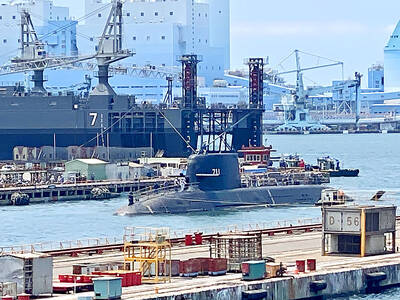
AGING: While Japan has 22 submarines, Taiwan only operates four, two of which were commissioned by the US in 1945 and 1946, and transferred to Taiwan in 1973 Taiwan would need at least 12 submarines to reach modern fleet capabilities, CSBC Corp, Taiwan chairman Chen Cheng-hung (陳政宏) said in an interview broadcast on Friday, citing a US assessment. CSBC is testing the nation’s first indigenous defense submarine, the Hai Kun (海鯤, Narwhal), which is scheduled to be delivered to the navy next month or in July. The Hai Kun has completed torpedo-firing tests and is scheduled to undergo overnight sea trials, Chen said on an SET TV military affairs program. Taiwan would require at least 12 submarines to establish a modern submarine force after assessing the nation’s operational environment and defense

Yangmingshan National Park authorities yesterday urged visitors to respect public spaces and obey the law after a couple was caught on a camera livestream having sex at the park’s Qingtiangang (擎天崗) earlier in the day. The Shilin Police Precinct in Taipei said it has identified a suspect and his vehicle registration number, and would summon him for questioning. The case would be handled in accordance with public indecency charges, it added. The couple entered the park at about 11pm on Thursday and began fooling around by 1am yesterday, the police said, adding that the two were unaware of the park’s all-day live
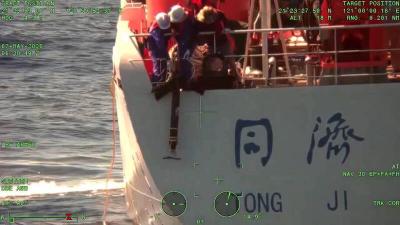
The coast guard today said that it had disrupted "illegal" operations by a Chinese research ship in waters close to the nation and driven it away, part of what Taipei sees a provocative pattern of China's stepped up maritime activities. The coast guard said that it on Thursday last week detected the Chinese ship Tongji (同濟號), which was commissioned only last year, 29 nautical miles (54km) southeast of the southern tip of Taiwan, although just outside restricted waters. The ship was observed lowering ropes into the water, suspected to be the deployment of scientific instruments for "illegal" survey operations, and the coast

A former soldier and an active-duty army officer were yesterday indicted for allegedly selling classified military training materials to a Chinese intelligence operative for a total of NT$79,440. The Taipei District Prosecutors’ Office indicted Chen Tai-yin (陳泰尹) and Lee Chun-ta (李俊達) for contravening the National Security Act (國家安全法) and the Anti-Corruption Act (貪污治罪條例). Chen left the military in September 2013 after serving alongside then-staff sergeant Lee, now an army lieutenant, at the 21st Artillery Command of the army’s Sixth Corps from 2011 to 2013, according to the indictment. Chen met a Chinese intelligence operative identified as “Wang” (王) through a friend in November


 RSS
RSS