

Having long enjoyed courteous treatment from the pan-blue camp, independent Legislator Sisy Chen (陳文茜) fell from grace this past week, becoming a target for blue-camp lawmakers.
Believing that her baseless allegations at the March 19 press conference with regard to the assassination attempt on President Chen Shui-bian (陳水扁) and Vice President Annette Lu (呂秀蓮) had provoked resentment among undecided voters and shifted support to Chen Shui-bian, a number of Chinese Nationalist Party (KMT) legislators said Sisy Chen ought to be held responsible for the KMT-People First Party (PFP) alliance's defeat in last month's presidential election.

TAIPEI TIMES FILE PHOTO
Chen Shui-bian and Lu defeated the ticket of KMT Chairman Lien Chan (連戰) and PFP Chairman James Soong (宋楚瑜) by a razor-thin margin.
Lien has refused to concede defeat in the election and claimed, although lacking evidence, voting irregularities. The blue camp has filed lawsuits demanding a recount and seeking to declare the election a fraud.
Via TV and radio programs, Sisy Chen defended herself, saying her allegations were based on information provided by the alliance and that Lien, Soong and a number of key campaign figures knew what she was going to say at the press conference beforehand.
Although the KMT's criticism of Sisy Chen appeared to have come to a halt since Lien urged an end to finger-pointing, the brouhaha nonetheless shed light on Chen's intriguing relationship with the blue camp.
Known for her witty, sarcastic speeches and eloquence, the 46-year-old Chen had generally been regarded as a "bright and talented female" in Taiwan's political arena.
But given her bold and resolute manner, she projected a controversial image in the eyes of the public.
A Democratic Progressive Party (DPP) publicity chief from 1995 to 1998, Sisy Chen defected from the DPP after the 2000 presidential election. She has since become one of the fiercest critics of Chen Shui-bian and her former party.
Since her election in December 2001 as an independent legislator, she has sided with the pan-blue camp on a number of issues and was a driving force behind the pan-blue camp's publicity machine during this year's presidential campaign.
Although the upper echelons of the alliance appreciated and relied on her contributions to battling the DPP, her lack of official title or position within the camp generated resentment. Members of the alliance grumbled that she had too much influence and that she meddled in the blue camp's affairs.
Sisy Chen defended her role, saying she did not want "to get too involved" with either the KMT or the PFP and that she was helping out merely as a friend.
Her remarks at the March 19 press conference showed the level to which she was involved in the alliance's campaign affairs and her contacts with pan-blue leaders.
"It turned out that the more Sisy Chen talked [about her involvement with the alliance], the more clear it became to us how close she had been with the core of the party leaders," KMT Legislator Hsu Shu-poh (許舒博) said.
One reason why the KMT welcomed Sisy Chen's input was that she introduced new ways of thinking that the 109-year-old KMT seemed to lack, said veteran media figure Yang Hsien-hung (楊憲宏).
"It has been the KMT's longtime practice that subordinates do as they are told," Yang said. "Sisy Chen's joining the team brought in multi-faceted views and ideas to the KMT's otherwise rather systematic way of thinking."
An obdurate critic of Chen Shui-bian, Sisy Chen's skillfulness in media strategy as well as her former ties to the DPP gave Lien and Soong confidence in her, Yang said.
Terming Sisy Chen's relationship with the KMT and the PFP as "one of mutual interest," Yang described Sisy Chen as skillful at politics and public relations.
She "knows what power is and how to manipulate power," Yang said.
TV host Clara Chou (周玉蔻) compared Sisy Chen to the Empress Dowager Tzu-hsi (慈禧太后) of the Manchu Dynasty, who manipulated the 5-year-old Emperor Te Tsong (德宗) like a puppet.
"Sisy Chen is not a mere guest adviser [to the pan-blue camp], but is one like the Empress Dowager Tzu-hsi, who administered affairs from behind the scenes," Chou said.
Yang added that, "We should feel relieved that Lien was not elected, for otherwise one would be left to wonder based on whose orders and opinions the country is being run."
Sisy Chen has also been criticized for acting as both a legislator and a talk-show host.
She hosts a radio talk show as well as a nationwide TV political commentary program on a KMT-affiliated station.
Despite her declaration that she would withdraw from the media if DPP Legislator Trong Chai (
Saying that the public's long-held suspicions about Sisy Chen's dual roles in politics and the media were proven valid in her recent remarks, DPP Legislator Luo Wen-chia (羅文嘉) said, "All was far more serious than the public had imagined."
"If politicians do not know how to conduct themselves, we have to resort to laws and regulations to eliminate and preclude such events from happening," Luo said, adding that it is his aim to push for an amendment to the Broadcasting and Television Law (廣電法) to make it illegal for politicians to double as media hosts.
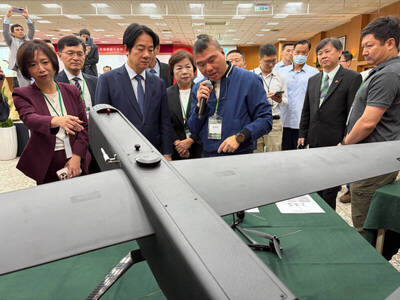
Two executives of drone supplier Jiin Ming Industry Co (錦明實業) have been detained and held incommunicado over the company's alleged use of prohibited China-made chips and camera lenses in drones supplied under recent military contracts, the Taoyuan District Prosecutors' Office said today. In a statement, prosecutors said they raided the offices of Jiin Ming — headquartered in Taoyuan — as well as those of its subsidiaries and its suppliers on Thursday last week. The raids followed a report that the company had breached its procurement contracts by putting the prohibited components into drones delivered to the military. During the raids, prosecutors summoned
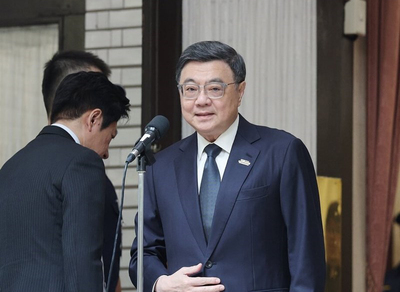
The government would continue monitoring online rumors that a pneumonic plague outbreak has spread from Russia into China and could enhance existing quarantine measures, Premier Cho Jung-tai (卓榮泰) said today. During a legislative meeting, Democratic Progressive Party Legislator Wang Ting-yu (王定宇) said rumors were circulating that the disease had spread across several Chinese provinces. He asked Cho whether the government was prepared to prevent the disease from spreading to Taiwan, given the frequent exchanges between Taiwan and China, and how concerned the government was about the alleged outbreak. The Ministry of Health and Welfare implemented border quarantine measures after briefing the Executive Yuan
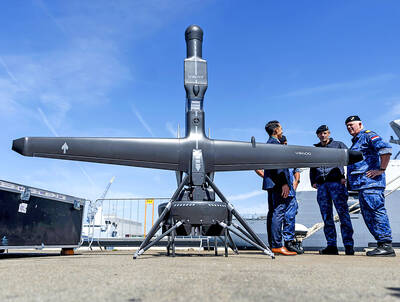
DEFENSE PROCUREMENT: Taiwan could become the largest operator of V-BAT drones outside the US once they are delivered, the Ministry of National Defense said The navy and the coast guard are acquiring 292 units of MQ-35A V-BAT vertical takeoff and landing (VTOL) surveillance drones manufactured by US-based defense technology company Shield AI, making Taiwan one of the largest buyers of the drone. The Coast Guard Administration budgeted NT$1.2 billion (US$37.1 million) to buy 12 drones, which have been delivered, Shield AI said in a report on Oct 13. The navy is planning to spend NT$36 billion under a four-year program code-named Project Yuan Xiao (遠鴞) to acquire 280 V-BAT drones, the Ministry of National Defense’s fiscal 2027 report showed. The combined procurement is expected

South Korean boy band BigBang drew 120,000 fans to three concerts at Taipei Dome from Friday through yesterday, as the band thanked them for their support over their 20-year career. The Taipei Dome concerts were part of BigBang's "2026-2027 World Tour XX: Cosmos." Friday's concert was BigBang's first performance in Taiwan in 11 years. During the encore, group leader G-Dragon (GD) shouted "I love you" in Chinese and said he was especially happy to perform in Taiwan with bandmates Taeyang and Daesung. "Taipei, I'm very grateful to you all," GD said in Chinese, asking fans to wait for the band's return. Daesung thanked


 RSS
RSS