


As the navy phases out its World War II-era Yang-class destroyers in favor of Kidd-class destroyers, it has also started to search for a replacement for its Knox-class frigates, defense sources said yesterday.
The navy has had eight Knox-class frigates in service since 1992. The frigates are equipped with the most effective anti-submarine warfare sensors that the navy has ever had at its disposal.
These frigates, built in the early 1970s, were already approaching their service ceiling of 20 to 30 years when the US delivered them to the navy between 1992 and 1998.
Though useable for a few more years, the Knox-class frigates are already spending much more time in port than at sea.
All the Knox-class frigates are based at the Suao military port.
A naval officer who spoke on condition of anonymity said many of the Knox frigates have developed serious mechanical problems, causing their patrol missions to have been greatly reduced.
"The No. 932 Chiyang, for instance, has become inoperable. Its problems are both mechanical and structural," the officer said.
"Other ships in the same class are not in much better shape. They are either short of spare parts or damaged in some vital way," he said.
A senior official serving with the navy general headquarters acknowledged that the Knox-class frigates are not in good condition but denied that the ships have become "beached wrecks."
"The combat readiness ratio of the Knox-class frigates is still over 50 percent, which is good in terms of ships of this age," the official said.
"We hope to use these ships for another four to six years. We are desperate to find a replacement for the Knox, but it is not easy to find one for the moment," the official said.
The navy is divided over what type of ship should be chosen to replace the Knox, sources said. One group favors smaller ships, of around 2,000 tonnes in displacement, while the other group argues that the navy needs a larger platform to accommodate not only old weapon systems from the Knox but also new ones that could be added. The Knox has a displacement of 3,877 tonnes.
If the navy chooses smaller ships, it might ask the state-run China Shipbuilding Corp (CSBC) to build the new vessels. This would be welcomed by local shipbuilders who would benefit from any contracts won by CSBC.
But the larger platform might win out because many in the navy don't want to wait for new ships to be constructed domestically, which would take many years and entail great cost. For these reasons, many in the navy are inclined to buy ships from the US second-hand market.
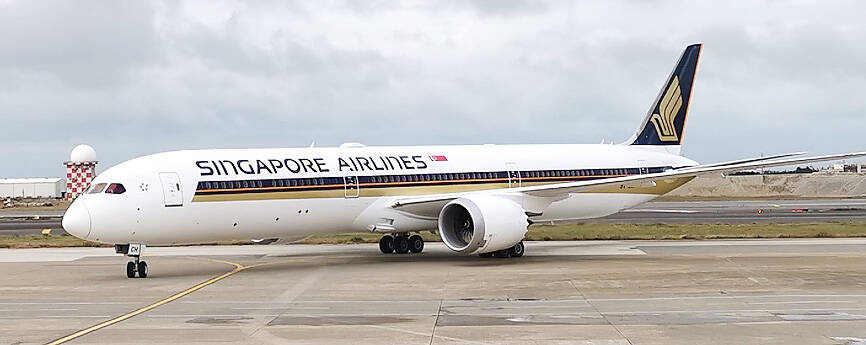
INCREASED CAPACITY: The flights on Mondays, Wednesdays, Fridays and Sundays would leave Singapore in the morning and Taipei in the afternoon Singapore Airlines is adding four supplementary flights to Taipei per week until May to meet increased tourist and business travel demand, the carrier said on Friday. The addition would raise the number of weekly flights it operates to Taipei to 18, Singapore Airlines Taiwan general manager Timothy Ouyang (歐陽漢源) said. The airline has recorded a steady rise in tourist and business travel to and from Taipei, and aims to provide more flexible travel arrangements for passengers, said Ouyang, who assumed the post in July last year. From now until Saturday next week, four additional flights would depart from Singapore on Monday, Wednesday, Friday
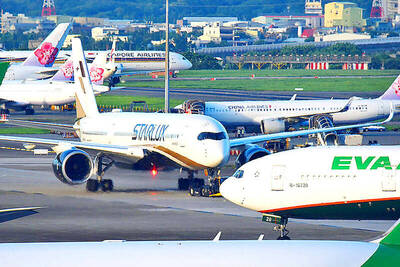
Taiwan’s three major international carriers are increasing booking fees, with EVA Airways having already increased the charge to US$28 per flight segment from US$25, while China Airlines (CAL) and Starlux Airlines are set to follow suit. Booking fees are charged by airlines through a global distribution system (GDS) and passed on to passengers. Carriers that apply the fees include CAL, EVA, Starlux and Tigerair Taiwan. A GDS is a computerized network operated by a company that connects airlines with travel agents and ticketing platforms, allowing reservations to be made and processed in real time. Major players include Amadeus, Sabre and Travelport. EVA Air began
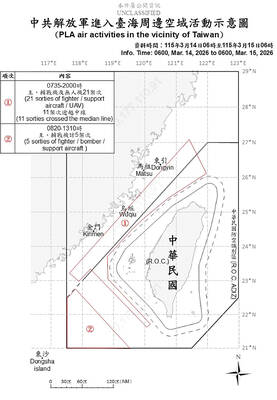
The Ministry of National Defense yesterday reported the return of large-scale Chinese air force activities after their unexplained absence for more than two weeks, which had prompted speculation regarding Beijing’s motives. China usually sends fighter jets, drones and other military aircraft around the nation on a daily basis. Interruptions to such routine are generally caused by bad weather. The Ministry of National Defense said it had detected 26 Chinese military aircraft in the Taiwan Strait over the previous 24 hours. It last reported that many aircraft on Feb. 25, when it spotted 30 aircraft, saying Beijing was carrying out another “joint combat

WATCH FOR HITCHHIKERS: The CDC warned those returning home from Japan to be alert for any contagious diseases that might have come back with them People who have returned from Japan following the World Baseball Classic (WBC) games during the weekend are recommended to watch for symptoms of infectious gastroenteritis, flu and measles for two weeks, the Centers for Disease Control (CDC) said. Flu viruses remain the most common respiratory pathogen in Taiwan in the past four weeks and the influenza B virus accounted for 55.7 percent of the tested cases, exceeding the percentage of influenza A (H3N2) infections and becoming the local dominant strain, CDC Epidemic Intelligence Center Deputy Director Lee Chia-lin (李佳琳) said at a news conference on Tuesday. There were 82,187 hospital visits for


 RSS
RSS