


The Democratic Progressive Party (DPP) yesterday urged the Taiwan Solidarity Union (TSU) to cooperate in a joint campaign strategy for the legislative elections at the end of the year as part of President Chen Shui-bian's (陳水扁) goal of gaining a majority in the Legislative Yuan.
"To avoid dividing our supporters, the DPP and TSU must cooperate over nominations and propose a unified campaign theme," senior DPP Legislator Wang Sing-nan (王幸男) said yesterday.
It would be difficult for the DPP to increase its legislative seats, Wang said, but the TSU is in a much better position to double its number of legislators.
In the previous legislative election in 2001, the DPP won 33 percent of votes, which gave it 87 of the total number of 225 legislative seats, while the TSU received around 7 percent of votes and 13 seats, although it lost one of these seats last year.
The pan-green alliance needs 24 seats to have a majority in the Legislative Yuan.
According to Wang, a crucial factor in Chen's re-election was the victory in seven counties and cities in the south, where the TSU's spiritual leader, former president Lee Teng-hui (
Wang said that the TSU can easily get 20 to 25 seats this year under Lee's guidance, although the DPP is unlikely to gain more than 10 legislative seats.
The TSU reacted positively to the DPP's suggestion, saying that a joint campaign would improve its candidates' chances of being elected, although it could detract from the party's distinctive platform.
"The idea will help our candidates to efficiently mobilize supporters and target our voters," said TSU caucus whip Chen Chien-ming (陳建銘).
He said a joint campaign will help the pan-green alliance to choose better candidates, but might have an adverse effect on the TSU's voter base.
"The TSU might get fewer legislators-at-large than it should, which depends on the percentage of votes a party gets," Chen Chien-ming said.
DPP legislative caucus leader Tsai Huang-liang (
"The president's re-election marks the first time in the DPP's history that it received the support of more than half the voters. However, we will not be conceited. The DPP will again be very cautious about its nominations this year, using a similar strategy to 2001's legislative elections. This means that the DPP needs to replace members with a bad image," he said.
"We will nominate roughly the same number of candidates as three years ago. We won't increase the number of nominees just because Chen got 10 percent more votes in the presidential election," Tsai said.
Meanwhile, DPP secretary general Chang Chun-hsiung (
DPP Legislator Lee Chun-yee (李俊毅), who heads the party's "welfare state" faction, said that Chang would be a proper choice to run for legislative speaker, but stressed that other party heavyweights would make good candidates, including Trong Chai (蔡同榮), Ker Chien-ming (柯建銘) and New Tide stalwart Hong Chi-chang (洪奇昌).


An essay competition jointly organized by a local writing society and a publisher affiliated with the Chinese Communist Party (CCP) might have contravened the Act Governing Relations Between the People of the Taiwan Area and the Mainland Area (臺灣地區與大陸地區人民關係條例), the Mainland Affairs Council (MAC) said on Thursday. “In this case, the partner organization is clearly an agency under the CCP’s Fujian Provincial Committee,” MAC Deputy Minister and spokesperson Liang Wen-chieh (梁文傑) said at a news briefing in Taipei. “It also involves bringing Taiwanese students to China with all-expenses-paid arrangements to attend award ceremonies and camps,” Liang said. Those two “characteristics” are typically sufficient
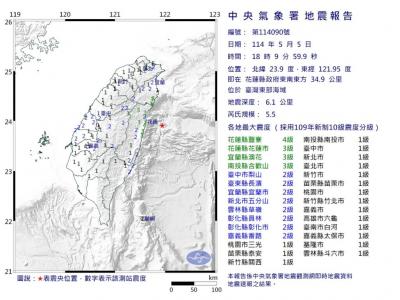
A magnitude 5.9 earthquake that struck about 33km off the coast of Hualien City was the "main shock" in a series of quakes in the area, with aftershocks expected over the next three days, the Central Weather Administration (CWA) said yesterday. Prior to the magnitude 5.9 quake shaking most of Taiwan at 6:53pm yesterday, six other earthquakes stronger than a magnitude of 4, starting with a magnitude 5.5 quake at 6:09pm, occurred in the area. CWA Seismological Center Director Wu Chien-fu (吳健富) confirmed that the quakes were all part of the same series and that the magnitude 5.5 temblor was

The brilliant blue waters, thick foliage and bucolic atmosphere on this seemingly idyllic archipelago deep in the Pacific Ocean belie the key role it now plays in a titanic geopolitical struggle. Palau is again on the front line as China, and the US and its allies prepare their forces in an intensifying contest for control over the Asia-Pacific region. The democratic nation of just 17,000 people hosts US-controlled airstrips and soon-to-be-completed radar installations that the US military describes as “critical” to monitoring vast swathes of water and airspace. It is also a key piece of the second island chain, a string of
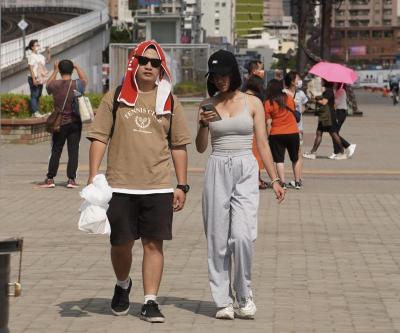
The Central Weather Administration has issued a heat alert for southeastern Taiwan, warning of temperatures as high as 36°C today, while alerting some coastal areas of strong winds later in the day. Kaohsiung’s Neimen District (內門) and Pingtung County’s Neipu Township (內埔) are under an orange heat alert, which warns of temperatures as high as 36°C for three consecutive days, the CWA said, citing southwest winds. The heat would also extend to Tainan’s Nansi (楠西) and Yujing (玉井) districts, as well as Pingtung’s Gaoshu (高樹), Yanpu (鹽埔) and Majia (瑪家) townships, it said, forecasting highs of up to 36°C in those areas


 RSS
RSS