


After a violent incident occurred in front of the Kaohsiung District Prosecutors' Office early yesterday morning during a protest, Kaohsiung Mayor Frank Hsieh (
"We should not let the violence carried out by the pan-blue camp after the election set a precedent," Hsieh said at a press conference.
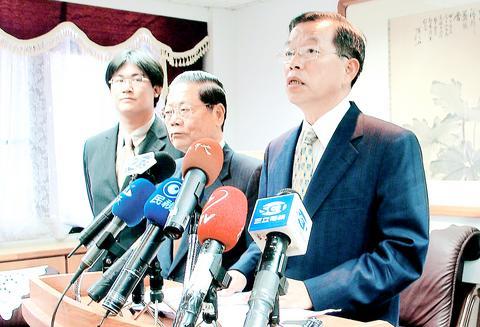
PHOTO: YUTZU CHIU, TAIPEI TIMES
The violence would be a very bad example, which might be imitated by losers in future elections, Hsieh said.
Hsieh urged the city's green-camp supporters to respect the right of the pan-blue camp to seek judicial assistance in clarifying suspicious points about the presidential election, in order to lower the risk of disintegrating the fragile foundation of mutual trust in society.
"The city government will leave all the pan-blue camp's accusations about polling stations to the court to decide," Hsieh said.
Yesterday morning, the Kaohsiung District Court sealed all ballot boxes in Kaohsiung City and Kaohsiung County. In addition, the court kept all information about electoral affairs, including the name lists of both voters and staff at the polling stations.
On Saturday evening, hundreds of pan-blue supporters lamenting the loss of the election gathered in front of the Kaohsiung District Prosecutors' Office to protest.
Led by Lin Shiang-nung (林享能), in charge of the pan-blue camp's campaign in Kaohsiung, residents sang songs loudly and shouted slogans agitatedly. Some even cried.
Lin listed nine doubtful points to do with the election, urging the government to seal ballot boxes for recounting. He claimed there were irregularities at many polling stations in the city.
A campaign truck rammed into the building's iron gate, injuring some residents and seven police officers on duty. More than 500 police officers were on duty to handle the violent incident. The crowd did not leave the scene until 4am yesterday morning.
Some pan-blue supporters were yesterday still offering evidence and clues about irregularities about the election to their camp's chapter in the city.
Hsieh Hsiu-neng (
Mayor Hsieh stressed that it was time for the city's residents to reveal their democratic self-discipline.
"At this moment, the foundation of mutual trust in our society is relatively fragile. Both sides have to respect each other in order to mend the cracks in society," Hsieh said.
He said that his planning for the city's future development would further receive support from the central government because the DPP remains the ruling party.
Hsieh said that he was sorry to see foreign media reports that Taiwan's political situation would be turbulent.
"In fact, I'd like to urge foreign investors to come to Kaohsiung to seek business opportunities because influential steel-making and petrochemical industries are here," Hsieh said.
Hsieh said that he would urge the Democratic Progressive Party (DPP) to keep in mind that both camps were supported by more than 6 million voters.
Hsieh believed that listening to different opinions would effectively mend the cracks in society created by the presidential election.
"Let's move on. Most people need a society allowing them to sleep well, eat well and make a profit from real-estate or stock market deals," Hsieh said.

NATIONAL SECURITY: Authorities are working to confirm the identities of the military personnel involved and investigating possible illegal conduct and regulatory violations Authorities are probing possible national security implications after Kinmen police and immigration officers on Sunday found a Chinese woman allegedly posing as a tourist while engaging in prostitution involving more than 10 military personnel. The woman, surnamed Chen (陳), has since been deported, authorities said, adding that investigators are still working to confirm the identities of those implicated, as the records only listed code names and aliases. The case stemmed from a report received by the Kinmen District Prosecutors’ Office on Friday last week from the Jinhu Precinct of the Kinmen County Police Bureau. On Sunday, police, along with the National Immigration

GLOBALGIVING: ‘ Caving to external pressure is not acceptable for an organization that has cultivated justice reform and human rights for 30 years,’ one NGO said A slew of non-government organizations (NGOs) have withdrawn from the GlobalGiving fundraising platform after it announced it would use “Chinese Taipei” instead of “Taiwan” from next month. The Taiwan Good Rice Association wrote on Facebook on Friday that it was informed on April 28 via a teleconference call of the change, which was made because the platform wanted to operate in China. Taiwan Good Rice is to terminate all cooperative relationships with GlobalGiving in response to the platform’s “unilateral and non-negotiable” decision to remove references to Taiwan, the NGO said. “Taiwan is in the official name of Taiwan Good Rice Association and the

HEAVY WEATHER: Typhoon Jangmi is due to crash straight into the Ryukyus as airlines look to shift flights to larger aircraft or cancel flights to Okinawa entirely Taiwan’s international air carriers announced flight adjustments over the weekend as Typhoon Jangmi is forecast to hit the Ryukyu Islands today and tomorrow. The Central Weather Administration (CWA) upgraded Jangmi from a tropical storm to a typhoon at 8am yesterday, with the eye located 580km south of Naha city. It was moving north at 19kph. Today, China Airlines’ CI-120, CI-121, CI-122 and CI-123 flights between Taoyuan and Naha, Okinawa, have been canceled as well as CI-132 and CI-133 between Kaohsiung and Naha. EVA Air’s BR-112, BR-113, BR-186 and BR-185 flights between Taoyuan and Naha are also canceled. Low-cost carrier Tigerair Taiwan canceled IT-230,

Chinese Nationalist Party (KMT) Chairwoman Cheng Li-wun (鄭麗文) yesterday briefed her party’s Central Standing Committee regarding her scheduled visit to the US between Monday next week and June 16, saying that her purpose would be to persuade the US that the Republic of China (ROC) Constitution was a “one China” constitution that would foster stable and peaceful cross-strait relations. The ROC Constitution is the most important defense for all Taiwanese citizens, as it upholds our democracy and has contributed to our robust economy, which aligns with international and US interests, she said. “We would not be troublemakers and drag the US under,”


 RSS
RSS