


The shooting of President Chen Shui-bian (
"The incident will definitely have an impact on tomorrow's election because it would win some sympathy from undecided voters," said Wang Yeh-lih (王業立), chairman of Tunghai University's department of political science.
Although dramatic events have happened during election campaigns over the years, Wang said that the impact this time would be significant because of its brutality.
Yesterday's shooting was not the first time pro-unification supporters have apparently attacked political figures or commentators who opposed their views.
Last November, New York-based political commentator Cao Chang-ching (曹長青) was assaulted by members of the pro-unification Patriot Association (愛國同心會).
Unhappy with Cao's pro-independence remarks during an international conference, four members of the association beat and insulted Cao in the lobby of the Grand Hotel where the conference was being held.
In March last year, Chin Heng-wei (金恆煒), a political commentator and editor-in-chief of Contemporary Monthly magazine, was attacked while walking home with his wife. The assailant was believed to have been angry with Chin's liberal stance on cross-strait affairs and Taiwanese independence.
In May 2000, retired serviceman Shih Li-hsing (史力行) poured red ink onto former president Lee Teng-hui (李登輝) who, he said, had raised tensions between ethnic groups in Taiwan and betrayed the Chinese Nationalist Party (KMT) during his 12 years as head of the party.
Chin and Lee chose not to press charges against their attackers.
Wang said he was reluctant to say that pro-unification supporters were more violent because it was inappropriate to blame a specific camp as a whole for election violence.
"The prohibition of violence is absolute in a democratic country, and it's not conducive to social stability and harmony to lay the blame on any political camp," he said.
Refusing to speculate on the impact of the shooting on the election, Liao Yung-lai (廖永來), director of the Cabinet's Central Coordination Office, condemned violence.
"I wish voters would exercise more rationality and less passion when it comes to elections," Liao said.
Yang Ming-yu (
Yang also said that KMT officials had been brutally attacked by pro-independence advocates during KMT rule, including the late former vice president and Taiwan provincial governor, Hsieh Tung-min (
Shieh suffered serious injuries to both hands when a parcel bomb sent to his office blew up on Oct. 10, 1966. The bomb was sent by Wang Sing-nan (王幸男), who is now a DPP legislator, to highlight the cause of Taiwan independence.
Chiang escaped an assassination attempt unscathed in New York in 1970. The attempt to kill Chiang was staged by Peter Huang (黃文雄), now an advisor to the president and former Taiwan Association for Human Rights (台灣人權促進會) president.

FUKUOKA SITUATION: Japanese media reported that the pathogen is expected to be identified by the summer, while the CDC downplayed the idea that it was hMPV A “mysterious cold-like illness” reported in Japan’s Fukuoka Prefecture does not seem to be a new disease, but Japanese authorities have been asked about the situation, the Centers for Disease Control (CDC) said yesterday. The Fukuoka Prefectural Medical Association on Wednesday told a news conference that a “mystery cold” that has become a hot topic on social media is “highly likely to be caused by some kind of viral infection,” Japan’s KBC News reported. “Many people are experiencing symptoms starting with a sore throat, followed by a runny nose, phlegm and a severe cough,” KBC News reported, citing association officials. Health authorities are

Nvidia Corp CEO Jensen Huang (黃仁勳) arrived in Taiwan yesterday ahead of upcoming AI and technology events, saying he plans to meet with clients and Taiwan Semiconductor Manufacturing Co Chairman C.C. Wei (魏哲家) during his visit. After landing at Taipei Songshan Airport, Huang posed for photos with fans and handed out Yakult drinks to reporters and supporters waiting at the scene, saying he has “a lot to do” during the trip. Asked about reports that Nvidia’s planned headquarters site in Taipei’s Beitou Shilin Technology Park could break ground on May 27, Huang said that if the company holds an event, he would

The Ministry of Finance this afternoon announced the winning numbers for the March-April uniform invoice lottery. The winning number for the NT$10 million (US$318,060) special prize is 19531471, and the winning number for the NT$2 million grand prize is 85941329. Three numbers were drawn for the NT$200,000 first prize: 07225810, 20231230 and 83518781. Those with receipts matching the last seven digits of any of the first-prize numbers will win the NT$40,000 second prize, while those matching the last six digits will win the NT$10,000 third prize. Those whose receipts match the last five digits of the first-prize numbers can claim the NT$4,000 fourth prize,
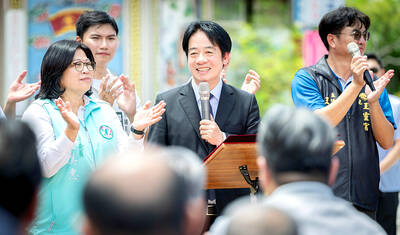
SIX SUBSIDIES: The monthly allowance for older farmers is to increase to NT$10,000, and NT$5,000 is to be given to homemakers under the national pension system, Lai said The government is to implement major welfare policies for disadvantaged groups, including raising the monthly allowance for older farmers to NT$10,000 and providing homemakers with NT$5,000 per month, President William Lai (賴清德) said yesterday. Lai made the remarks during a visit to Wangling Temple in Chiayi County, saying that the planned increases were being introduced amid economic growth and an increase in tax revenue. Touting a policy, in which the government plans to provide a monthly allowance of NT$5,000 for every child under the age of 18 in a bid to address Taiwan’s low birthrate, Lai said that if received for the


 RSS
RSS