


Secretary General to the Presiden-tial Office Chiou I-jen (邱義仁) yesterday said that if President Chen Shui-bian (陳水扁) were reelected Beijing would "face reality" and agree to reach some sort of accommodation with Taiwan on at least some issues dividing the two sides.
Speaking at a pre-election press conference for international media, Chiou said that Chinese President Hu Jintao (
Chiou said that while both sides would not be able to settle their disputes in the near future, he expressed the hope that they could still discuss cultural and economic exchanges if Chen won.
"President Hu will lead his country for a certain period, and President Chen will be this country's leader. So this is the reality," he said.
"I don't think we can deal with these kinds of issues from a sense of trust, but we can deal with the issues from a sense of reality," he said.
In the wide-ranging meeting with some 200 visiting foreign journalists, Chiou came under an equal amount of questioning on domestic politics and foreign policy.
On the election, Chiou said he "can't imagine Chen losing," but repeated recent Democratic Progressive Party (DPP) assertions that the consequences for the pan-blue alliance would be the same regardless of the result -- a massive power struggle between Chinese Nationalist Party (KMT) Chairman Lien Chan (
If Chen loses, "I would be curious who would be the premier," he said.
On US relations, Chiou denied that US President George W. Bush's statement last December opposing the referendum had resulted in "serious damage to the fundamental relationship," describing it merely as a matter of a "difference of opinion."
He said dialogue with the US would continue and that through communication with them "the US will find the results of the political reality will truly coincide with [advances in communication], and after that, I think the sense of trust can be built again."
Chiou was asked if, in the event of the referendum question on defense spending being defeated, the DPP would consider this to be a mandate from the people to reduce spending on defense. Such reductions could irritate the Bush administration, which has long urged Taiwan to boost spending and buy the weapons that Bush promised in April 2001.
If the question was defeated, Chiou said, the government would not be able to increase the defense budget to buy advanced anti-missile systems, but could still buy the weapons that it had already agreed to purchase from the US.
"I don't think that in the near future it would make US-Taiwan relations any more difficult," he said. "Taiwan would still need to purchase the weapons."
Chiou said that he worried about whether the failure of the referendum would give Beijing a propaganda edge. China's reaction would be a stereotype, he said along the lines of "the Taiwan people reject Taiwan independence so `one country, two systems' is a feasible system for Taiwan."
"If the referendum fails, it will be a Chinese victory," he said, restating the DPP position.
On other matters, Chiou criticized recent French-led efforts in the EU to lift an embargo on weapons sales to China dating back to the Tiananmen Massacre.
"We are fully opposed" to the lifting of the embargo, he said. Such a move would hurt the security and stability of the entire region, in addition to the situation in the Taiwan Strait, and would not improve China's human-rights record, he said.
On joint military exercises between France and China, Chiou said the government was adopting a "cautious reaction." He said Taiwan needed more information about the exercises to see whether they were a straightforward, one-off exercise, or whether they would have "any further implications."
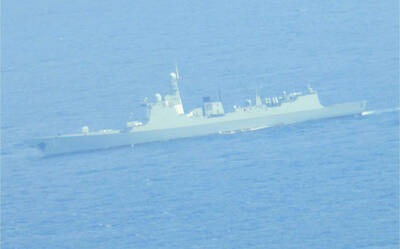
The military has spotted two Chinese warships operating in waters near Penghu County in the Taiwan Strait and sent its own naval and air forces to monitor the vessels, the Ministry of National Defense (MND) said. Beijing sends warships and warplanes into the waters and skies around Taiwan on an almost daily basis, drawing condemnation from Taipei. While the ministry offers daily updates on the locations of Chinese military aircraft, it only rarely gives details of where Chinese warships are operating, generally only when it detects aircraft carriers, as happened last week. A Chinese destroyer and a frigate entered waters to the southwest
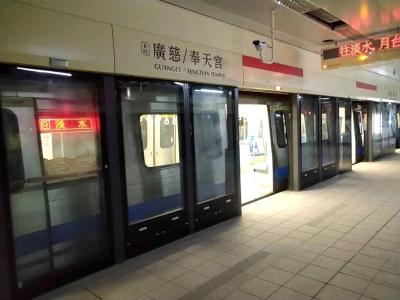
The eastern extension of the Taipei MRT Red Line could begin operations as early as late June, the Taipei Department of Rapid Transit Systems said yesterday. Taipei Rapid Transit Corp said it is considering offering one month of free rides on the new section to mark its opening. Construction progress on the 1.4km extension, which is to run from the current terminal Xiangshan Station to a new eastern terminal, Guangci/Fengtian Temple Station, was 90.6 percent complete by the end of last month, the department said in a report to the Taipei City Council's Transportation Committee. While construction began in October 2016 with an
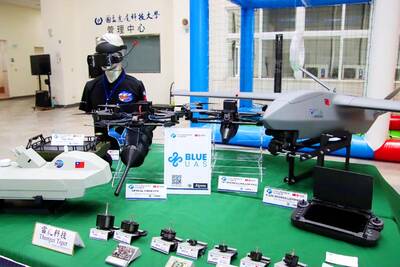
NON-RED SUPPLY: Boosting the nation’s drone industry is becoming increasingly urgent as China’s UAV dominance could become an issue in a crisis, an analyst said Taiwan’s drone exports to Europe grew 41.7-fold from 2024 to last year, with demand from Ukraine’s fight against Russian aggression the most likely driver of growth, a study showed. The Institute for Democracy, Society and Emerging Technology (DSET) in a statement on Wednesday said it found that many of Taiwan’s uncrewed aerial vehicle (UAV) sales were from Poland and the Czech Republic. These countries likely transferred the drones to Ukraine to aid it in its fight against the Russian invasion that started in 2022, it said. Despite the gains, Taiwan is not the dominant drone exporter to these markets, ranking second and fourth
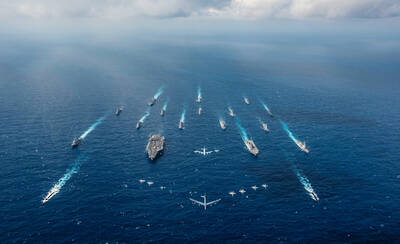
Japanese Prime Minister Sanae Takaichi’s comment last year on Tokyo’s potential reaction to a Taiwan-China conflict has forced Beijing to rewrite its invasion plans, a retired Japanese general said. Takaichi told the Diet on Nov. 7 last year that a Chinese naval blockade or military attack on Taiwan could constitute a “survival-threatening situation” for Japan, potentially allowing Tokyo to exercise its right to collective self-defense. Former Japan Ground Self-Defense Force general Kiyofumi Ogawa said in a recent speech that the remark has been interpreted as meaning Japan could intervene in the early stages of a Taiwan Strait conflict, undermining China’s previous assumptions


 RSS
RSS